






The New York Times placed Rep. Elise Stefanik (R., N.Y.) third on its non-fiction Best Sellers list even though her book, Poisoned Ivies, sold more copies than the top-ranked title. In fact, nearly twice the number of copies of Poisoned Ivies were sold last week than of the book in the number two slot, Belle Burden’s Strangers, according to publishing data obtained by the Washington Free Beacon.
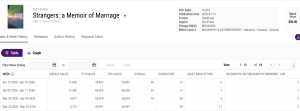
Poisoned Ivies, which chronicles "how elite universities abandoned academic excellence for far-left ideology" and "embraced a culture of antisemitism," sold 20,186 copies between April 12 and April 18, according to data from BookScan, the "gold-standard data service that tracks actual weekly retail sales of trade print books in the US." Burden's Strangers, a memoir about the liberal Vanderbilt heiress’s divorce, has been the subject of two pieces in the paper and originated with a 2023 "Modern Love" essay. It sold 11,802 copies over the same time period. The top-ranked book, Lena Dunham's Famesick, sold 19,270 copies in its first week, roughly 1,000 fewer than Stefanik's Poisoned Ivies.


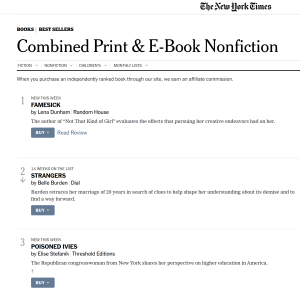
It's unclear why the Times placed Stefanik third on its list given the sales data.
The Times says it compiles its rankings based on "sales reported on a confidential basis by vendors," including "national, regional and local chains representing tens of thousands of storefronts; many hundreds of independent book retailers; scores of online and multimedia entertainment retailers; supermarkets, university, gift and big-box department stores; and newsstands." The Times does not otherwise identify those vendors or publish its data, and it is not known to answer questions about its methodology beyond what it posts online.
"We follow a methodology for all books, which is linked here," Times spokeswoman Danielle Rhoades Ha said in a statement shared with the Free Beacon. "When the Times has reason to believe that sales of a book include a mix of organic and bulk sales, the book's best-seller ranking is accompanied by a dagger."
The Times's handling of Stefanik's book is reminiscent of its treatment of another Republican lawmaker, Texas senator Ted Cruz. The Times declined to place Cruz's biography, A Time For Truth, on its Best Sellers list in 2015 "despite the fact that the book has sold more copies in its first week than all but two of the Times' bestselling titles," Politico reported, prompting Cruz to accuse the Times of political bias. More than a decade later, Stefanik is leveling the same charge.
"As I predicted, even when my first book Poisoned Ivies shattered records and sold the most hardcover books, the inaccurate NYT 'Best Sellers' would never acknowledge the fact that it was the #1 best-selling non-fiction book in America," Stefanik wrote on X. "Because of the topic and viewpoint of the book, the NYT refuses to acknowledge the crisis of antisemitism and the fact that their paper has helped fuel this moral rot."
The Times said it excluded Cruz's book due to an "overwhelming preponderance of evidence … that sales were limited to strategic bulk purchases." But the Times recently placed California's Democratic governor, Gavin Newsom, on its Best Sellers list even as it acknowledged that Newsom used "bulk sales" to sell tens of thousands of copies. In the buildup to the release of his memoir, Young Man in a Hurry, Newsom offered to send a copy of the book to supporters who contributed "ANY AMOUNT" to his PAC. Nearly three-quarters of the books Newsom had sold as of March 4—67,000 of 91,000, or 73.6 percent—came from the scheme.
Stefanik emerged as the leading congressional critic of elite U.S. universities in the wake of a Dec. 5, 2023, congressional hearing featuring the presidents of Harvard University, the University of Pennsylvania, and MIT. She asked them if "calling for the genocide of Jews" violated their schools' rules. All three presidents said it was a "context-dependent decision," and two of them—Harvard's Claudine Gay and Penn's Liz Magill—resigned in the wake of the hearing.
Stefanik's book indicates that the video of her questioning has been viewed more than a billion times, making it "the most-watched congressional hearing in history." That does not appear to impress the Times, which has not reviewed the book or mentioned it in any coverage beyond the Best Sellers list. The paper reviewed Dunham’s Famesick—favorably, with praise for its "quick hits of wit"—and also published an interview with her about the book, an essay about the book in the New York Times Magazine, and a fourth piece about Dunham promoting the book.