




Harvard University—which is being sued by the federal government for antisemitism, has been laying off employees, and is going around telling courts, Congress, and alumni that federal funding cuts are threatening life-saving cancer research—is launching a new publication named after a Canaanite goddess that the Bible bans.
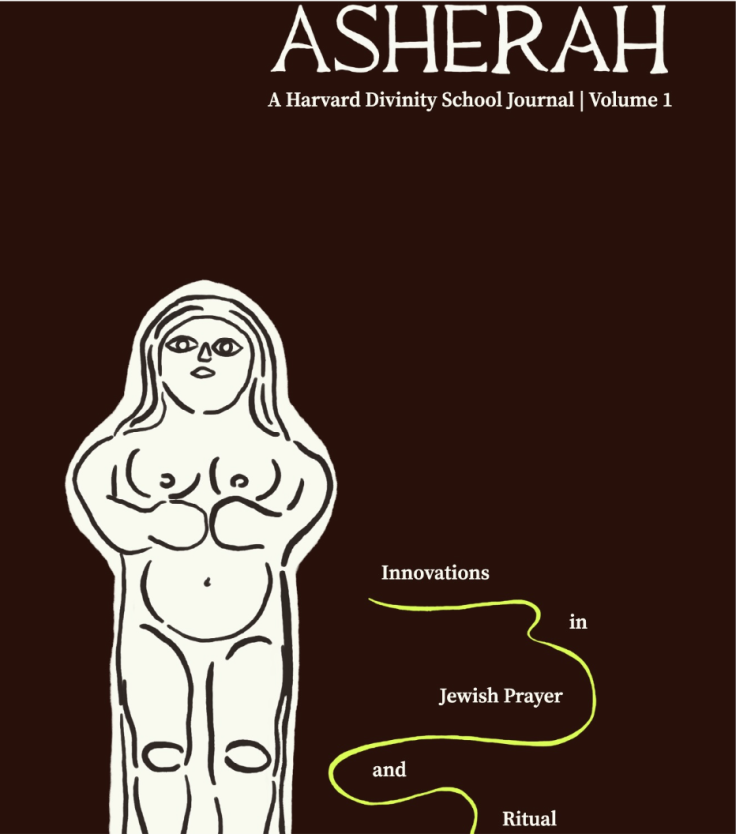
The first issue of Asherah: A Harvard Divinity School Journal touts "Innovations in Jewish Prayer and Ritual." It is really something to behold, even by the provocative and sophomoric standards of student publications.
While the journal’s website describes it as "a student publication of Harvard divinity school," it also says it was "Created by Shaul Magid," who is not a student but rather the Professor of Modern Jewish Studies in Residence at Harvard Divinity School and a member of the executive committee of Harvard’s Center for Jewish Studies. In his 2023 book, The Necessity of Exile, Magid declared that "Israel is mired in an increasingly chauvinistic ethnonational project," and said that he doesn’t think "that liberalism and Zionism can be seen as compatible in any easy way." The book, he writes, is "in some sense, anti-Zionist" or "more precisely … counter-Zionist." Magid wrote two of the 16 articles in the journal, including a preface that begins, "When we first announced our new Harvard Divinity School Jewish liturgy journal, ASHERAH, we received many responses stretching from congratulations to curiosity to disturbance and even anger."
Magid writes, more than a little defensively, that the name was chosen "not to subvert the norms that constitute Judaism today as much as to enhance them." A reasonable response would be, spare us the enhancement. Deuteronomy 16:21 states: "Do not plant an Asherah for yourself [or] any tree near the altar of Adonoy, your God, that you will make for yourself." Encyclopedia Judaica describes Asherah as "A Canaanite fertility and mother goddess." The Babylonian Talmud, in Sanhedrin 7b, describes it as a tree used for idolatry.
Magid’s letter goes on to say, "I have heard (I have no scholarly verification of this) it suggested that there is an etymological, perhaps midrashic, connection between Asherah (AshR) and the Hebrew word Osher or Ashrei (AshR), meaning both abundance and joy." The "I have no scholarly verification" acknowledgment by the professor and self-described "founder" of the journal sets the tone for what follows.
Next up comes a statement from the student editors in chief, Daisy Jacobs and Lila Rimalovski, who write, "Please know we are not scholars of the ancient texts, we did not go to yeshiva, nor are we Rabbis."
Instead, they write, they are coming from "the sidelines of mainstream Jewish life, largely because of our queerness, our anti-racism, our support for Palestinian liberation."
"We must also note that this publication finds itself in a moment encumbered by war, by fascism and genocide, by religious- and ethno-nationalism, by a reckoning with the rapid development of AI and its impact on planet and people, by climate collapse, by pandemics, and by the pervasive presence of disconnection and loneliness," they write, tossing in a reference to "What was suppressed by the Holocaust, by the whitening hand of Zionism, or by the global project of Christian conversion," as if Zionism or Christian evangelism belong on the same list as the Holocaust.
The journal plods on for 131 pages in this sad, irresponsible, mediocre, nihilistic, narcissistic, and self-congratulatory manner.
Magid has an article about how he usually prays alone even though Jewish tradition encourages communal prayer. The word "I" appears 31 times in the three-page essay, or an average of more than ten times a page.
Alex Baskin, a staff chaplain at Mass General Hospital who boasts "over a decade of Buddhist practice," has a poem about Gaza: "IS this what my russian-born grandfather had in mind? we’ve lost the plot. OUR history didn’t prepare us for the gun’s trigger side. GOD’s silence stretches from river to sea while idf soldiers wrap tefillin. THE palestinian parents nearby should not have to choose which child will eat. one holocaust should not LORD over another. as a child, i wasn’t once shot in the head by an ISraeli sniper."
Shir Lovett-Graff offers up some erotic poetry: "we taste euphoria in salt … we fall asleep laughing / blanketed in heavy tonguing prayer … temple-worshippers / also called trans bed-makers." Also, "I have never sexted so well … stomach, thigh I wonder if God hears bed-prayer in two different ears, consummating interfaith with fingers."
The journal concludes with acknowledgments and contributor biographies. Magid thanks "the Dean’s office at Harvard Divinity School — Marla Fredrick." The dean actually spells her last name Frederick. Her inaugural convocation speech as dean proceeded directly from the Holocaust to "the Nakba, catastrophe in Arabic, referring to the mass displacement and dispossession of Palestinians during the 1948 Arab-Israeli War."
Of the 14 contributors listed, four use they/them pronouns and four mention being involved in Harvard Divinity School Jews for Liberation, an anti-Israel group that is an official student organization at Harvard "for anti-Zionist, non-Zionist, and diasporist Jews, as well as Jews questioning their relationship with Zionism."
I emailed Dean Frederick’s office. The journal mentions "the generous support of the Dean’s Office at HDS." I asked, "What do you think of the publication? In retrospect are you proud to have supported it or do you regret having done so? Why?" I got no response.
It’s tempting to shrug it all off—a student publication that no one will take the time to read, sponsored by a professor without tenure in a Harvard graduate school that is one of the university’s smallest, poorest, and least relevant.
Yet the "anger" that the name Asherah was met with is justified by the journal itself. That is especially so given the context, which is that Harvard Divinity School has been a cesspool of Jew-hate. This has been documented extensively and incontrovertibly. Robert L. Friedman, a graduate of the school, wrote "How Harvard Divinity Teachers Hate." Harvard’s own Presidential Task Force on Combating Antisemitism and Anti-Israel Bias wrote a report scathingly documenting how an entire program at the Divinity School "appears to have focused on non-mainstream Jewish religious perspectives that lack widespread support within the Jewish diaspora or in Israel. These perspectives arguably offer a particular political theology that attributes to Jews two great sins: first, in the Levant, the establishment of the State of Israel and the Palestinian Nakba; and second, in the United States, participation in White supremacy. According to these perspectives, it seems, Jews can and should repent by dedicating themselves to pro-Palestinian activism." The highest profile student who sued Harvard and who spoke at the 2024 Republican National Convention about the antisemitism he experienced on the campus, Alexander "Shabbos" Kestenbaum, was a Harvard Divinity School student.
So even for those of us who think universities should have wide latitude for free expression and not a lot of sacred cows, it’s more than a bit much for the Harvard Divinity School dean’s office—after all that has happened in recent years—to subsidize the production of an openly non-scholarly magazine devoted to redefining Judaism into something that will strike many Americans, justifiably, as a perversion or as insanity. If anti-Israel Harvard students want to produce a queer erotic poetry magazine named after a Canaanite idol, let them do it on their own without the university’s name or financial support. As for the professor who thinks it’s a worthwhile project, he’s subtracting from, rather than adding to, what remains of the university’s reputation.