
The Trump administration has pointed to stymieing the Venezuelan drug trade as a central motivation behind its operation to capture dictator Nicolás Maduro. But narcotics are not the only dangerous export the operation crippled: Taking out Maduro and asserting U.S. authority in the country means delivering a big hit to Iranian drone production, U.S. officials and regional analysts told the Washington Free Beacon.
"Iran reportedly established a drone development base and trained Venezuelan military personnel on the technology and designs, specifically the Mohajer and Shahed lines," said Jason Brodsky of United Against a Nuclear Iran (UANI). Tehran's Islamic Revolutionary Guard Corps embedded itself within an air base in the city of Maracay, Brodsky noted, and the country has functioned as "a hub of Iranian drone activity" since as far back as 2001.
Trump's operation in Venezuela came at the beginning of a wave of popular protests against the Islamic Republic. With Maduro gone, the Iranian regime has lost access to a sophisticated drone and weapons production pipeline that became even more important after the losses it took in Israel's operations against Hamas, Hezbollah, and Tehran itself.
"For more than a decade, Maduro's Venezuela has become a socialist safe haven and supply depot for rogue states and agents of chaos," Rep. Pat Fallon (R., Texas), a member of the House Armed Services Committee, told the Free Beacon. "The Commander in Chief understands well that the U.S. absolutely could not continue to allow the likes of China, Russia, and Iran to operate freely in our backyard. By cutting off oil sales and production, as well as the sale and manufacture of weapons components, Operation Absolute Resolve has struck a blow against this anti-US axis that seeks to undermine the West."
In the immediate aftermath of the Maduro raid, unconfirmed reports that the United States had targeted an Iranian drone facility as part of its operation began circulating online. A Pentagon spokesman declined to confirm or deny those reports to the Free Beacon, but it is clear that the Trump administration considered the Islamic Republic's weapons facilities in Venezuela to be an immediate national security threat. A Trump administration official briefed on the military campaign said the operation was necessary to disrupt not only the flow of drugs into the country but also a range of anti-American activities in the country.
"President Trump's decisive leadership in Venezuela struck a blow to malign actors, such as China and Iran, who had been given a foothold in our Hemisphere by the Maduro regime," the administration official told the Free Beacon.
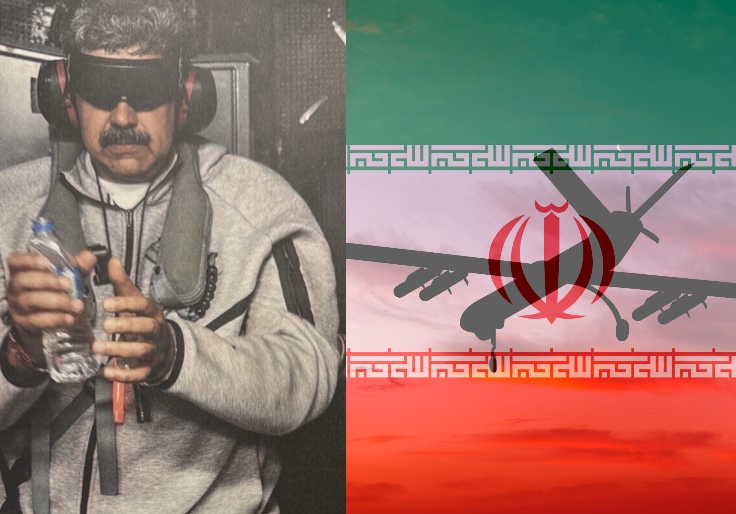
The Department of the Treasury indicated the administration's interest in Iranian drone production with a series of sanctions issued on December 30. An IRGC offshoot provided Venezuela with the blueprints and technology needed to manufacture combat drones, the Treasury Department stated. A state-owned aerospace company, which purchased "millions of dollars' worth of Mohajer-6 UAVs" in recent years, assembled the drones under instruction from Iran.
The Treasury Department published photos that show partially built Mohajer-6 drones sitting in a warehouse at the El Libertador Air Base, the central hub for Tehran's illicit weapons activities.

Secretary of State Marco Rubio highlighted those threats in the days after the United States seized Maduro and his wife Cilia Flores.
"In the 21st century, under the Trump administration, we are not going to have a country like Venezuela in our own hemisphere, in the sphere of control and the crossroads … for Hezbollah, for Iran, and for every other malign influence in the world," Rubio said Sunday on CBS's Face the Nation.
Sen. Ted Cruz (R., Texas), echoing the secretary of state's initial remarks, told the Free Beacon that "there are countless reasons why President Trump's action to remove Maduro will enhance American national security, and near the top of the list is that it dismantles a key hub used by the Ayatollah to undermine America in our own hemisphere." Maduro, Cruz said, "transformed Venezuela into a safe haven for Iranian operatives and terrorists, who used it to move personnel, money, weapons, and energy resources."
For nearly two decades, Iran and its chief proxy Hezbollah used Venezuela as a launching pad for terrorist operations, weapons smuggling, and sanctions evasion. As the Free Beacon reported last month before Trump's operation, Hezbollah fighters flocked to Venezuela for refuge and cash after the terror group suffered devastating military defeats at the hands of Israel.
For UANI's Brodsky, Iran's future in the country largely depends on whether the United States can moderate Maduro's de facto successor, acting president Delcy Rodriguez.
"Rodriguez greeted the Iranian ambassador very prominently as she took the oath of office at the National Assembly on Monday," Brodsky noted. "So, this raises concerns. But judging from the public comments of Trump administration officials, I sense that Venezuela continuing to provide Iran with such a platform will be a nonstarter for the United States."