


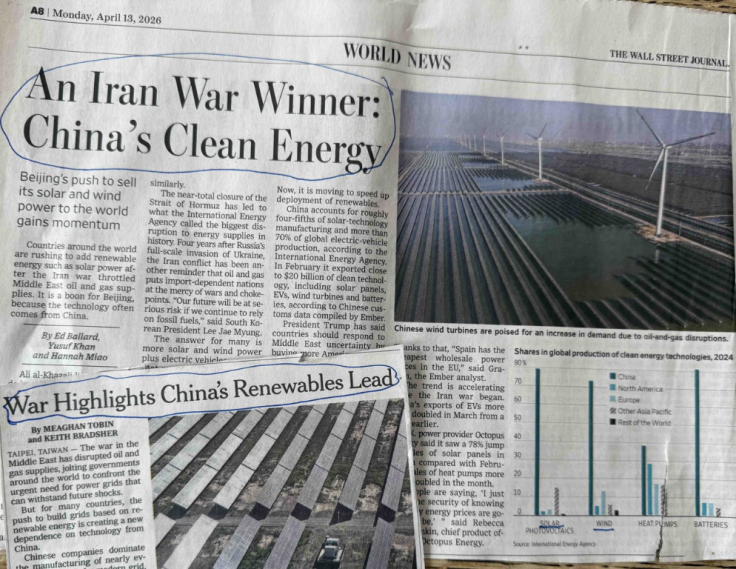
"Never just read one newspaper" is one of my media literacy rules. Sometimes even that fails, as it did on Monday April 13, 2026, when the New York Times and the Wall Street Journal both weighed in with suspiciously similar, and sadly unskeptical, stories claiming that the Iran war somehow provided vindication for China’s emphasis on wind and solar energy.
How’d the New York Times ("War Highlights China’s Renewables Lead") and the Wall Street Journal ("An Iran War Winner: China’s Clean Energy") wind up with the same bad takes on the same story on the same day? It’s likely that their editors were both reading the Associated Press, a wire service that drives newsroom agendas by providing a tip sheet in advance disclosing what stories the AP is working on. The AP had its own version of the same story, headlined, "Iran war’s global energy crisis sharpens China’s advantage in clean tech." Datelined Hong Kong, a China-controlled territory where journalists are imprisoned if they publish articles that the Chinese authorities disapprove of, the AP story begins, "China is poised to benefit from the Iran war as global energy disruptions accelerate a shift away from fossil fuels and toward clean technologies and renewable power, industries that China dominates."
The gist of the story—that the Iran war somehow demonstrates that China is right about wind and solar energy—is a fantasy, not a fact. Even if you rely on China's own unreliable data, the International Energy Agency lists coal and coal products as 71 percent of China's energy production, and solar, wind, and other renewables combined at 5.4 percent.
Not everyone agrees that the Iran war is a win for China, energy wise.
President Trump posted to Truth Social over the weekend, "Massive numbers of completely empty oil tankers, some of the largest anywhere in the World, are heading, right now, to the United States to load up with the best and ‘sweetest’ oil (and gas!) anywhere in the World. We have more oil than the next two largest oil economies combined - and higher quality. We are waiting for you. Quick turnaround! President DJT"
Trump also posted a world map of marine traffic depicting tankers headed for the U.S. to fill up. "GREAT!!!," Trump commented.
"The U.S. is going to make a fortune," said an Israeli reserve brigadier general, Amir Avivi, the founder and chairman of Israel’s Defense and Security Forum. Avivi said in Monday’s IDSF briefing that American interests for the conflict include moving Iran "from alliance with China to alliance with the United States." He also said that a successful war outcome for America would likely include Iranian oil being traded in petrodollars as part of the SWIFT system (Society for Worldwide Interbank Financial Telecommunication) rather than on the black market.
A headline that said "Iran War Winner: U.S. Fracking and Offshore Drilling" would be as accurate, probably more accurate, than the Wall Street Journal, New York Times, and Associated Press headlines. It’s unlikely to appear so long as the AP is driving the agenda.
The AP used to be funded largely by dues from member newspapers. But as the newspaper industry has collapsed, the AP has become increasingly reliant on grants from nonprofit organizations with ideological agendas.
The AP website also lists a "partnership" with the China News Service. It describes the China News Service as providing "News and insight from daily life in China," illustrating the partnership with a pair of adorable pandas. "China News Service (CNS) provides in-depth news from China to an international audience, with coverage including feature stories and topics such as current events, art, lifestyle, people and travel," the AP website says. What AP doesn’t say is that China News Service is controlled by the Chinese government and its governing Communist Party.
The AP article carries a disclaimer stating that "The Associated Press’ climate and environmental coverage receives financial support from multiple private foundations. The AP is solely responsible for all content." The Washington Free Beacon has previously exposed this relationship with articles such as "The AP’s Climate Coverage Is Funded by Left-Wing Groups—And It Shows" and "AP Quietly Reveals Donation From Foreign Group That Trains Journalists as Climate Change ‘Activists.’" I wrote about it in the Wall Street Journal in 2025: "Following the Money, the Associated Press Moves Left." This latest AP article fits the pattern.
The first quote in the AP article says: "China’s approach to energy sector development and geopolitics has been completely validated by the Iran conflict," said Sam Reynolds with the U.S.-based Institute for Energy Economics and Financial Analysis.
The Institute for Energy Economics and Financial Analysis is funded by the same left-wing foundations that fund the AP. For example, the Hewlett Foundation gave $200,000 to the Institute for Energy Economics and Financial Analysis in 2025 and $750,000 to the AP’s climate desk in October 2024 for a 24-month grant.
A member of the board of the Institute for Energy Economics and Financial Analysis is Sarah Brennan, who works at the Rockefeller Family Fund on the Funder Collaborative on Oil & Gas. The Rockefeller Family Fund gave $347,250 to the Institute for Energy Economics and Financial Analysis in 2024, according to the Rockefeller Family Fund tax return, and the Rockefeller Brothers Fund gave the Institute for Energy Economics and Financial Analysis $570,000 in 2025. The AP website lists "The Rockefeller Foundation" as a current funder. There are lots of Rockefellers, and the Brothers Fund, the Foundation and Family Fund are distinct entities, but the heirs of John D. Rockefeller, founder of what is now ExxonMobil, have been outspoken against fossil fuels. "Supporting the AP’s climate desk dovetails with The Rockefeller Foundation’s recognition of climate change as a singular threat to humanity," the Rockefeller Foundation website says. The Rockefeller Foundation 2024 tax return listed a $250,000 grant to the AP in 2023 "in support of launching a climate coverage initiative."
Another passage in the AP article: "They are at the very forefront of this, more so than any other countries in the world, certainly more so than the United States," said Li Shuo, director of the Asia Society Policy Institute’s China Climate Hub. The Rockefeller Foundation gave the Asia Society $200,000 in 2024 for "researching China’s climate goals and implementation strategies," according to the Rockefeller Foundation tax return.
There’s nothing necessarily problematic about a news organization funded by Rockefellers publishing news articles that also quote sources funded by Rockefellers. The problem is when it leads to readers being misled about reality. The stories are deceptively illustrated with pictures of windmills, solar panels, and batteries instead of coal mines or nuclear power plants.
The executive editor of the New York Times, Joseph Kahn, has been pushing this Chinese triumphalist line: "It’s obvious China has taken the lead … America is relatively stagnant by comparison," he claimed in December 2025. The reality is that China is heavily dependent on imported oil, notwithstanding all the greenwashing pliantly provided by the AP, New York Times, and Wall Street Journal reporters. The U.S., by contrast, is a net exporter of energy.
The AP’s director of Media Relations & Corporate Communications, Patrick Maks, answered a question about the organization’s partnership with China News Service, providing a statement that said, "AP distributes clearly labeled third-party content from hundreds of unconnected organizations around the world. This content is marked as fully separate from the core AP news report. None of the AP’s business relationships have any connection to, or influence over, the journalism AP produces and provides to its customers and audiences around the world."
He did not say directly whether the AP is paid for the arrangement, or if so, how much. Whether it’s a paid or voluntary "partnership," it’s concerning, no matter the labeling. China will have less money to throw around on this sort of thing now that its supply of smuggled petroleum from Iran is getting more scarce and more pricey. Alas the same does not apply to the Rockefeller and Hewlett Foundations, at least if their return is measured in articles produced rather than in readers convinced.