




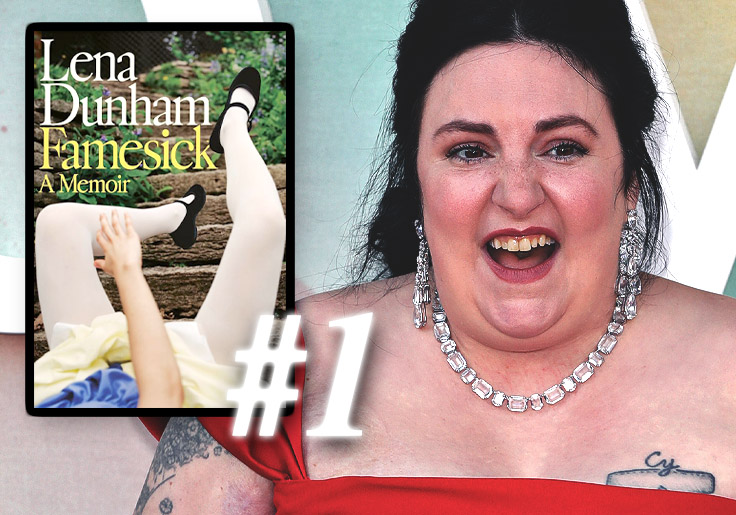
Lena Dunham's latest memoir is the top-ranked title on the New York Times Best Sellers list. The mid-tier actress and producer—best known for dating musician Jack Antonoff before he upgraded (spectacularly) by marrying Margaret Qualley—posted a video last week of her reaction to hearing the news. "Screaming, crying, throwing up," she wrote. "Almost two decades into my career, I know enough to know what a rare and special thing [it] is to feel seen and heard."
The book, Famesick, is Dunham's third memoir since 2014. She is 39 years old, at which point Barack Obama had only managed to write a single memoir. So there's that. Dunham's feat is even more impressive when you consider that Famesick was not the top-selling nonfiction title in its first week since publication. Poisoned Ivies, Rep. Elise Stefanik's (R., N.Y.) new book about the "moral rot" befouling America's elite universities, sold roughly 1,000 more copies than Dunham's memoir, but placed third on the Times Best Sellers list.
How did Dunham pull this off? And why did Stefanik fail? It's because the former followed these 10 easy steps to topping the Times Best Sellers list, while the latter did not. Enjoy!
1) Be a celebrity adored by New York Times staffers even though most average Americans don't know (or don't care) who you are.
For non-churchgoing white women with university degrees, Dunham is the "voice of a generation." For everyone else, she's that annoying celeb who is always making headlines for talking about how she wishes she could have had an abortion and other nonsense.
2) Have the "correct" political views.
Stefanik's biggest mistake was being a Republican, whereas Dunham supports Democrats and has political opinions that align with those of Times staffers.
3) Choose a topic the New York Times will love (or at least care about).
A wealthy white woman writing about her struggles with fame, addiction, body dysmorphia, chronic illness, and weird sex stuff? The Times will review it and like it—provided the author adheres to Step 2. For context, the paper recently published a (mostly) positive review of a Polish novel about a cult of pagan feminists who fornicate with plants and includes depictions of "violence, suicide, sexual assault, torture, murder, genocide, bestiality, cruelty to children, sex with moss, sex with grass, sex with mushrooms, sex with lichens, sex with feathers, sex with rotten vegetables and sex with frozen dirt."
4) Don't choose a topic the New York Times has no interest in covering.
Related to Steps 2 and 3, but writing about the "moral rot" at elite universities, which most Times journalists attended and continue to hold in high regard, all but ensured that Stefanik's book would not even warrant a (disparaging) review. Antisemitism on college campuses is an especially sore subject. Meanwhile, the Times was more than happy to review Gov. Gavin Newsom's (D., Calif.) book about himself.
5) Write a book.
Dunham reportedly spent almost a decade working on Famesick. That sounds like a long time, but Barack Obama left office in 2017 and still hasn't finished his multi-volume post-White House memoir. The first volume, A Promised Land, was 768 pages long. Obama is sometimes regarded as a talented writer, but talented writers are typically able to condense their prose, whereas self-absorbed nerds tend to overindulge.
6) Get a positive New York Times book review.
Alexandra Jacobs—a white woman (obviously) who works for the Times—praised Dunham for her "quick hits of wit" that feel like "sniffs from an oxygen mask," and used the phrase "Well, gals..." to commend the author's description of "post-surgery scenes of sex with a high school ex."
7) Score an interview with the New York Times.
Times journalist David Marchese sat down with Dunham for his regular series of interviews with "the world's most fascinating people." Not surprisingly, he adored Famesick and its "carefully wrought and provocatively unstinting reminiscences."
8) Get an essay about the book published in the New York Times Magazine.
Another white woman, Amanda Hess, wrote about Dunham's outsized influence on "Millennial Culture" while lamenting the ascendant "far-right harassment machine" and the "durable legacy" of the author's "most brutal misogynistic critics," as well as the dangerous consequences of writing a best-selling memoir in our "post-woke, casually callous and conspiracy-minded era."
9) Convince the New York Times to write an article about your book tour.
Elisabeth Egan, yet another college-educated white woman who writes about culture for the Times, attended Dunham's book tour event in Brooklyn, along with what appeared to be a mostly white and female audience. All of the interviews on the Famesick tour will be conducted from bed and feature a "guided meditation" along with a slide show of Dunham's pets. Egan notes that the author is "traveling with her own pillows, blankets and other favorite items," in case you were wondering.
10) Sell enough copies (thanks to Steps 1-9) to be close enough to the top spot.
Given the sales data from BookScan, the "gold standard" for tracking print sales, it's not clear why the Times listed Dunham's book ahead of Stefanik's—apart from the obvious explanation. Poisoned Ivies was listed at number three despite selling almost twice as many copies as the second-ranked title, Strangers, a memoir about an old-money heiress whose hedge fund manager husband has an affair and abandons the family at their beach estate on Martha's Vineyard.
The Times is known to frown on books it suspects of being purchased through "bulk sales," but is notoriously tight-lipped about its methodology. For example, Newsom's political action committee accounted for roughly 75 percent of the book's sales in the first few weeks after publication.