

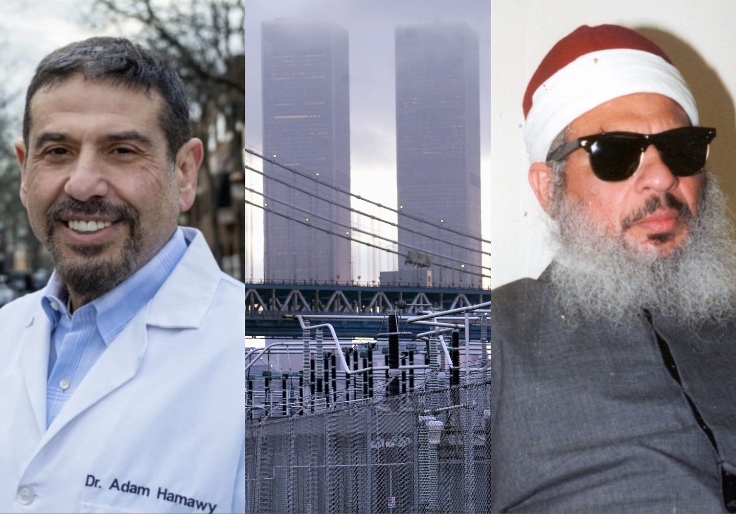
Victims and survivors of the 1993 World Trade Center bombing reacted with shock and horror at the possibility—if not likelihood—that a close associate of the "Blind Sheikh" terrorist mastermind who inspired the attack may soon be a member of Congress.
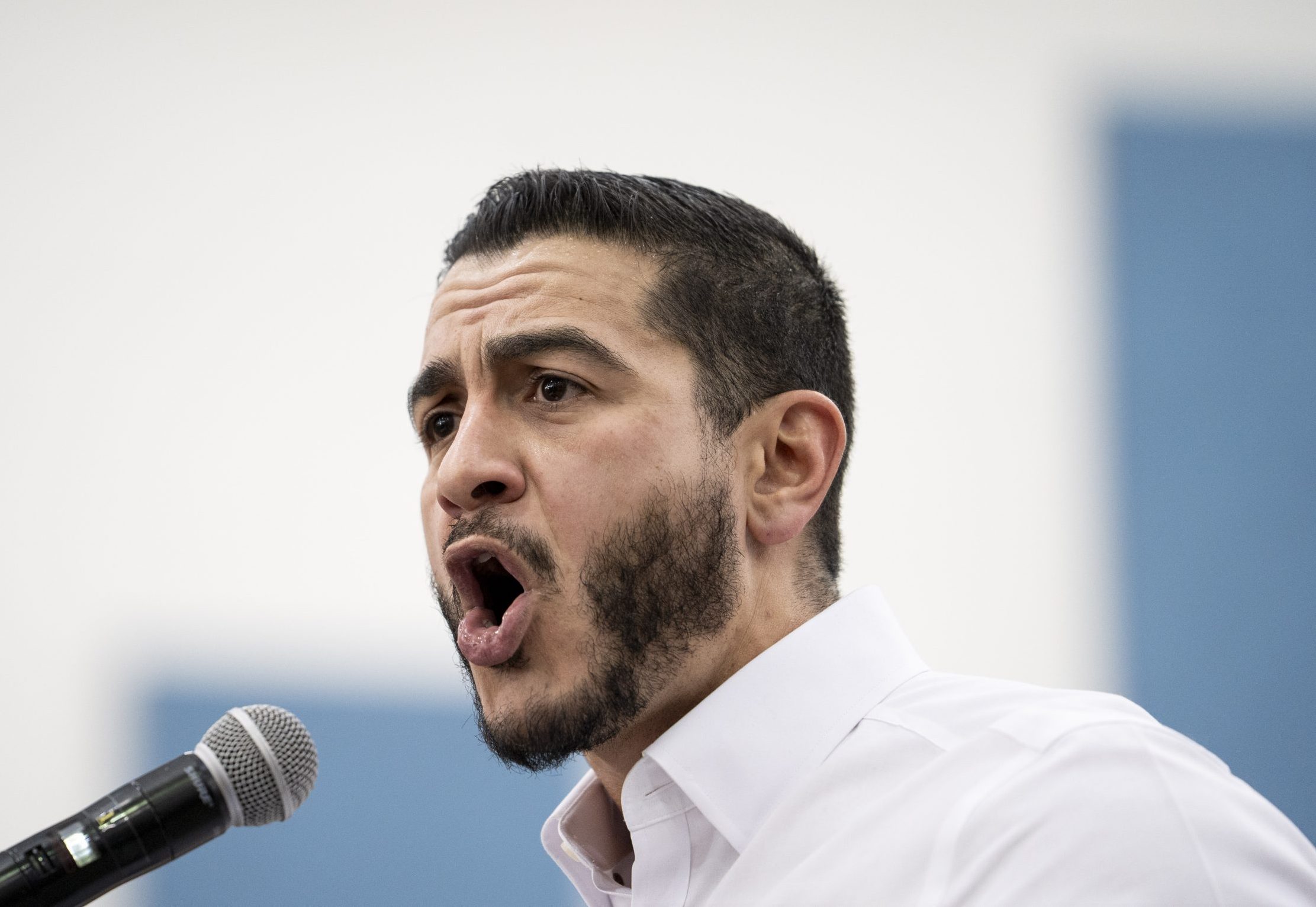
Adam Hamawy, a Princeton plastic surgeon, is a frontrunner in a crowded Democratic primary to replace retiring Rep. Bonnie Watson Coleman (D.) in New Jersey's deep-blue 12th Congressional District—despite his years-long friendship with Omar Abdel-Rahman, the Muslim extremist cleric who was sentenced to life in prison for his role in the 1993 bombing.
The February 1993 blast killed 6 people and wounded more than 1,000. Rahman, better known as "the Blind Sheikh," went on trial in 1995 for his role in the attack. Hamawy was a defense witness in the spectacular trial and described the terrorist as a "leader of the community" on the campaign trail just last week.
He also claimed he never heard Rahman discuss terrorism or violence, even though he took a 13-hour road trip in 1991 with the Blind Sheikh to a Detroit conference called "Toward a Global Islamic Economy in Detroit," which featured multiple extremist speakers talking about jihad and infidels.
"I would never vote for Hamawy because of this and again, saying that as a lifelong Democrat and someone who really wants to keep New Jersey blue, I would find another Democrat to vote for even if it meant writing in someone. I could not with a clear conscience ever vote for this man. Nor would I encourage anybody else to. Some things are just not forgivable," Michael Macko, a retired fashion consultant who lives in Morristown, told the Washington Free Beacon.
Macko's father, William Macko, worked at the World Trade Center as an assistant chief mechanical supervisor. He was killed by the blast while on his lunch break in the basement of the north tower.
"These are people being associated with the very horrific killing of my father. Whenever I see things like this it's hard because your immediate reaction is just unbelief," Michael Macko continued.
"Maybe he didn't know how bad the sheik was," Macko said of Hamawy, "but I would find that hard to believe given his closeness to him."
Memories of the 1993 bombing, when a terrorist bomb exploded in the underground parking garage of the north tower, have been obscured by the horror of the 2001 attacks that brought both towers down. But survivors of the 1993 attack say they are still suffering.
James Outerbridge—who survived both the 1993 bombings and the 2001 attacks—said he was still in therapy over his experiences in the buildings decades later.
"What had happened [in 1993] not only affected me, but was a precursor to 9/11," Outerbridge told the Free Beacon from North Carolina, where he is now retired.
Outerbridge, who worked at a bank and is credited with saving hundreds of lives on 9/11, said there should be no place for people like Hamawy in government.
"There's no place for people like this," Outerbridge told the Free Beacon. "Allowing people who have those kinds of connections to come in here, run for political office, and then who knows, down the line, put their own agenda into play."
"He doesn't deserve to run for political office in our country," Outerbridge went on.
Charles Maikish was director of the Port Authority World Trade Department at the time of the bombings and was at his desk when he heard the blast.
"I was sitting at my desk in Tower One when the tower heaved. It just actually heaved. And I knew something had happened," he told the Free Beacon.
"I always referred to them as my twins," he added wistfully from his home in Florida, where he is now retired. "And it was a devastating experience to have it, you know, injured the way it was injured."
"Personally, it disgusts me," he said of Hamawy's relationship with Rahman. "For somebody that has befriended that group, or the head of that sect that perpetrated such a heinous crime, to me, is just totally against what would be a free, open, democratic society."
The scandal has been slowly percolating in New Jersey since the Free Beacon first flagged a 1995 New York Times article labeling Hamawy a "supporter" of the radical cleric.
"If you need anything, you can just give me a call," Hamawy told Rahman in 1993, just months after the bombing.
Hamawy has never denied his relationship to the sheikh—who died in prison in 2017—but has attempted to distance himself from the issue by blasting the story as "right-wing, MAGA smears."
Hamawy's Democratic opponents in the race have so far treated the scandal gingerly—though there are signs that is beginning to change as the race heads into the final two weeks before the primary, which will almost certainly crown the winner of the general election.
"You are known by the company you keep. In the mid 1990s when Adam Hamawy indicated he was an interpreter for [the Blind Sheikh], who was convicted of acts against this country, he sat in a ride and developed amnesia about what transpired on that very long road trip," Plainfield, N.J., mayor Adrian Mapp (D.) told InsiderNJ Thursday.
"You can't describe Adam Hamawy as a progressive," Mapp went on. "He is what you would call a radical extremist. Individuals associating with clearly anti-American views like the convicted Sheikh call into question people like Dr. Hamawy."
Reps for Hamawy did not respond to requests for comment from the Free Beacon.