





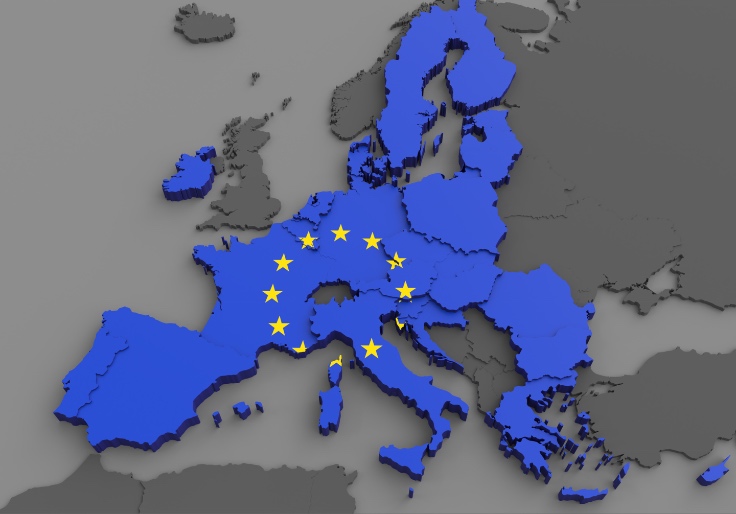
All roads lead to the European Union. This, in a nutshell, is the argument of Roderick Beaton's book covering the history of the continent from ancient Greece to today's war in Ukraine. A professor emeritus of history at King's College London, Beaton wants his readers to consider the idea of Europe as it developed from around the battle of Marathon (490 B.C.) to the siege of Mariupol (2022 A.D.). And in a swift narrative he recounts this history, moving seamlessly from wars to peace treaties, from Polybius and Dante to Francis Fukuyama, from Jesus to Jacques Delors.
The book moves briskly across centuries, covering the Roman Empire, the barbarian kingdoms, the Carolingian attempts at European unity, Charles V, the Renaissance, the bloody French Revolution, the Concert of Europe, and the violent 20th century ending with the euphoria of the 1989 miracle and the rapid unifying efforts of European institutions. This is obviously a lot to cover in about 300 pages and the reader should already possess some knowledge of European history to place everything in a more detailed context.
But why a new history of Europe? After all, there are shelves of such histories, and it is unlikely that new discoveries will dramatically change our understanding of past events. The author acknowledges this crowded field at the outset, yet justifies his opus by the need to remind us what it means to be European. Europe's very existence is, he argues, at risk, threatened by Putin's Russia on its eastern frontier and by Trump's United States to its west. Hence, we should remember what Europe is and why people fought for it, starting with the Greeks beating the Persians in 490 B.C.
The author, a specialist in ancient history, is at his best giving a succinct history of Greece and Rome. But he also skillfully weaves into the history of events some formative moments of Europe's intellectual history. Dante plays an important role, and so do various authors of the Renaissance (such as Enea Silvio Piccolomini or Pius II) and the Enlightenment (Voltaire and Rousseau). All this makes for an enjoyable book, written in a clear style and avoiding a "one fact after another" litany.
But in the end this is less a history of Europe and more a search for the European Union through 2,500 years of history. The metric used to examine and judge the past is how close it resembles the last few decades of the European political project. For example, the Achaean League failed to unify Greek city states, which then fell under the control of a well-armed Rome—a warning to European states that do not want a greater union. The Roman Empire was the closest thing to the EU in ancient times, even though it achieved that through arms rather than rules and norms. In 212 A.D., Emperor Caracalla extended Roman citizenship to every subject of the empire except for slaves, a rare political decision that did not occur until the 1992 Maastricht Treaty that created an EU citizenship supplementing the national one. Charles V was the last emperor to attempt to unify Europe as a coherent Christendom, and the treaties of the peace of Utrecht (1715) were the last to mention a respublica Christiana, giving space to secular political entities that could seek cooperative arrangements from the Concert of Europe to the Versailles accords.
The narrative culminates in what it presents as its apex—its conclusion, its true telos: the post–World War II drive to unify Europe. The significance of these efforts, from Jean Monnet to the euro and beyond, is reflected in the space they occupy in the book: While the first 1,300 years of Europe's history are admirably condensed in 100 pages, a comparable length is devoted to the 70 years since 1945. Europe is, according to the book's argument, reaching its full and best expression as it progresses toward the unity that neither the Greeks nor the Christians could achieve.
And yet, this unity seems as much a mirage now as it had been in the past. Some of the reasons for failure are given, perhaps unwittingly, by the author. For one, the gradual expulsion of Christianity from the idea of Europe undermined it. Twenty years ago, Brussels tried to have EU member states ratify a European Constitution (all 448 articles, compared with the 7 of the U.S. Constitution). The French and the Dutch rejected it, and the constitution was transformed into a mere treaty that did not require popular ratification by each nation. One of the key criticisms of this constitution was that the preamble rejected all reference to Christianity as foundational to the idea of Europe, choosing instead an insipid reference to the "cultural, religious and humanist inheritance." A political project based on uninspiring ideas in the end has little chance to succeed. People don't sacrifice for "To Whom It May Concern."
The progressive march of history toward the current idea of Europe as a "European Union," moreover, is full of violence that increases as Christendom fades away and Christianity is relegated to the private realm. The rise of secular states brought neither unity nor peace from the 17th century on. As the book shows, peace in Europe was present mostly in utopian treatises seeking to unify a continent that had lost a rationale for its unity. William Penn wrote one before heading to America; Abbé de Saint-Pierre wrote a "Project to Render Peace Perpetual throughout Europe"; later that century, Kant added his "Perpetual Peace" to the list. But none of these made much of a dent in the violence that tore the continent.
On the contrary, the implementation of secular ideas made violence industrial and necessary. The French Revolution sought to create a new polity and engaged in mass slaughter. "Mercy is not a revolutionary sentiment," in the words of the general who in 1793 in the French Vendée massacred the Catholics who opposed the revolutionary efforts to nationalize the Church. Violence was not a momentary blip but part of the progressive secularization and atheization of Europe.
The rise of nationalism created new divisions and reasons to fight. Beaton quotes Joseph Roth, who in his great novel The Radetzky March has Count Chojnicki lamenting that "people have stopped believing in God. Nationalism is the new religion. People [albeit other translations have 'nations' here] don't go to church. They go to nationalist meetings." The problem was less the rise of nations, which for Beaton seems to be the primary cause of division, but the rejection of God, which resulted in totalitarianism; nations venerated themselves rather than something outside and above them.
The book ends with a dispiriting recounting of the last 20 years, characterized by one disaster after another, from 9/11 to Brexit, all an affront to the end of history represented by the EU. Russia's attack on Ukraine in 2022 seems to point, according to the author, to the real possibility that Europe may fall under the control of an authoritarian Moscow, like the divided Greek cities that fell under Rome's ruthless dominion. The only answer is, for the British historian, a stronger, more united European Union, especially as the United States is allegedly abandoning its democratic nature and championing a "Russian-style authoritarianism."
Besides the very dubious analysis of American politics, the hope that the EU can protect Europe is just that, a hope. Right now Russia can't conquer Europe not because the EU is manning the frontline, but because Ukrainians are dying in the trenches of the Dnieper Basin "wild fields." And they are willing to incur massive casualties, not to mention devastating economic losses, because they are defending their own nation from annihilation. Ironically, the nations the EU has tried to alter and fuse into a new identity underwritten by borderless markets are the best defense against Russia's imperialist aggression.
In the end, the book is less a history of Europe than a plea for the European Union, seen as the culmination of centuries of struggle for unity and peace. EU bureaucrats will find this satisfying and even vindicating. Most readers will remain unconvinced. Who, after all, is willing to fight another battle of Marathon for rules and procedures and insipid "values"?
Europe: A New History
by Roderick Beaton
Basic Books, 432 pp., $35
Jakub Grygiel is a professor at the Catholic University of America.