


Yale Law School is no longer number one.
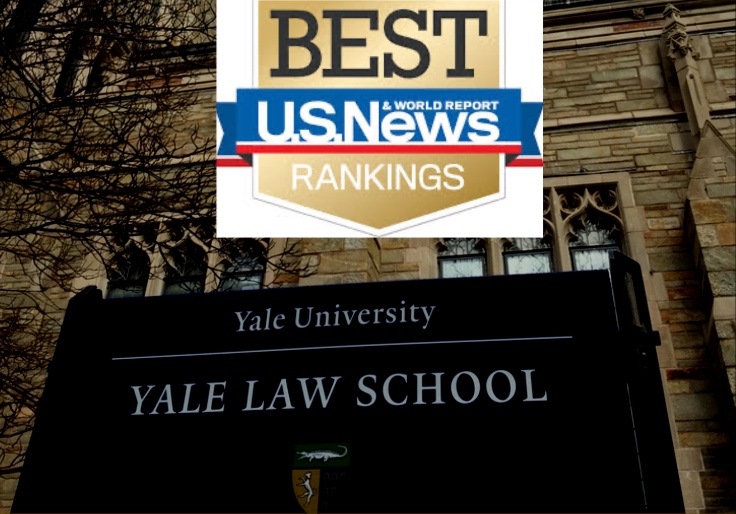
Four years after a bevy of free speech scandals, several revealed in the pages of the Washington Free Beacon, shook the Ivy League school, Yale on Tuesday lost its spot atop the U.S. News & World Report law school rankings, which it had occupied for more than 35 years. Stanford is now the top law school, with Yale and the University of Chicago tied for second place. Harvard Law School, meanwhile, ranks number six.
Yale pulled out of the rankings in 2022 after its "peer assessment" score, a key metric in the ratings that reflects a law school's reputation among academics at other institutions, dropped to its lowest point in over a decade. The peer assessment score was the single largest component in the U.S. News & World Report's law school rankings, accounting for 25 percent of the overall rank.
Yale's decision prompted speculation at the time that the school was about to lose its number one spot. Heather Gerken, then the law school's dean—she has since left New Haven to lead the left-wing Ford Foundation after being passed over for the university's presidency—claimed that the rankings were "profoundly flawed" and "disincentivize programs that support public interest careers."
Others interpreted Yale's move to ditch the rankings as a cynical ploy to stem the fallout from the year's controversies, which triggered a boycott by 12 federal judges who said they would no longer hire clerks from the law school.
"Students should be mindful that they will face diminished opportunities if they go to Yale," one of those judges told the Free Beacon at the time. "I have no confidence that they're being taught anything."
Though Yale no longer provides data to U.S. News & World Report, it is still included in the publication's rankings. U.S. News tweaked its methodology after Yale and other top law schools withdrew, and Tuesday's shakeup represents a symbolic if belated blow to the law school's prestige, long defined by its spot at the top of the ratings.
"Yale Law School is focused on providing a rigorous and excellent legal education and increasing access and opportunity to law school and the profession," Alden Ferro, the interim director for public affairs at Yale Law School, said in a statement on Tuesday. "We are proud to have sparked a movement away from these rankings four years ago."
Whether Yale actually provides such an education became the subject of debate in 2021, when a second-year law student, Trent Colbert, wrote an email inviting classmates to his apartment, which he lightheartedly described as a "traphouse," a slang term for an inner-city drug den to which many of his classmates took offense. The email, which sparked nine complaints to the law school's discrimination and harassment office, led to a weeks-long inquisition in which administrators pressured Colbert to sign an apology they had written on his behalf, citing the "trauma" he had caused his classmates and suggesting that he could face disciplinary action and professional repercussions if he failed to apologize.
The administrators added that the email was especially "triggering" given Colbert's membership in the Federalist Society, a conservative student group, and his promise to serve fried chicken, which "is often used to undermine arguments that structural and systemic racism has contributed to racial health disparities in the U.S."
Critics across the political spectrum panned the incident as a case of political correctness run amok. Gerken blamed her subordinates for the episode—even though she had personally authorized a school-wide message condemning Colbert—and issued a statement on the law school's commitment to free speech.
It soon became clear that many students did not share that commitment. When the Federalist Society hosted a bipartisan panel on free speech in March 2022, hundreds of students disrupted the panel and attempted to shout down its speakers, causing so much chaos that the panelists needed a police escort to leave the building.
The mob was especially incensed by the appearance of Kristen Waggoner, a religious liberty litigator who has won multiple cases at the Supreme Court, whom the protesters accused of supporting the "state-sanctioned sterilization of trans people." Waggoner's group, the Alliance Defending Freedom, on its website explicitly condemns "forced sterilization."
The law school did not punish a single student involved in the protest, which the moderator of the panel, Kate Stith, described as a "blatant violation of Yale's Free Expression policy." Meanwhile, Gerken took flak for her apparent vendetta against Amy Chua, a Yale Law School professor and mentor to Vice President J.D. Vance.
The scandals helped keep Gerken, now the president of the Ford Foundation, from the Yale presidency, a position for which she was considered and ultimately passed over. They also had a major effect on the law school's peer assessment score, which dropped to 4.6 in 2022 from 4.8 in 2021.
The peer assessment score, which now accounts for 12.5 percent of a school's overall rank, is one area where Stanford narrowly edged out Yale in the latest rankings. Stanford also had a slightly higher long-term employment rate, and its students passed the bar at the same rate as Yale's—even though the California bar has a much lower passage rate than its northeastern counterparts.
David Lat, the author of the popular legal blog Original Jurisdiction, said the ratings matter more than naysayers like to think.
"For better or worse, the legal profession is obsessed with prestige, so where you went to law school tends to matter more than where you went to college," he wrote on Tuesday. "Over the years, I have heard members of the profession comment negatively on where a lawyer went to law school—even if that lawyer graduated decades ago."
Yale Law School did not immediately respond to a request for comment.