

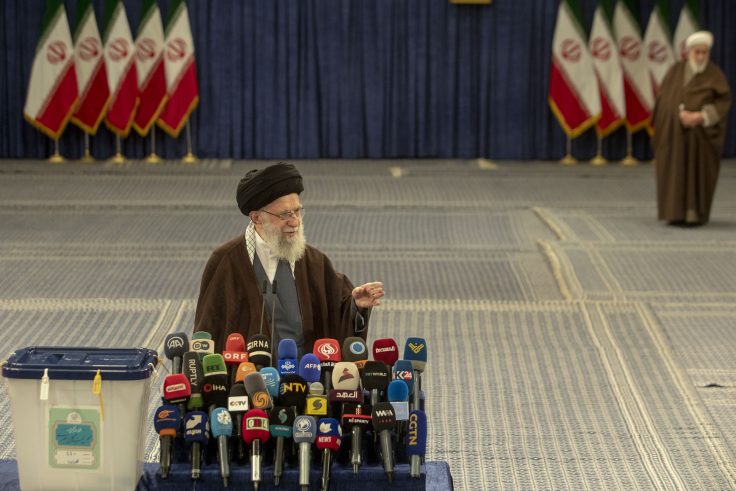
Iranian supreme leader Ali Khamenei threatened to attack U.S. warships in the Middle East as his representatives took part in indirect nuclear negotiations with the United States. At the same time, his security forces fired on civilian crowds gathered in Iran to mourn those killed during the anti-regime protests earlier this year.
"The Americans constantly say that they’ve sent a warship toward Iran," Khamenei wrote on X early Tuesday morning, referring to the USS Abraham Lincoln aircraft carrier and other military assets that President Donald Trump sent to the region. "Of course, a warship is a dangerous piece of military hardware. However, more dangerous than that warship is the weapon that can send that warship to the bottom of the sea."
Just hours after Khamenei issued his threat, Iran International published a video of Tehran’s security forces opening fire on a crowd of mourners gathered in the southern city of Abdanan for a vigil honoring the thousands the regime slaughtered in January. Other videos posted on social media and verified by outlets like Iran International showed civilians screaming as they fled from the gunfire.
Khamenei’s post and news of the attack on mourners came as U.S. and Iranian diplomats wrapped up a round of indirect negotiations in Geneva, Switzerland, meant to address the Islamic Republic’s nuclear weapons program. Iranian foreign minister Abbas Araghchi said the discussions made "good progress" following a session in Oman earlier this month. Iranian leaders, though, have already stated that they will not stop enriching uranium and that their ballistic missile program is not on the table.
The threat from Khamenei and further violence against civilians throws another wrench into the negotiation process. Trump has repeatedly warned the Iranian regime against targeting civilians and has stated that a good deal with Iran would mean "no nuclear weapons, no missiles." Last month, Trump said that "it’s time to look for new leadership in Iran" after a reporter read him a series of social media posts from Khamenei.
Khamenei’s Tuesday comments appeared to refer to the country’s arsenal of anti-ship ballistic missiles. The Islamic Republic’s weapons are smaller and less sophisticated than those the U.S. military employs, but still pose a threat to vessels operating in the region. Behnam Ben Taleblu, senior director of the Iran program at the Foundation for Defense of Democracies, told the Washington Free Beacon that Iran’s anti-ship missile system would be an obstacle to overcome should Trump approve military action against Tehran.
"Tehran has a whole host of asymmetric maritime capabilities like anti-ship cruise missiles and anti-ship ballistic missiles, as well as drones and fast attack craft, that could try to make the narrow environs of the Strait of Hormuz and Persian Gulf a more challenging jurisdiction for the U.S. Navy to operate out of," he said. "The U.S. does have overwhelming firepower, but the regime has been telegraphing over the years that it is willing to try and concentrate its own firepower against larger U.S. vessels."
Also on Tuesday, the Islamic Republic announced a "temporary" closure of the Strait of Hormuz, a critical shipping route, "for live fire military drills" meant to showcase the regime’s capabilities at sea. The Iranian military used live missiles as part of a drill that state-run press said was meant to "assess the readiness of naval operational units" Tehran would use in an attack against U.S. ships within the Strait of Hormuz.
Russia and China will join Iran for drills in the coming days "to test coordination, tactical readiness, and rapid-response procedures in the Strait of Hormuz," state-run media reported. Taleblu told the Free Beacon that the exercises are meant to send a message to the Trump administration about what could happen if talks fail.
"Despite being the weaker party, Tehran is trying to signal that, should negotiations collapse, it is not afraid of a potential military conflict that could come next," he said.
A State Department spokesman told the Free Beacon that the administration is keeping tabs on Iran's moves to fire on civilians and close the Strait of Hormuz.
"Iran would be wise to focus on negotiations," the spokesman said. "The United States is committed to ensuring the safety of international waterways and protecting global commerce that is critical to American safety, security, and prosperity. ... We will continue to support the people of Iran against the regime’s continued abuses and brutal repression."
In the meantime, the United States is sending the USS Gerald R. Ford to the region alongside a group of destroyers to join the Abraham Lincoln and its carrier strike group. Trump warned last month that a "massive Armada" was heading to Iran and would be "able to rapidly fulfill its mission, with speed and violence, if necessary."