




Republican lawmakers are taking the most ambitious federal action yet to shield oil companies from a growing number of state lawsuits and bills that seek to force them to pay billion-dollar penalties related to their alleged role in contributing to climate change.
In state courts, more than two dozen Democratic-led states and cities, which are collectively home to roughly a quarter of the nation's population, have accused dozens of oil companies of misleading consumers about the impact burning fossil fuels has on the climate. The ongoing lawsuits argue oil companies are responsible for paying hundreds of millions of dollars in damages caused by extreme weather—which Democrats blame on man-made climate change—in those states and cities.
And in statehouses, Democrats are pushing laws that require oil companies to pay state coffers to fund environmental resilience and infrastructure repair projects. A dozen states have introduced such laws, and two—Vermont and New York—have passed them. Under New York's law, oil companies will be forced to pay the state $75 billion over the next 25 years.
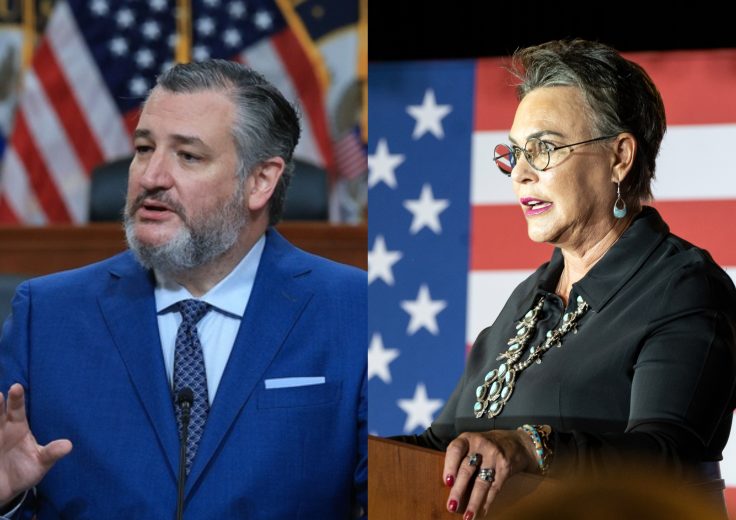
Sen. Ted Cruz (R., Texas) and Rep. Harriet Hageman (R., Wyo.) authored the Stop Climate Shakedowns Act last month, which they say would prohibit such litigation and laws. According to the lawmakers, the increasingly common state actions, while pursued at a local level, ultimately seek to regulate nationwide emissions and enforce a far-left climate agenda on all Americans.
The bill represents Congress's first attempt to rein in the state-level efforts and shield oil companies from climate-related liability. And if successful, it could pull the rug out from under those lawsuits and laws, while eliminating what has emerged as a central pillar of activists' and Democrats' anti-oil climate agenda.
"Through a coordinated campaign by radical environmental groups, our judicial system has been weaponized against American energy producers, including many in Texas," Cruz told the Washington Free Beacon. "Through meritless lawsuits, they're seeking to bankrupt our energy industry, kill good-paying jobs, and drive up the cost of electricity and gasoline for hardworking families."
Cruz said his bill "will stop that abuse and protect American jobs, lower energy costs, and strengthen American energy dominance."
Hageman added that it is "just a really bad idea" to target oil companies. Democrats, she said, have resorted to these efforts after failing to pass carbon tax and cap-and-trade legislation at the federal level.
"We need energy to power our economy," Hageman said in an interview. "But you have a very small number of people who are in leadership roles making the decisions to do this that have the ability to destroy the energy climate for everybody and make all of us poor."
"It will increase the cost of food, transportation, housing—if they succeed, it will increase the cost of everything that we need for a modern society," she continued.
The majority of cities and states involved in the effort, meanwhile, employ the same outside law firm, the San Francisco-based Sher Edling. That firm is funded by left-wing environmental-focused nonprofits, a scheme that has sparked ethics concerns among lawmakers and at least one IRS complaint.
Overall, since 2018, states including California, Delaware, Hawaii, Minnesota, and New Jersey, and cities including Chicago, Honolulu, San Francisco, and New York have all filed similar lawsuits against oil companies. Some of the suits, like Honolulu's, are farther along and fast-approaching a potential trial.
While some state courts have allowed the cases to proceed, some have thrown them out of court. Earlier this year, the Supreme Court of Maryland tossed lawsuits brought against more than a dozen oil companies by the City of Baltimore, Anne Arundel County, and the City of Annapolis. The court's majority opinion stated that seeking to use state courts to reduce worldwide greenhouse gas emissions "is so far afield from any area of traditional state or local responsibility that it cannot be seriously contemplated."
The Supreme Court is slated to hear another case, filed by the City of Boulder, Colorado, in the coming months. Depending on how the High Court rules, it could have significant ramifications for the cases that remain pending.
Environmental groups have sharply criticized Cruz and Hageman's bill, saying it provides "immunity" to oil companies. The Center for Climate Integrity, a well-funded group that has supported lawsuits against oil companies, for example, has organized a campaign alongside several other prominent activist groups to oppose the legislation. They argue it gives the oil industry "blanket immunity from any laws or lawsuits that could hold them accountable."
But John Shu, a constitutional law scholar who worked in both Bush administrations, pushed back on that argument and said the legislation should be able to withstand constitutional challenges.
"The bill doesn't shield American energy producers if they engage in intentional wrongdoing," Shu noted. "In that case, they can still be sued for their wrongful behavior, assuming the plaintiffs have actual and sufficient evidence of the alleged wrongdoing."
"The Constitution's structure gives the federal government, not the individual states, the power to regulate interstate, national, and international issues, which include greenhouse gas emissions and 'climate change.' Besides, it wouldn't be right for one state to determine or regulate the policy of another state," Shu added.