


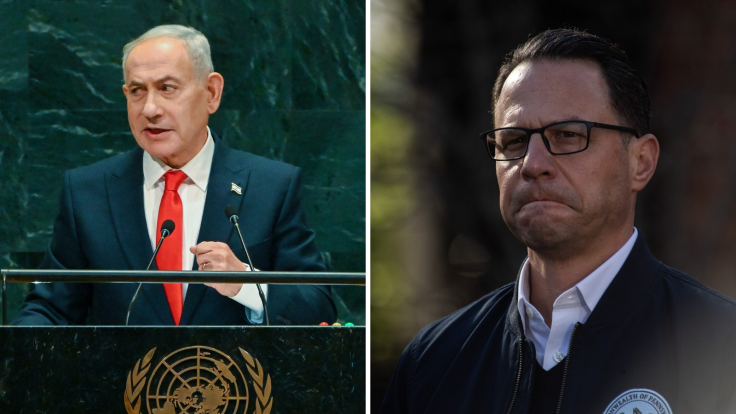
Governor Josh Shapiro of Pennsylvania—a likely 2028 Democratic presidential contender perceived in some circles as a pro-Israel moderate—used a recent debate in his own re-election campaign to call on Israeli voters to dump Prime Minister Benjamin Netanyahu.
During the debate, held on October 7, the anniversary of the terrorist attack on Israel, Shapiro said, "The people of Israel here in another couple weeks will determine who their leader should be. I hope it's not Benjamin Netanyahu. I think he has led Israel down a very dangerous and isolated path. I want America to have a strong relationship with Israel and with the Israeli government. That's not possible right now with the Netanyahu government in charge."
The national president of the Zionist Organization of America, Morton Klein, a Pennsylvania resident who has known Shapiro for 30 years, told the Washington Free Beacon that Shapiro’s comments were "shameful" and "disgraceful," driven by Shapiro’s own personal political ambitions.
"What has Netanyahu done to deserve that comment?" Klein asked. "What is he talking about?"
"Shapiro is not a friend of Israel," Klein said. "He is nothing but a political animal. That’s all he cares about."
The comments mark at least the second time this year that Shapiro has made news by publicly distancing himself from Netanyahu. In an April interview on the All-In Podcast, Shapiro suggested that Netanyahu "bullied" President Trump into war with Iran.
"America should never be led around by any other nation. … We should never ever be bullied as maybe President Trump was by any other world leader," Shapiro said then.
"I’ve been supercritical of the Israeli government, the Netanyahu government, and I’m someone who loves Israel," Shapiro said then. The Pennsylvania governor faulted Netanyahu for having "fractured really what used to be a nonpartisan or bipartisan American support for Israel, and I think he has put Israel in a very dangerous place, and of course, he was the leader of Israel who wasn't minding the shop when October 7th happened. So I’ve been very critical of Netanyahu for years and years and years."
It’s an illuminating situation that casts some doubt about Shapiro’s claim that it’s Netanyahu, rather than Democratic voters and politicians, that have caused any weakening of the U.S.-Israel relationship. Shapiro went to Jewish day school, proposed marriage to his now-wife on a trip to Israel, was the target of an antisemitic firebombing in the governor’s residence on Passover, has a sukkah at the governor’s residence, and says that when he was being vetted as a possible vice presidential choice by Kamala Harris in 2024, a Harris campaign official asked him if he’d ever been an agent of the Israeli government.
Yet rather than maintain a judicious silence in advance of the Israeli elections scheduled for October 27, 2026, out of respect for Israeli democracy and the Jewish state’s longest-serving leader, Shapiro opened his mouth. It’s unlikely to sway any Israeli voters against Netanyahu. It might even stiffen the resolve of others who don’t want their national leadership chosen by Shapiro, a former "Jews for Obama" leader in a foreign country thousands of miles away. And if Netanyahu does win re-election and Shapiro by some miracle prevails in a Democratic primary against Alexandria Ocasio-Cortez and other contenders, it will only complicate any future Shapiro-Netanyahu relationship. The audience seems less Israeli voters than American Democratic presidential primary voters, who hate Netanyahu almost as much as they hate President Trump.
It’s also not clear that the problem Shapiro and other Netanyahu-bashers have is really with Netanyahu or, rather, with the Israeli public that elected him. Any candidate elected as an alternative to Netanyahu is unlikely to pursue dramatically different security policies. Some of the anti-Netanyahu politicians have already been talking in recent days about, if they win, including Netanyahu in a governing unity coalition rather than relying for a parliamentary majority on Arab parties or fervently religious Jews who don’t serve in the army.
Shapiro, who faces Republican state treasurer Stacy Garrity in the Pennsylvania governor’s race, has not campaigned publicly alongside the Michigan Democratic Senate nominee Abdul El-Sayed. Shapiro did, however, appear in a video with Michigan Governor Gretchen Whitmer and say, "This November, let’s elect Democrats all across America, and here in Pennsylvania … up and down the ballot … from Pennsylvania to Michigan, I hope you’ll join us."
Netanyahu has ties to the Keystone State. He attended high school in Elkins Park, Pennsylvania from 1963 to 1967, before Shapiro was born.
Shapiro is only the latest Democratic politician to bash the Israeli leader.
Another 2028 likely candidate, Gavin Newsom, also recently denounced Israel and Netanyahu, though he later said he regretted using the phrase "apartheid state."
The Democratic leader in the U.S. Senate, Chuck Schumer of New York, is frequently described by President Trump as "used to be pro-Israel" and now "like a Palestinian." Schumer gave a major Senate speech in April 2024 that, while paying lip service to the notion that "As a democracy, Israel has the right to choose its own leaders," also called for the downfall of Netanyahu’s government and described him as an obstacle to peace. He described Netanyahu as "stuck in the past" and said "he has shown zero interest in doing the courageous and visionary work required to pave the way for peace, even before this present conflict." If Shapiro winds up running against Trump in 2028, maybe Trump will call Shapiro a Palestinian, too. Trump might even claim in such a situation that he’s the lone pro-Israel candidate in the race.