

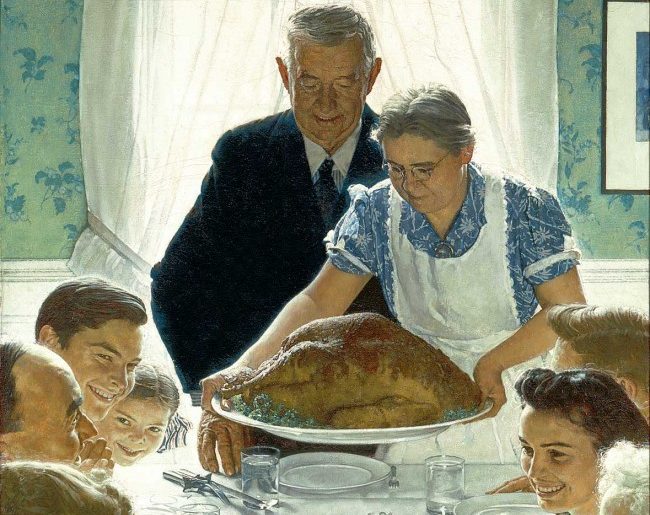


Thanksgiving is just around the corner, and like a horde of locusts, a host of tendentious think pieces about how to argue with loved ones about politics will descend. But much like the wedding in Monty Python and the Holy Grail, this family-themed holiday is supposed to be a happy occasion. So instead of bickering and arguing about who killed who, try spending Thanksgiving remembering and celebrating one of the greatest American traditions: Zionism.
Americans have held this holiday in special regard for decades. George Washington and Abraham Lincoln each have a claim for instituting it nationally, but Thanksgiving is significantly older than the United States. Most famously, the Pilgrims thanked the Almighty in 1621 for their first successful harvest. Some Virginians grumble that, since their colonists had a similar service nearly two years earlier, Old Dominion should have pride of place in the Thanksgiving story.
Many Americans are familiar with the origin story of the early Puritans, who reached Plymouth just before the dead of winter and barely made it to the spring. They may also know that the first settlers in Massachusetts had become convinced that there was no place for their religious views in England and so they sought out a new land where they could live and worship as they saw fit. But few know that, thanks to the early Puritans, Zionism is as American as pumpkin pie.
The early Reformation was not very good for Jews. Martin Luther initially criticized the antisemitism that was all too common among Christians at the time, but he became a ferocious critic of the Jewish people once it became clear they would not convert en masse to his church.
The Anglo-American branch of the Reformation grew in a healthier direction. As they read their Bibles, many English reformers became convinced that many of the Old Testament covenants still applied to the descendants of Abraham, Isaac, and Jacob. They too hoped for large-scale conversions, but they believed Jews still had a special place in the divine plan.
Some took this analysis a step further and concluded that part of God's plan for the children of Israel was to restore their homeland in Israel. Increase Mather stated in 1666 from the pulpit to the largest and oldest congregation in Massachusetts that the Jews would "recover the Possession of their Promised Land." Jonathan Edwards, one of the most significant figures in pre-revolutionary America, wrote, "and it is the more evident, that the Jews will return to their own land again."
Support for Jewish statehood has been a fixture in American public life ever since. John Adams wrote that he wished to see a Jewish acquaintance at the head of an army of coreligionists on their way to the Holy Land. Five years before Theodor Herzl wrote The Jewish State, many of the most prominent Americans signed the Blackstone Memorial asking President Benjamin Harrison to diplomatically assist plans for Jewish statehood. The Lodge-Fish resolution endorsing the Balfour Declaration sailed through Congress. Zionism was one of the few subjects on which liberal icon Eleanor Roosevelt and "Mr. Republican" Robert Taft agreed.
The sources of American Zionism are as diverse as the country itself. For some, their reading of Scripture prodded them to champion Jewish statehood. Others were deeply grateful for the blessings of liberty they enjoyed and wanted to see other peoples taste similar fruits under their own flags. And still more were revolted by the persecutions Jews suffered, even before the Holocaust, and wanted to right this great historical wrong.
That is not to say every American heart filled with longing for a Jewish state, nor that all Americans looked fondly on their Jewish neighbors. But they were on their back heels. George Washington reassured his Jewish fellow citizens, "It is now no more that toleration is spoken of, as if it was by the indulgence of one class of people, that another enjoyed the exercise of their inherent natural rights." The United States would not merely tolerate them, but accept them with open arms.
Americans have reaped enormous dividends from these two legacies, Zionism and philosemitism. One has given the American people a powerful friend in a strategically important part of the world. The other has inoculated the United States from one of the most self-destructive forms of ignorance and bigotry.
Today, though, some want to renounce this precious inheritance. Under a variety of slogans, such as claiming to support "heritage Americans," shortsighted bigots want to jettison some of this country's oldest and greatest traditions.
As Washington put it, "the Citizens of the United States of America have a right to applaud themselves for having given to mankind examples of an enlarged and liberal policy. … For happily the Government of the United States, which gives to bigotry no sanction, to persecution no assistance requires only that they who live under its protection should demean themselves as good citizens, in giving it on all occasions their effectual support."
This week is for appreciating and expressing gratitude for the great and good things in life, such as America’s heritage. The next, and every following one, is for defending it.