

"If it is just us," the celebrated astronomer Carl Sagan supposedly once said, "it seems like an awful waste of space."
The past century has seen plenty of rational arguments for the existence of intelligent life beyond Earth, along the lines of Sagan's inference. But it's also witnessed an ample number of observations and contentions about aliens that strain credulity, to say the least.
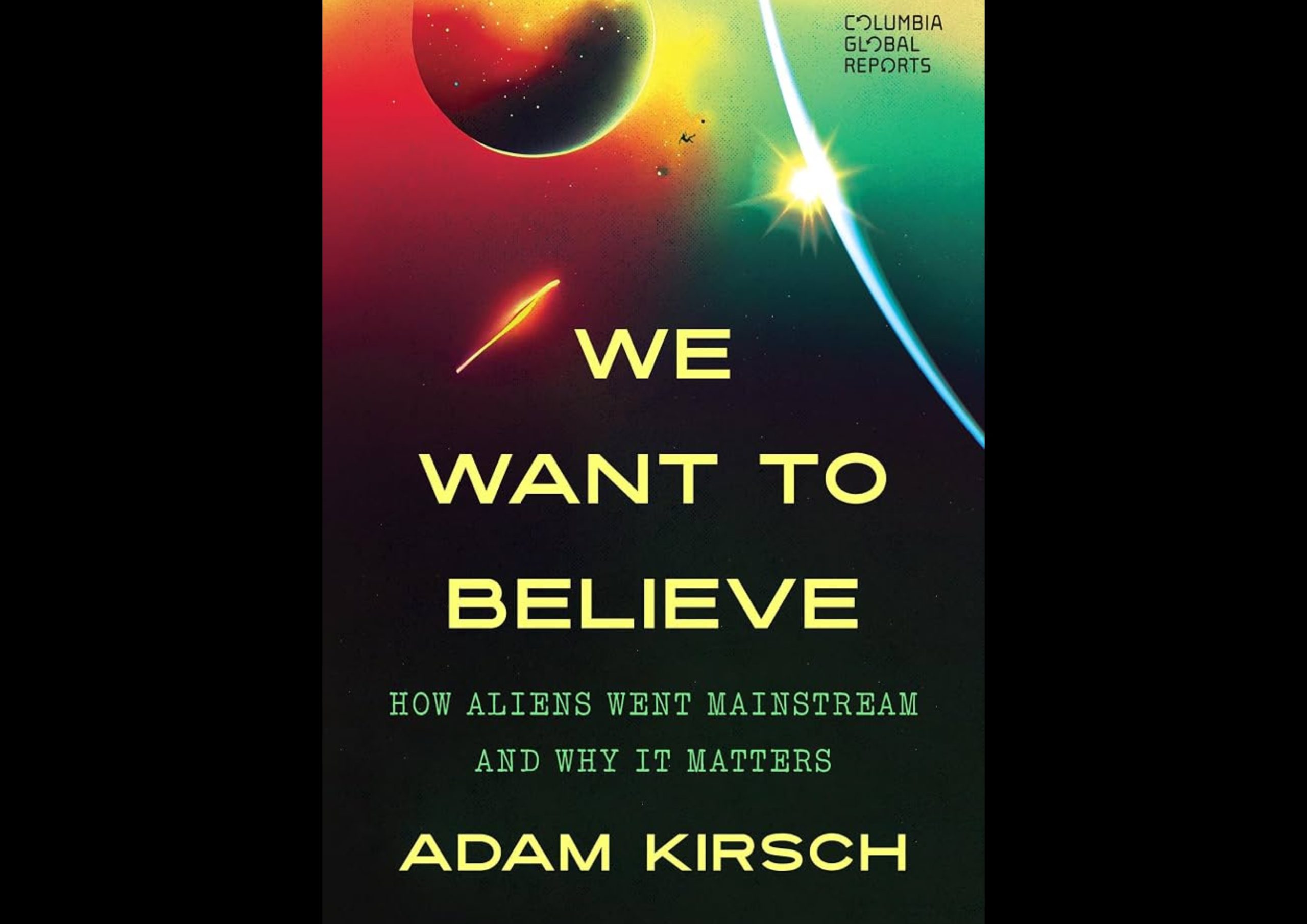
In We Want to Believe, the cultural critic Adam Kirsch's concise, illuminating study of contemporary trends in supposed extraterrestrial encounters, we engage the rational and the irrational at once and, thanks to the author's limpid prose and persuasive analysis, come to understand how and why alien belief has proliferated in today's society. "The moAlst interesting thing about aliens," Kirsch contends, "is what we reveal about ourselves when we talk and think about them."
Actual human-alien encounters, of course, remain the stuff of science fiction and grainy, ambiguous recordings. "We have yet to find evidence that life exists anywhere except on our planet," Kirsch writes, "but this has never stopped human beings from imagining alien beings and hoping to encounter them." And while humanity has speculated about interplanetary species for centuries, Kirsch finds that scientists are "increasingly confident that humanity will discover extraterrestrial life," even as "public opinion on the subject has changed significantly, with more Americans than ever saying they believe the Earth has been visited by aliens."
UFOlogy itself originated in the mid-20th century with the emergence of commercial aviation. The United States Air Force commissioned Project Blue Book in 1952 to study alleged sightings of unidentified flying objects, ultimately concluding that "nothing has come from the study of UFOs in the past twenty-one years that has added to scientific knowledge." Congressional hearings, including recent ones, on what are now more charitably called unidentified anomalous phenomena (UAPs) have also revealed very little of provable value. Decades of radio telescope transmissions, SETI projects, and interplanetary probes haven't turned up much either.
Still, the desire for transcendence persists. Kirsch invokes Heidegger's philosophy of the unknown and applies it to putative alien encounters. "When something appears out of place in the sky," Kirsch explains, "it is profoundly disorienting." Only by naming these phenomena can we begin to restore our sense of balance and assimilate unfamiliar experiences into our reality—what Kirsch elegantly labels "domesticating its unknowability."
But along the way, he argues, we improperly conflate evidence with testimony; apart from inconclusive audio and photographic recordings, the only support for extraterrestrial encounters comes from inherently unreliable human recollections of sightings, abductions, and even the occasional anal probing. We also render alien life in human terms and confine it into human categories—a natural tendency, since these are the only conceptual boxes we truly understand. "All our thinking about aliens and how to find them," Kirsch posits, "is best understood as humanity's evolving self-portrait."
Kirsch surveys numerous instances of "contact" and the multifarious approaches scientists and laypeople have adapted to understand them. Among these, the author meticulously examines, and ultimately rejects, the claim by the controversial Harvard astrophysicist Avi Loeb that the Oumuamua object detected in October 2017 in the skies above Hawaii's Haleakala Observatory could have been a "lightsail" spacecraft dispatched by extraterrestrials. Loeb's epistemological project, in Kirsch's eyes, wrongly "implies that our beliefs about the world should be determined not by evidence of how the world actually is, but by how we would like it to be."
This sensibility jibes cleanly with contemporary cultural and scientific debates like those over COVID, vaccines, and nutrition, where a vocal, impassioned cadre of activists who’ve "done their own research" vigorously challenges consensus views. Many people want to believe—the title of Kirsch's book, which he borrowed from the tagline of the 1990s-era sci-fi drama The X-Files—in a quasi-religious way. "Perhaps that is what humanity really needs from extraterrestrials," Kirsch posits. "Not conclusive proof of their existence, but a sense of possibility."
Indeed, in an increasingly secular and polarized age, on a planet shrunk by technology, humans crave something that might unify us all. "At a moment," Kirsch asserts, "when all kinds of previously taboo ideas are going mainstream—from xenophobia and vaccine denial to the suppression of speech and the acceptability of political violence—UFOs raise questions that all of us have to confront, whether we believe in them or not." They implicate the role of scientific expertise in public policy, the relationship between the individual and the community, and the importance of the unmediated human experience of the universe. While neither Kirsch nor anyone can resolve these competing forces, We Want to Believe skillfully presents them for our careful consideration.
We Want to Believe: How Aliens Went Mainstream and Why It Matters
by Adam Kirsch
Columbia Global Reports, 128 pp., $18
Michael M. Rosen is an attorney and writer in Israel, a nonresident senior fellow at the American Enterprise Institute, and author of Like Silicon From Clay: What Ancient Jewish Wisdom Can Teach Us About AI.