

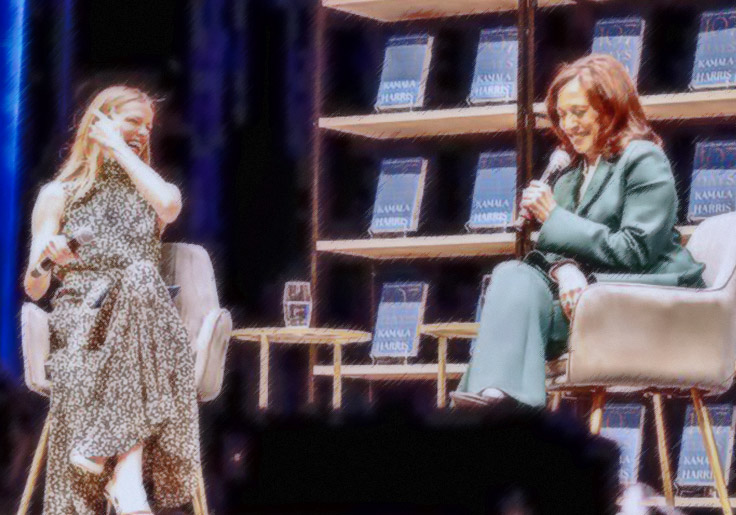
CHARLOTTE—Kamala Harris is technically still on tour promoting 107 Days, her critically panned campaign memoir that came out almost seven months ago. Copies of the book adorn the stage at Ovens Auditorium, but no one wants to hear her rehash petty grievances from a lost election in what feels like the distant past. Maybe that explains the empty seats.
A lot has happened since early February, when Harris was originally scheduled to appear in Charlotte before canceling due to winter storms. There's war in Iran and chaos in California—specifically the governor's race Harris almost joined. Now she's being urged to reconsider—filing deadlines notwithstanding—after the Democratic frontrunner, Eric Swalwell, quit the race and resigned from Congress amid allegations of sexual assault.
Harris doesn't want to talk about that either, or say anything that might seem newsworthy. If she wanted to answer probing questions on the spot, she would have chosen a different moderator. Harris was joined on stage Wednesday by Brooklyn Decker, a former swimsuit model who publicly supported Harris's campaign. She doesn't even bother to ask if Harris is thinking about running for president again. That might ruin the vibe.
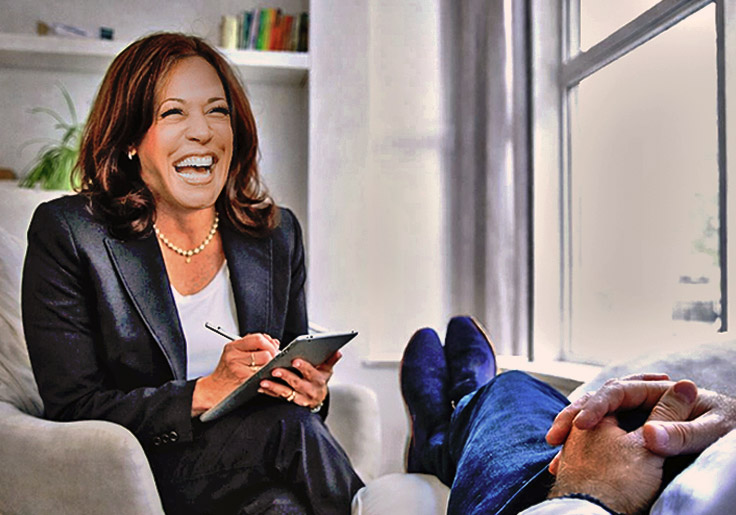
This is a therapy session, not a promotional event. Harris is just cashing checks, and doing her best to fill the hour. Decker serves up a series of softballs inviting her to denounce Donald Trump. Harris holds forth in her signature style—panicked college student midway through an oral report on a book she hasn't read, stalling for time.
Whereas her potential 2028 rival Gavin Newsom might say something like, "Orange man poop," Harris can't help but ramble semi-coherently, even when Decker invites her to sound off on Trump's ongoing feud with the pope. "Part of what we have always believed, we know that individuals are flawed—they're all flawed—but we have a right to expect that an individual who is such a leader, at such a level would assume a responsibility—flawed though they may be, imperfect, though we all are, that they would assume some responsibility for moral leadership," she explains, sort of.
If Harris has a coherent thought about the war in Iran, she declines to share it when prompted. She defaults to word salads and stale talking points, evoking memories of the campaign. "You look at what is happening with this administration on the issue of foreign affairs, and by extension, because anything that relates to our foreign affairs, at some point, directly or maybe a bit indirectly, relates to our national security," Harris says. "I served as vice president of the United States. During that time, I met over 150 world leaders—presidents, prime ministers, chancellors, and kings."
In a sign that Harris is not seriously considering another White House run, she declines to denounce (or even mention) the State of Israel. She'll never survive a Democratic primary with that kind of attitude. Decker wonders if Trump started bombing Iran to distract from the Epstein files. Harris, not interested in taking the bait, says she doesn't know. What she does know is that Trump "creates distractions to distract from the fact that he is incompetent and corrupt." The crowd erupts in ecstasy. Now the healing can begin.
Harris is feeling good about the coming midterms, but not so good about all the "cheating" Republicans are doing to rig the results. People ask her all the time what gives her hope, and the answer is young people. That reminds her of freshman orientation, when volunteers handed out goodie bags with toothpaste and deodorant, among other things. "And the reason is because the companies know, let's get them right now, because they'll be committed to that product for the rest of their lives," Harris cackles maniacally. "And I actually am. I won't tell you the brand." So begins a meandering diatribe about the alleged Republican plot to stop college students from voting, which is exactly like Jim Crow.
The former vice president boldly suggests, in her most sincere impression of a new age healer, that our politics would improve if we could all just get along. "We cannot give up on each other," she says in response to a question about whether "truth is dead." In soothing tones, she implores the audience to combat misinformation by educating their ignorant Republican friends in the fashion of a mother comforting a crying toddler.
Harris envisions a "project of civic renewal" that involves getting "back to a priority that we collectively are invested in and engaged in around building back up a sense of community and connection," whatever that means. She remains the undisputed queen of using the most amount of words to say so little. We are almost out of time.
Decker reads a question from the audience. Jayla is a 24-year-old aspiring leader seeking advice for people like her "who are still learning to believe their own voice matters." Harris leans forward in her therapist's chair. She tells Jayla to stand up. To the surprise of at least one audience member, Jayla is a real person. The crowd goes wild, and Harris dispenses the pablum.
"Remember that, what you just heard, OK?" she tells the aspiring young leader. "You've got to remember that when you're in any room and you have something to say, something to share, based on who you are, what you care about, your experiences. And you might feel like you're the only one in the room who has those experiences, or those thoughts, or looks like you. I want you to hear that applause that you just heard."
And that's our time for today. The event concludes precisely 59 minutes after Harris walked on stage.