


Roy Cohn, who burst onto the national political scene in the 1950s by pursuing communists, first in the trial of Julius and Ethel Rosenberg and later as chief aide to Senator Joseph McCarthy, transformed himself in the 1960s and '70s into a take-no-prisoners divorce lawyer and mouthpiece for Mafia bosses, and then served as a mentor to an up-and-coming New York developer named Donald Trump.
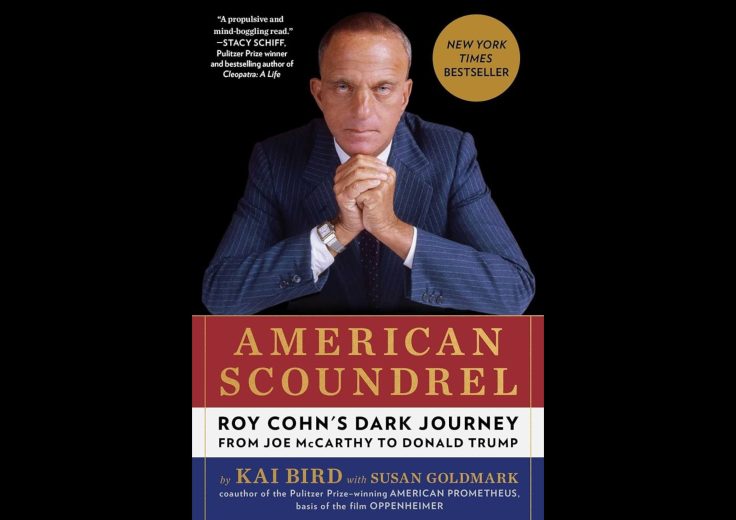
Through it all, he cultivated a sneering, brash confidence, relishing the opportunity to lie about matters large and small, refusing to stay within whatever limits the law or propriety or common decency prescribed, and never apologizing or backing down. A sexually active homosexual, he opposed laws designed to protect homosexual rights. A self-proclaimed patriot, he evaded the draft. For most American liberals he was, Kai Bird and his wife, Susan Goldmark, write in American Scoundrel: Roy Cohn's Dark Journey From Joe McCarthy to Donald Trump, "a nefarious actor in one unseemly drama after another from the dark side of the American Century."
Bird and Goldmark pepper their account of his life and times with a cornucopia of insults: "the ghoul of our nightmares," "charming but also obnoxious," "a serial fabulist," "a disciplined hypocrite." They document a tax cheat who routinely stiffed creditors, large and small, a serial leaker to gossip columnists, and "a rogue always on the make." Even if only half of the stories they retell are true—and there is good reason to doubt many of them—he was a profoundly amoral, and often immoral human being. He was tried three times for felonies ranging from extortion to bribery to perjury but was acquitted every time, in part because the government had to rely on sleazy co-conspirators.
He was generous, although his generosity was usually transactional. He expected favors to be repaid and banked them. And the loyalty he prized above all else could be—and often was—given to and received from morally compromised people. Cohn particularly admired mobsters because they were loyal, "stand-up guys." During one period in the 1970s Cohn represented every one of the leaders of the five major New York Mafia families. Even criminals deserve lawyers, of course, but Cohn admired these clients; while they had a "penchant for violence," their "word was good." Of one, Fat Tony Salerno, Cohn enthused that "I have found him to be a warm, decent human being. … He's refined. A quiet, peaceful person." Cohn described Carmine Galante, a stone-cold killer whom he represented on a number of occasions, as "a quiet gardening man I know, who is devoted to a small circle of close friends and family."
Cohn was born in 1927. His father was a New York judge whose long career on the bench was facilitated by his steadfast loyalty to the Democratic patronage machine in the Bronx and his wife's wealthy family of bankers. Growing up as an only child in Park Avenue luxury, Roy was the apple of his mother's eye. She spoiled him rotten and never set any boundaries on his behavior. He was an ardent New Deal Democrat and a nominal Jew whose family attended synagogue twice a year.
Cohn skipped his senior year in high school and attended Columbia University after his parents pulled strings to get him admitted. After graduating, he used his father's connections to get appointed as an assistant U.S. attorney in the Southern District of New York at the age of 21, even before he was old enough to take the bar exam. Within a year, his new assignment had him involved in several cases dealing with the Communist Party, including the prosecution of Alger Hiss. Cohn was already an ardent anti-communist; he had joined the American Jewish League Against Communism.
Bird is either scornful or skeptical of the government's legal assault on the CPUSA. He ignores the new evidence indicating Alger Hiss was guilty of perjury for denying he knew Whittaker Chambers, merely noting that "historians are still hotly debating the case." He sympathetically paints William Remington for telling "a little white lie" about his dealings with Soviet agent Elizabeth Bentley, a disastrous choice that sent him to prison, and insists "no further evidence has emerged to suggest that Remington could have been convicted of espionage," despite a KGB document that surfaced after the collapse of the USSR that gave his code name and listed him as a source. For Bird, "the communist threat [at home] was negligible."
When it comes to the Rosenberg case, in which Cohn played a major role as a prosecutor, Bird emphasizes Cohn's improper ex parte communications with the judge, insists Julius was a minor spy, and that Ethel Rosenberg was "not a working accomplice." KGB documents, however, detail Julius's extensive spy network passing along secrets about radar, sonar, jet propulsion, and proximity fuses, and another, written by him, demonstrating Ethel had persuaded Ruth Greenglass to recruit her brother, David, to spy from Los Alamos.
The most notorious portion of Cohn's life came when he worked as chief counsel to Joe McCarthy's Senate Investigating Committee from 1953 to 1954. Far smarter and more strategic than McCarthy, Roy later modestly admitted that he was McCarthy's brains. His recklessness, however, contributed to McCarthy's downfall. Cohn had formed a close bond with David Schine, son of a wealthy hotel magnate. When the two of them toured U.S. Information Service Libraries in Europe, their antics, including efforts to censor books written by communists or communist sympathizers, generated widespread ridicule. Cohn tried to get Schine exempted from the military draft; when that failed he badgered Army officials to extend him special privileges. Despite rumors that Cohn and Schine were lovers, Bird argues that Cohn was just besotted with the handsome, but somewhat dimwitted Schine.
The conflict with the Army escalated into a full-blown war with McCarthy and Cohn lobbing charges of communist sympathies at Army officials and culminated in televised hearings during which McCarthy's boorishness cratered his public support. As the senator descended into alcoholic irrelevance after his censure by his Senate colleagues, Cohn moved back to New York to reinvent himself as a prominent figure in local politics and the gossip columns.
There is plenty of gossip in this biography, which makes for lots of juicy stories, although how true all of the stories were, is another matter. Susan Rosenstiel, estranged wife of the liquor baron Lewis Rosenstiel, had a long-standing hatred of Cohn stemming from his role representing her husband during their divorce. She peddled stories of seeing Cohn in bed with her husband, and of attending a sex orgy at the Plaza Hotel where she recognized J. Edgar Hoover "in full drag, sitting with his legs crossed, wearing a fluffy black dress, lace stockings with high heels, and a black curly wig." Bird dutifully quotes critics of both Cohn and Hoover, who gave the tale short shrift, but refuses to dismiss the claim, noting that "whether true or not, many of our fellow citizens want to believe them."
This example also illustrates the difficulty of writing about a man who deliberately avoided taking notes or leaving a paper trail and delighted in spreading rumors. There is enough in the lives of Roy Cohn and J. Edgar Hoover to criticize without believing some of the wilder, uncorroborated smears that abound in this account. It is unfortunate that Bird emphasizes the sometimes-questionable tactics they employed while ignoring the documentary evidence that makes clear that the anti-communist trials of the 1940s and '50s vindicate many of their claims.
The end of Cohn's life was of a piece with how he had behaved for decades. When Lewis Rosenstiel was comatose and dying, Cohn had shown up at his bedside. He put a pen in his hand and guided it to scrawl some lines that were supposedly a signature to a codicil to his will, making Roy the executor of his estate. That episode later cost Cohn his law license shortly before his death in 1986. Although he died from AIDS, Cohn resolutely refused to admit he had the disease—he told friends he was suffering from liver cancer. To the end he refused to admit that he was gay because he associated it with weakness. "Every facet of my personality, of my aggressiveness, toughness and everything along those lines" was incompatible with being gay. And yet, he reveled in having unprotected sex virtually every night.
The truth about Roy Cohn is damaging enough without retailing gossip and third-hand stories about his supposed exploits. He was an unattractive and deeply flawed man. Donald Trump, like Cohn, has no core beliefs but only resentments. That Cohn taught Trump how to construct an alternative universe in which telling the truth and behaving honorably are neither necessary nor desirable is a mark of the degeneration of our political culture.
American Scoundrel: Roy Cohn’s Dark Journey from Joe McCarthy to Donald Trump
by Kai Bird with Susan Goldmark
Scribner, 528 pp., $32
Harvey Klehr is the author of numerous books and articles on communism and Soviet espionage.