





Since its inception as an academic discipline, criminology has concerned itself first and foremost with the question of why people commit crime. Beginning with their earliest research, criminologists gathered extensive data on large groups of people to try to disentangle which variables predicted offending. With sufficiently large samples and adequate measurements, these criminologists thought, they could determine why some people commit lots of crime, while others commit none at all.
Over time, the discipline has evolved into different schools of thought on this question. To oversimplify, there are two major tendencies. Some criminologists identify the fundamental determinants of criminal behavior as a feature of the criminal himself—a criminal "propensity" or "tendency" or "character," often with special emphasis placed on self-control as the critical variable. Others argue crime is caused by the criminal's social or identity status, arguing that intersecting forces like race, class, and wealth determine who is and is not a criminal. (You can guess how these tendencies cash out politically.)
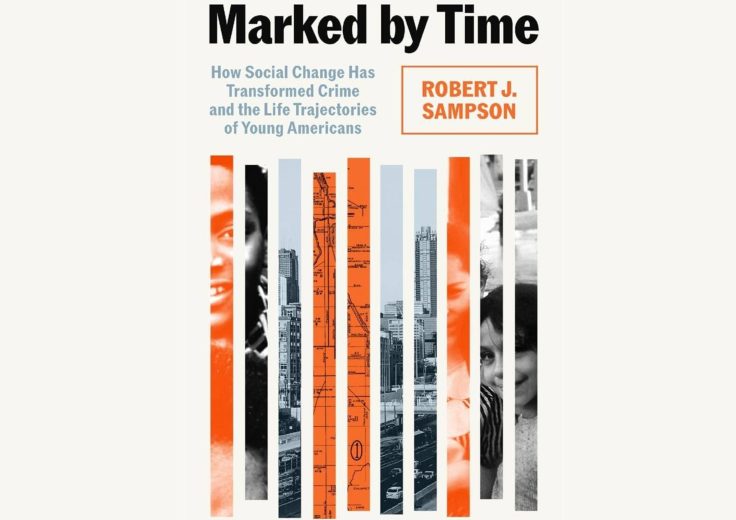
Marked by Time, the new book from Robert J. Sampson—Harvard sociologist and former president of the American Society of Criminology—is an attempted intervention into this debate. Sampson's central point is that both sides err by focusing on the unchanging characteristics or situation of the individual. Rather, to understand why some commit crime and others don't, we should look more carefully at the character of society when a would-be offender hits his peak years for criminal offending.
The work Sampson did to reach this conclusion—a multi-decade study of thousands of Chicagoans—is impressive. But the reader is left wondering whether his conclusion is a radical one or a truism. That said, whether he intends to or not, Sampson does an excellent job demonstrating why the entire exercise of determining why people commit crimes—the central enterprise of criminology—is essentially misguided.
Marked by Time is first and foremost a culminating summary of Sampson's work on the Project on Human Development in Chicago Neighborhoods (PHDCN). That project began in the mid-1990s, when Sampson and a team of 120 researchers enrolled some 6,000 children between the ages of 0 and 18 in their study. The researchers deliberately selected seven birth-year "cohorts," identifying children at ages 0, 18, and each of the ages at three-year intervals in between.
This initial enrollment was the first "wave" of PHDCN. Sampson and his team collected another wave 2.5 years later, and a third wave 2.5 years after that. The project languished for a number of years, but after a decade, Sampson and a colleague collected a fourth wave from a subsample of the original respondents. Finally, they collected a fifth wave in 2021, capturing 682 of the original 6,200 participants.
As Sampson notes, many criminological studies look at people of many different ages over a single year, or follow one group over many years. But relatively few criminology studies follow people of different ages over many years, allowing the researcher to disentangle the effect of age, year of birth, and current year on outcomes of interest.
What's the use of such "cohort" studies? Recall that criminological theories—both of the character school and the social status school—tend to suggest that crime derives from features of the individual. That would imply that criminal outcomes should be cohort-invariant: How likely you are to commit a criminal offense should be dependent on whether you have low self-control or are poor, not when you were born.
What Sampson observes, by contrast, is that there are actually quite large differences in rates of offending—as measured by arrest rate—between his different cohorts. PHDCN participants born in 1980 were about twice as likely to be arrested in their peak offending years (around age 20) as were those born in 1995. These disparities persist even after introducing statistical controls that account for demographic and other differences between cohorts.
Just as importantly, these cohort disparities persist even within different "kinds" of offenders. For example, more socioeconomically disadvantaged participants were more likely to be arrested than less disadvantaged ones—evidence for the view that disadvantage causes criminal behavior. But there are large cohort differences within the disadvantaged and advantaged groups: A disadvantaged project participant born in the 1980s was about twice as likely to be arrested as a similarly disadvantaged participant born in the 1990s.
The same pattern obtains for self-control, the variable commonly cited as central to character-based theories of crime. High self-control participants are indeed less likely to be arrested than low self-control participants. But a high self-control participant born in the 1990s faces the same arrest risk as a low self-control participant born in the 1980s. Again, the cohort matters.
Sampson's inference from this is that arrest risk is not solely dependent on individual characteristics. Rather, variation in the larger social environment is another key determinant, such that (for example) a boy coming of age in the 1990s has a dramatically different arrest risk from a boy coming of age in the 2000s. Cohort effects, in Sampson's telling, are proxies for broader social phenomena.
Which social phenomena? "Two broad sets of factors—institutional changes in law enforcement practices … and behavioral changes in crime … —each account for about half of the cohort divergence in arrest trajectories," Sampson writes. Earlier PHDCN cohorts aged into a different crime and policing environment than did later ones. Those born in the 1980s came of age amid the intensified policing and still-high crime rates of the 1990s, which drove their arrest risk up. Those born a decade later came of age in the less-policed, lower-crime 2000s, which means they were arrested far less.
The amount of work required to reach this conclusion is, of course, impressive on its own, the culmination of a remarkable and important career. Still, a reasonable reader might ask: So what? Yes, cohort effects matter. But what do we do with that information? It is here, unfortunately, that Marked by Time grows somewhat confusing.
To be sure, Sampson draws some good conclusions. The best of these is that criminal risk-assessment tools—which use statistics to predict whether a given offender is likely to reoffend—can't be built on individual characteristics alone. Sampson shows that a tool trained on the data from PHDCN participants born in the 1980s dramatically overestimates the arrest risk of those born in the 1990s. Assessment tools calibrated on one cohort are not necessarily valid for another—an important consideration in designing algorithms that increasingly decide who does and doesn't lose his liberty.
But beyond this, Sampson seems at different points to be making enormous claims and making very little claim at all. Much of Marked by Time is framed as a rebuttal to the "character" theory of crime, including a highly debatable chapter that excoriates the use of character and its proxies in criminal sentencing. Yet elsewhere, Sampson repeatedly concedes that character is an important determinant of crime—a conclusion supported not only by bountiful research, but by his own data, which show a large effect of self-control on offense risk.
Sampson's case against character, moreover, is undermined by the design of his analysis. Note that Sampson does not measure actual criminal offending, but rather uses arrest as a proxy. This is understandable—it's much easier to find out how many times someone has been arrested than how many crimes he has actually committed.
But Sampson then goes on to observe that the cohort differences in arrest are associated with changing arrest rates. Yet obviously, if society-wide arrest rates go down, then individual risks of arrest will go down mechanically, regardless of whether or not actual offending declines. That's not a devastating blow to the character view. It's a tautology.
While Sampson claims to believe character matters for offending—a view, again, that his data support—it's hard to square that with his broader policy conclusion. Take the argument in the book's last paragraphs: that because social effects determine arrest risk, we should try to reduce crime by changing society, not by changing people.
"If we truly want to elevate character," Sampson writes, "we should do so first at the social level, prioritizing justice in the here and now while preparing for whatever the future brings. Judgments about individual character or deservedness should be secondary to achieving societal character—pursuing socially integrative policies that mitigate past damage, maximize present justice, and prepare for a more equitable future."
This sort of utopianism is, in fact, part of what motivated the original criminologists in the quest for the hidden source of criminal behavior. Their hope was that by identifying what root cause made criminals offend, they could cure the social ill of crime. Similarly, Sampson's conclusion is that because crime changes with cohort, in order to address crime we must first address all the rest of society's ills.
The problem is that the search for the root causes of crime was always a sort of pointless exercise. Sampson in his own way demonstrates this: If no single variable is cohort invariant with regard to criminal offending, then whether or not self-control or socioeconomic status is the "root cause" of crime is irrelevant to its prevention. Yet Sampson's conclusion is similarly unhelpful: If we can't address crime until we've solved social injustice, then we will be stuck with a lot of crime for a very long time.
What actually matters—and, again, what Sampson's data show to matter—is the policy environment of crime and its control. The later cohorts in his study aged into adulthood in a period in which public policy regarded crime as something that could be addressed, not by solving all of society's ills, but through the sensible application of deterrence and incapacitation. Rather than fussing about what the "root cause" of criminal offending was, we put many more cops on the street, put many more people in prison, and otherwise enabled communities to deal with troublemakers directly.
You don't have to like this approach, but it's certainly better than worrying about which variable in a cohort study best predicts crime. That, after all, is a far better use of criminology as a discipline—not to explain crime, but to stop it from happening in the first place.
Marked by Time: How Social Change Has Transformed Crime and the Life Trajectories of Young Americans
by Robert J. Sampson
Belknap, 288 pp., $29.95
Charles Fain Lehman is a senior fellow at the Manhattan Institute and senior editor of City Journal.