



Even before she graduated from high school, Evan Barker was working in Democratic politics as a 2008 volunteer on Barack Obama's presidential campaign. She turned 18 just in time for the November vote, and the night Obama won was "one of the happiest moments of my life."
Coming from extremely modest circumstances in Missouri and burdened with "a severe lung disease" that was not fully curable, it took Barker six years to earn her college degree. "My mom sold all six of her wedding rings to pay for one semester of tuition," but Evan still had $30,000 in outstanding loans when she graduated from the University of Kansas. In the run-up to the 2016 election, Barker was making $3,000 a month working for Hillary Clinton's campaign in western Kansas, and the morning after Donald Trump's surprise victory, "I lay in bed, sick to my stomach, racked with nausea and fear."
Soon after, Barker moved to New York City and began working in a northern New Jersey Democratic primary for "an empty, out-of-touch housewife who was trying to buy herself a seat in Congress." She soon quit, moved to Kansas City, and began working for a progressive white lawyer who was running for Congress against an establishment-backed Native American lesbian. In July 2018, Vermont socialist icon Bernie Sanders came to campaign for Barker's boss, and Evan was present when a young woman who had just won a congressional primary in New York City also arrived, meeting Sanders for the very first time: Alexandria Ocasio-Cortez.
AOC's "win changed what we knew to be possible" in progressive challenges to the Democratic establishment, but in person that day Ocasio-Cortez struck Barker as "a quiet introvert" and indeed "timid," notwithstanding how she was "an attractive young woman" with potential "star power." Only over time would Barker come to realize that AOC "could become the first woman president. … I would never underestimate her."
In contrast, Bernie, who represented everything Barker believed in, was "standoffish and uninterested in speaking to most of the people around him." Later, a top Sanders aide would tell her that Bernie "doesn't care about people as individuals"; he "only cares about them as concepts." As the 2018 campaigns progressed, Barker helped her candidate raise well over $200,000 in just six weeks, but he nonetheless lost, a defeat that left her "bitter and rageful against the mainstream party."
Yet Barker's experience overseeing her candidate's "call time," when they cold-call potential donors' cell phones, opened the door to a significant professional career. Call time is "a brutal, soul-sucking process," and it's what candidates "hate most about being a politician," yet it's an inescapable fact of life for beginners who lack the name recognition that can generate large sums simply via mass emails, like Sanders. "Make the hard ask!" a call time manager sitting across from her candidate would insist. "If you gave the donor a specific dollar amount, you'd always get more money than if you left it open-ended." And, "if I let a donor get off the phone without processing their donation myself, my chances of getting the money were cut in half."
In 2019, Barker was hired by a little-known yet highly influential national fundraising consultancy, Left Rising, whose candidates included many of the Democratic left's most successful congressional contenders. Barker calls Left Rising "the secret weapon behind many insurgent campaigns," and she took professional pride in being "a ruthless fundraiser who taught progressive politicians how to raise money." Having risen to what she regarded as "the best fundraising consultant job possible in progressive politics," Barker was earning "more money than I'd ever made before."
But Barker held no illusions about what her profession entailed. "If voters saw what politicians really do behind closed doors, they'd be sickened and demand change to our campaign finance laws." Most people don't realize "how much influence donors have over politicians," and in time she came to realize how millionaire donors are of course "more comfortable with a focus on cultural rather than economic issues," contrary to Sanders's populist agenda which motivated her.
Barker's experiences at Left Rising increasingly disquieted her as she realized "progressives were not interested in building a movement to fight for economic populism" but were instead becoming "champions of identity politics and racialism." Even "AOC became a loyal lapdog for the establishment" as embodied by Speaker Nancy Pelosi once AOC was in the House, and in turn "the establishment embraced the most divisive aspects of progressive rhetoric. This merger came at the expense of the populist vision expressed in Bernie's 2016 campaign."
Nothing Left illuminates not only Left Rising's importance to the progressive project but also identifies several little-known names as influential behind-the-scenes figures. "Billionaire heiress" Leah Hunt-Hendrix "was the primary organizer of all the big money behind the Left's signature causes" to such a degree that "her importance to the progressive movement cannot be overstated." And Alexandra Rojas, head of Justice Democrats, is "possibly the most underrated and unknown key player," a young woman who was "quietly leading the movement to take over the Democrats from within."
Even back in 2008, Barker had witnessed "how prominent celebrities were on Democratic campaigns," but over time she concluded their visibility did not help Democrats win over undecided voters. She realized that "if anything, celebrities are a liability," but saw how "politicians just want to be around famous people." That speaks of course to just how deeply insecure needy candidates are, and Barker concluded that "the only reason Democrats bring celebrities around is because it's a way for them to feel cool."
As "the left-wing professional class's obsession with identity politics" took deeper hold in 2020-21, Barker felt increasingly uncomfortable. "The pressure from donors to place identity over everything was completely overwhelming," and "the professional pressure from outside our firm to discriminate against white men was unreal." Indeed, by late 2021 "a culture of fear and paranoia permeated the progressive movement."
Barker exaggerates not one whit when she acknowledges "my natural talent for writing," and Nothing Left features a tone of wistful sadness and regret. "I was seeing the destruction of the party of the working class in real time," by "people who had zero cultural connection to the people the party had long represented." She recounts how "most of the people I encountered in progressive politics, but especially in the criminal justice reform space, came from extremely privileged backgrounds," as of course so did virtually all of the party's significant donors, and she cites data showing that "Democrats now win 65 percent of Americans making over $500,000 a year." Given her own humble, working-class heritage, "I felt great resentment toward people who peg all white people together as belonging in one solidified homogenous culture, because I have little in common with many of the white people I know."
Barker had married a high-earning tech manager in 2020, and when her son was born in 2022 she resigned from Left Rising on friendly terms. Her fond memories of the early Obama years—when she was in college and needing health coverage, "the Affordable Care Act saved my life"—now mixed with the wisdom of young adulthood. "With no public option," Obamacare "was a giveaway to the insurance companies," which "left the structural problems of the American health care system intact." Obama had "promised that so much about America would change—but not much did."
Come summer 2024, Barker made a stab at rekindling her emotional loyalty to the party by attending the Democratic National Convention in Chicago. She already knew that as early as 2017, well before Joe Biden had selected Kamala Harris as his running mate, the then-senator had "a reputation among insiders for being difficult to work with and emotionally abusive to staff," but the convention forced her to realize Harris was simply "an empty vessel of a candidate," and she departed before it was over. "This is not the party I once supported. There is nothing left."
Barker is clear-eyed about what U.S. politics needs, but is unlikely to get. "Democrats should take the best parts of MAGA and the best parts of Bernie and marry them. The way forward is genuine economic populism, coupled with cultural moderation." True populism would campaign for "breaking up monopolies," like "the big hospitals that control pricing and overcharge" even under Medicare, while "increasing taxes for billionaires and advocating for a single-payer healthcare system."
Barker has remained true to the values that brought her into Democratic politics, even as the party itself has betrayed her and millions more. But the competition can be self-destructive too. "Cutting programs like SNAP and Medicaid is the quickest path to Republicans losing their broad working-class coalition" Donald Trump momentarily brought about in 2024. "I am no longer a Democratic foot soldier," Barker writes in conclusion, though "I don't consider myself a Republican either." She voted for Trump over Harris, but "Trump is not the answer I wanted. But neither is the modern Democratic Party."
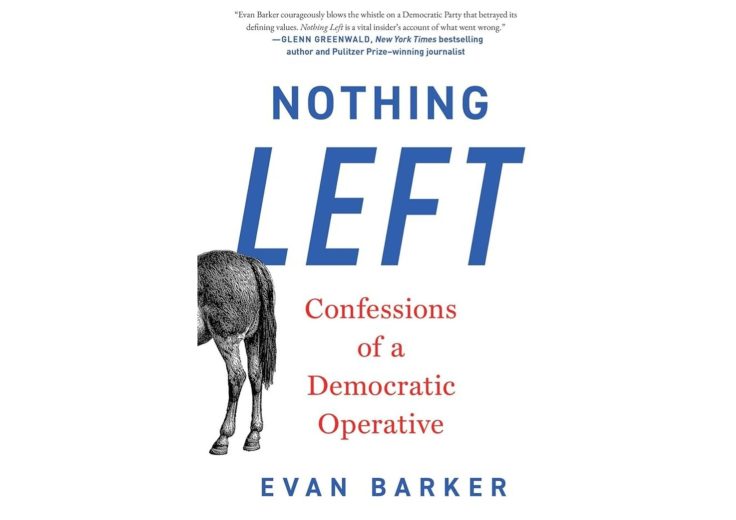
Nothing Left: Confessions of a Democratic Operative
by Evan Barker
Threshold, 268 pp., $29
David J. Garrow's books include the Pulitzer Prize-winning Martin Luther King Jr. biography Bearing the Cross and Rising Star: The Making of Barack Obama.