

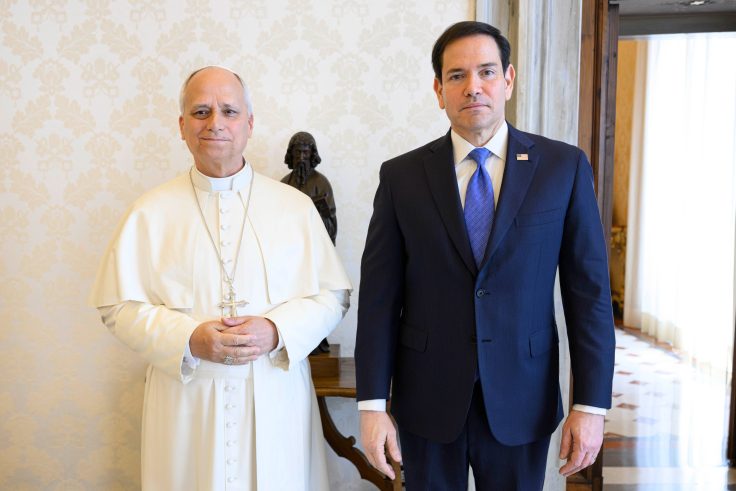
With President Trump facing high-stakes decisions about Iran and preparing for a summit with China, why would he dispatch his national security adviser and secretary of state, Marco Rubio, to the Vatican for a meeting with Pope Leo XIV?
It’d be easy to see it all in the context of short-term politics and the Iran conflict, which the pope has been critical of the U.S. for. But there’s a higher-level dynamic, too. If Rubio and the pope can get the relationship right, it has the potential to be really significant—for the church, for America, and for the world.
Trump spoke about the message he hoped Rubio conveyed. "Tell the pope, very nicely, very respectfully, that Iran cannot have a nuclear weapon, so when he comes to their defense…" Trump said. "Also tell the pope that Iran killed 42,000 innocent protesters who didn’t have guns, who didn’t have weapons. Tell that to the pope."
On social media, Rubio said he met with the pope "to underscore our shared commitment to promoting peace and human dignity."
The Vatican read out the May 7 meeting by saying, "During the course of cordial talks this morning in the Vatican with the Secretary of State of the United States of America, Marco Rubio, first with His Holiness Pope Leo XIV and subsequently with His Eminence Cardinal Pietro Parolin and His Excellency Archbishop Paul R. Gallagher, the shared commitment to fostering sound bilateral relations between the Holy See and the United States of America was reaffirmed." The Vatican went on, "Views were then exchanged regarding situations on the regional and international levels, with particular attention given to countries experiencing war, political tensions and difficult humanitarian situations as well as the need to work tirelessly for peace."
The politics of this for the Trump administration may appear straightforward. With midterm elections approaching, Trump and Republicans need support from Catholics and from Hispanic Catholics. It hurts Trump to have the pope or U.S. bishops denouncing his administration on Iran policy and immigration enforcement.
Yet there’s a bigger picture. There’s a temptation to say let Leo handle the religion, and let Rubio and Trump handle the politics and statecraft. That works up to a point, but it’s also true that they are related.
To really flourish, religion needs freedom. Dictators can’t tolerate genuinely independent churches, because their power poses a threat to the supremacy of the state. As President Kennedy put it in his 1961 Inaugural Address, "the same revolutionary beliefs for which our forebears fought are still at issue around the globe—the belief that the rights of man come not from the generosity of the state but from the hand of God."
And to really flourish, free societies also need religion. There’s no system better for cultivating virtue or for sustaining community, purpose, meaning, humility, and gratitude. As Washington put it in his farewell address, "Of all the dispositions and habits, which lead to political prosperity, Religion and Morality are indispensable supports … let us with caution indulge the supposition, that morality can be maintained without religion. Whatever may be conceded to the influence of refined education on minds of peculiar structure, reason and experience both forbid us to expect, that national morality can prevail in exclusion of religious principle."
The Catholic Church’s greatest recent accomplishment was one of America’s greatest recent accomplishments, too—defeating the Soviet Union by backing Lech Walesa’s Solidarity movement in Poland. When Washington and Rome are aligned, miracles—a Gdansk shipworkers union toppling a nuclear-armed Communist superpower—suddenly become possible.
As Rubio put it, he went not just to talk to the pope, but to listen: "share insights, but also to gain insights … in some cases in the past, the church has been an important interlocutor, not just with governments but with societies."
The West doesn’t face precisely the perils it did during the height of the Cold War, but there are new challenges to Christendom in the form of rising Islam and rising secularism. In England and Wales, less than half the population in the 2021 census described themselves as Christian. In the U.S., Catholic school enrollment is down 12 percent, to 1,674,907 from 1,915,836 over the past decade, with Rubio’s home state of Florida, where there are tuition scholarships, an exception to the trend of decline. Communism in North Korea, Cuba, and China is hostile to anything other than puppet priests. Rubio may be someone who can help push back against that—not just politically, but with a religious sensibility that is authentic and natural, by treating the pope as a partner, not a prop, and with a deep understanding of America’s history and role in the world.
Before he set out on his trip to the Vatican, Rubio appeared at the White House and was asked about his hope for America. "We want it to continue to be the place where anyone from anywhere can achieve anything," he said. "Our history is not one of perfection, but it’s still better than anybody else’s history. And ours is a story of perpetual improvement. Each generation has left the next generation of Americans freer, more prosperous, safer. And that is our goal as well."
The day of the meeting with the pope, the State Department social media account posted a picture of Rubio with the words, "America will always be a nation that calls to God in prayer." Maybe Leo and Rubio were able to reach an understanding, or start an ongoing conversation. If so, it has a lot of potential upside—over a timespan that might be measured not in months or election cycles, but, eventually, in generations.