




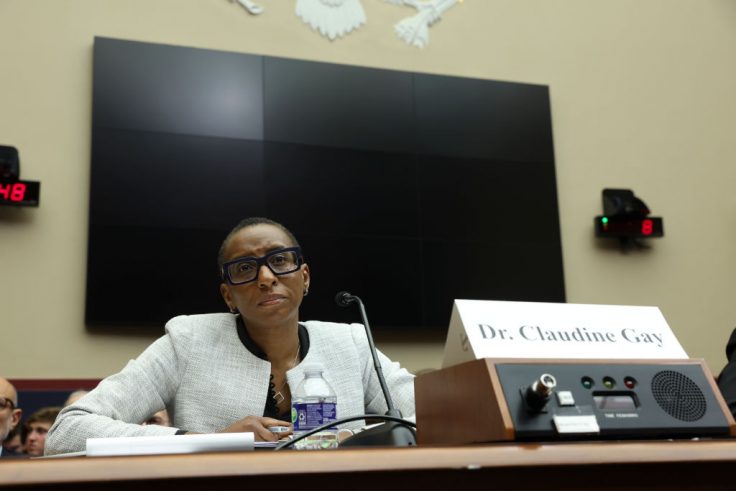
Two years after she resigned in disgrace as president of Harvard University, Claudine Gay is returning to the classroom to teach a Harvard course on "political pressures" at the Ivy League university.
Gay's course, titled "What is a University?: Purpose and Politics in Higher Education," will cover ongoing debates about "curriculum, admissions, research, preservation, and governance" at Harvard, according to a course description reported by the Harvard Crimson.
"The course will place Harvard as its center, using ‘Harvard-specific cases, histories and examples’ as a lens for examining broader debates in higher education," the Crimson reports.
The course description states that the "tutorial" will "encourage Harvard students to engage in critical thinking about their own institution and to understand the background political, social, and market pressures that influence their college experience." The course, which begins in the fall of 2026, will include a maximum of 16 students, whose final project will be to propose "a vision for institutional reform or reinvention."
Gay is certainly familiar with the political headwinds facing Harvard, though her status as an expert in understanding them is up for debate.
Gay, who despite a thin résumé became president of Harvard in July of 2023, came under fire early in her presidency when, in the immediate aftermath of the Oct. 7 Hamas attack on Israel, she failed to condemn a letter from Harvard student groups blaming Israel’s "apartheid regime" for the massacre. A statement from Gay and other Harvard leaders merely said they were "heartbroken" by the violence. Under pressure, Gay eventually denounced Hamas.
Gay continued to equivocate about the murders during her disastrous December 2023 testimony on Capitol Hill when she was asked by Rep. Elise Stefanik (R., N.Y.) whether calling for the genocide of Jews constituted harassment at Harvard. "It depends on the context," Gay answered. She attempted to clean up the statement one day later, arguing that "some" had "confused a right to free expression with the idea that Harvard will condone calls for violence against Jewish students."
Gay—unlike another Ivy League president who testified, Liz Magill of the University of Pennsylvania—did not immediately resign in the wake of the hearing. Her ousting came weeks later, after powerful alumni began asking why she was ever appointed in the first place. Ultimately, Gay faced dozens of allegations of plagiarism in her academic work, involving nearly half of her 17 published works. Gay had lifted entire paragraphs from other academics' scholarly work and claimed them as her own.
Gay resigned as president of Harvard on Jan. 2, 2024, less than a month after her testimony and one day after the Washington Free Beacon reported on additional allegations of plagiarism against her. In a parting message, she argued that criticisms of her scholarship and leadership were "fueled by racial animus." Gay served as president for just six months and two days, the shortest tenure in Harvard's history.
Gay remained a tenured professor at Harvard, and was expected to return to teaching. But it's unusual, if not unique, for a deposed administrator like Gay to teach a course on a topic related to their ousting. Gay, however, had indicated that she would do so in a New York Times op-ed published one day after her resignation and headlined, "Claudine Gay: What Just Happened at Harvard Is Bigger Than Me." Gay blamed her resignation on "demagogues" who sprung a "well-laid trap" to "weaponize" her presidency and "undermine the ideals animating Harvard since its founding: excellence, openness, independence, truth."
"As I return to teaching and scholarship," Gay wrote, "I will continue to champion access and opportunity, and I will bring to my work the virtue I discussed in the speech I delivered at my presidential inauguration: courage. Because it is courage that has buoyed me throughout my career and it is courage that is needed to stand up to those who seek to undermine what makes universities unique in American life."
In addition to her class on university politics, Gay will be teaching—next spring—two other courses in her wheelhouse: "African American Politics," focusing on the legacy of the Voting Rights Act; and "Politics of Race, Ethnicity and Immigration," which will focus on "racial domination and contestation." The latter course is being taught with Harvard professor Jennifer Hochschild. Amid the plagiarism scandal that felled her, Gay was revealed to have lifted language without attribution from a book Hochschild wrote. Still, Hochschild defended Gay at the height of the scandal, saying Gay was merely using "cliches" from her work and calling the allegations of plagiarism a "highly selective, very targeted attack" against a black woman.
"The combination of race and gender and high status is a very volatile one," Hochschild told the Crimson.
Harvard did not immediately respond to a request for comment.
Scrutiny of Harvard's response to campus anti-Semitism in the wake of Hamas's Oct. 7, 2023, terror attack only accelerated in the wake of Gay's resignation and the election of President Donald Trump.
As the Trump administration froze billions of dollars in federal funding to Harvard, citing its repeated failure "to confront the pervasive race discrimination and anti-Semitic harassment plaguing its campus," Harvard, unlike other Ivy League institutions, opted to fight the federal government. The school sued the Trump administration in April 2025, arguing that it froze the funds in an unconstitutional manner. Gay nonetheless criticized her successor, Harvard president Alan Garber, for being too accommodating to Trump.
"The posture of the institution seems to be one of compliance," Gay said during a September 2025 address at the Netherlands Institute for Advanced Study. "This is distressing, not only for those of us who are on campus and facing the consequences directly, but also for all of those in higher ed who look to Harvard for leadership and guidance."
The Department of Justice filed its own suit against Harvard on Friday, citing the university's "toothless non-response to the ongoing relentless antisemitic on-campus discrimination."
Gay is not the only ousted Ivy League president to return to the higher education fold in recent weeks. Georgetown University Law Center named Magill, the former Penn president, as its dean on Feb. 13. The 14-person search committee that hired her included at least 11 Democratic donors, a Free Beacon review found.