


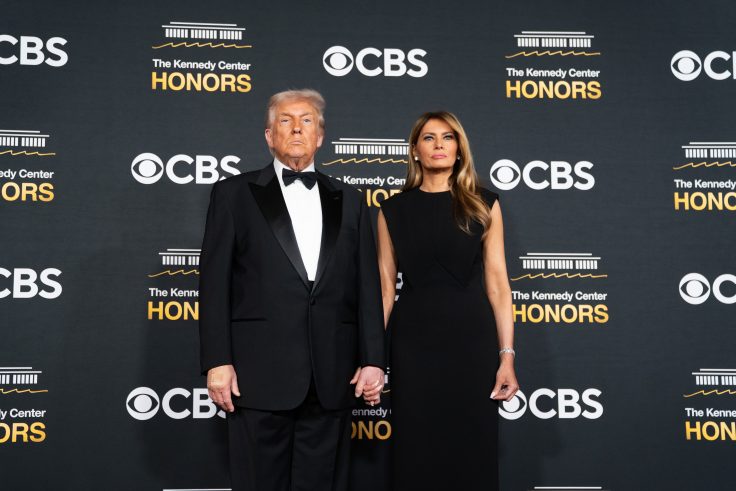
Hardly a day goes by without news of some performers performatively announcing that they'll refuse to take the stage at the Trump Kennedy Center, or the press portraying a canceled event in that light.
This week, composer Philip Glass said he wouldn't allow the National Symphony Orchestra to play a symphony he wrote honoring Abraham Lincoln. A touring production of the musical Hamilton canceled in March 2025 because, its producer, Jeffrey Seller, explained, "some institutions are sacred and should be protected from politics." Others who have backed out reportedly include musician Rhiannon Giddens, the Martha Graham Dance Company, and banjoist Bela Fleck, who explained on social media that "Performing there has become charged and political, at an institution where the focus should be on the music."
Some portion of contemporary artists, just like some portion of the rest of the country, doesn't like Trump. If they don't want to perform at the Trump Kennedy Center, no one is forcing them to, subject to the terms of whatever contract they entered into when they originally booked the engagement. But to frame it as Trump injecting politics into the supposedly previously sacred and apolitical Kennedy Center is just naive, ignorant nonsense.
It's not as if the presidential box there during the Obama administration was packed with the president's most vicious critics. And it's not as if the Democrats aren't themselves hoping to get it back under their control so that they can use it themselves. The best way to test that would be with a bill privatizing the thing by selling it to some high bidder in the entertainment industry. That'd be one way to get politics out of it. It's unlikely.
Not everything portrayed in the press as a political exit may actually be that. Some departures or cancellations may have been motivated by economics or other reasons. The president of the Trump Kennedy Center, Richard Grenell, fumed on social media, "Guess how many reporters actually reported the facts as to who asked who to end the EXCLUSIVE Opera partnership at the Trump Kennedy Center? Zero. We have a crisis in the media. Experienced editors are allowing young reporters to simply repeat, recycle and plagiarize other reporters without checking facts." Grenell has also asked who is making it political: the Trump administration or artists deciding to boycott the center in the Trump presidency?
Trump himself said on January 26: "People don't realize that The Trump Kennedy Center suffered massive deficits for many years and, like everything else, I merely came in to save it and, if possible, make it far better than ever before!"
My own preference would be to avoid naming any government structures for any living politicians, and to apply that rule equally to the Trump Kennedy Center and to the Joseph R. Biden Jr. Railroad Station, President Barack H. Obama Highway in California, and the Barack Obama Presidential Expressway in Illinois.
But as the author of a book about President Kennedy, I can at least bring some experience to bear on the history of the Kennedy Center for the Performing Arts. Simply put: Yes, a performing arts center in Washington, D.C., created by Congress with the National Cultural Center Act, on federal land, with a parking garage funded by a congressional appropriation, and a board composed of and appointed by politicians will be political.
Advocates for building a performing arts center in Washington were straightforward about the political rationale for the project. The chairman of the District of Columbia Auditorium Commission, Agnes Meyer, testified to a House subcommittee on Feb. 7, 1957, "Washington is not only the Capital of the United States. It is the capital of the free world." Meyer, a former New York Sun reporter whose husband, Eugene Meyer, owned the Washington Post and had been chairman of the Federal Reserve, spoke in the early years of the Cold War and said America was "in a period when our Republic must capture the imagination of all free peoples."
In a Jan. 31, 1957, report to President Eisenhower, "Plans for a National Civic Auditorium and Cultural Center," Meyer—the mother of legendary Washington Post publisher Katharine Graham—wrote that a cultural center in Washington would "enhance its prestige throughout the world." The report warned that "in the past, some foreign visitors have left the United States with an impression of American cultural poverty." It proposed a Great Hall where "the Government may act as host to officials of many nations." Meyer talked about what became the Kennedy Center the way Trump talks about his plans for a new White House ballroom: as a place for events "of high ceremonial importance," such as the Inaugural Ball.
When the building finally opened, named after a politician, it got a hostile reception from New York. Perhaps the cultural capital saw a threat from the political capital horning in—with federal subsidies—on what had traditionally been New York's turf. The architecture critic Ada Louise Huxtable, in a front-page review in the Sept. 7, 1971, New York Times, dropped in a first-paragraph reference to the Nazi architect who was Hitler's minister of armaments and war production: "Albert Speer would have approved." Later, she hammered the point home: "This is gemütlich Speer."
As if the Nazi comparisons weren't enough, Huxtable also likened the new building to a Soviet Communist edifice, calling its spaces "disquietingly reminiscent of the overscaled vacuity of Soviet palaces of culture."
Wrote Huxtable: "[T]he building is a national tragedy. It is a cross between a concrete candy box and a marble sarcophagus in which the art of architecture lies buried."
Art's use for arguably political purposes long predates the Nazis, the Soviets, or the Nixon administration's 1971 dedication of the Kennedy Center. It goes back at least to Solomon's Temple, to ancient Greece, to the Egyptian pyramids, and to the Medici family's patronage of the Italian Renaissance. Just as with the politicians who are the patrons, sometimes the art is great, and sometimes it is mediocre.