



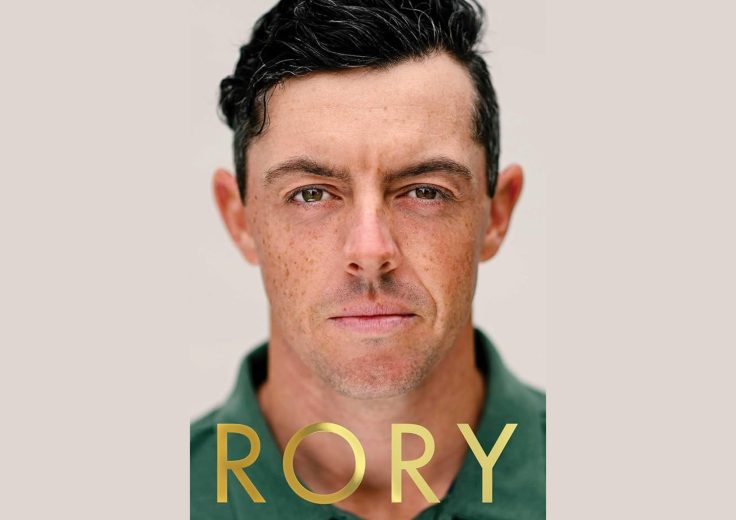
Alan Shipnuck has very good timing. His new book is a biography of Rory McIlroy, the golf champion. It was published last month, two days before the Masters tournament. McIlroy won the Masters last year. That was surely the "hook" of the book, its impetus.
The Masters had long been missing from McIlroy's "résumé." He had won the other three "majors": the U.S. Open, the British Open, and the PGA Championship. But now he had won all four, completing the "career Grand Slam." Only a handful in history have done that—among them, Ben Hogan, Jack Nicklaus, and Tiger Woods.
So, it was a good time for a Rory bio. But wait…
In the days following the publication of the book, Rory won the Masters again—becoming only the fourth player to go back-to-back in the tournament. (The other three are Nicklaus, Woods, and Nick Faldo.)
What more could the author and his publisher want? It's raining Rory.
Shipnuck is a veteran golf writer, an alumnus of Sports Illustrated and Golf Magazine. He has written several books, including a biography of Phil Mickelson. Published in 2022, it’s called Phil. The new bio is called Rory.
We tend to know our great golfers by their first names alone. I have already mentioned Ben, Jack, and Tiger, in addition to Phil and Rory. We also have Sam (Snead), Arnold (Palmer), Gary (Player), Lee (Trevino), Seve (Ballesteros), Scottie (Scheffler), Nelly (Korda)…
The subtitle of Shipnuck's Phil bio is The Rip-Roaring (and Unauthorized!) Biography of Golf's Most Colorful Superstar. The subtitle of his Rory bio is The Heartache and Triumph of Golf's Most Human Superstar.
Rory grew up idolizing Tiger, whose poster was on Rory's bedroom wall. But he is more like Phil, Shipnuck notes: mercurial rather than methodical. (Woods has had a turbulent private life, true, but at work—on the golf course—he was always quasi-scientific.)
Rory did not cooperate with Shipnuck on this bio. Indeed, he was hostile to it. Shipnuck explained to him that Arnold and Jack had always cooperated with their biographers—it helped burnish their legacies and the history of golf. But Rory was unpersuaded.
"It pisses me off that you're making money off my name," he told Shipnuck. That was one objection—or stated objection. Shipnuck guesses that the issue was less money than control. He also points out that, while Rory flies in a private jet, sportswriters usually fly coach, and sometimes in the middle seat.
I would have been tempted to tell Rory: "Would you rather be written about or the writer? Would you like to be the biographer or the biographee? The star or the scribe? Come on. Wanna trade places?"
In any event, Shipnuck has written a good and thorough biography, with the cooperation of plenty in the golf world. McIlroy, moreover, is a good subject: interesting, thoughtful, quirky. He took up juggling, because it engages both halves of the brain.
Rory was born in 1989 in Holywood, Northern Ireland, just outside Belfast. His parents are Gerry and Rosie, and they were working-class. They were also splendid parents, by all accounts—including Rory's, including Shipnuck's. They worked multiple shifts in order to feed the golf habit of their only child, who was a prodigy.
Did they push Rory? Gerry was a very good golfer himself. There may have been some pushing, or some steering, but Rory certainly wanted it. So did Tiger, no matter how ambitious his father, Earl Woods, was for him. Each of those future stars was hungry for golf.
I can't help thinking of Ruth Slenczynska, the pianist, who died last month at 101. Her life is a cautionary tale. She was a child prodigy, who was pushed by her father—abusively, monstrously. In fact, she abandoned the piano for a while.
In this new bio, Shipnuck chronicles Rory's boyhood, his amateur career, his professional career, his business dealings, his romantic and marital adventures—all of it. Rory is often likable or lovable in these pages. He is sometimes—a bit of a jerk?
He is "human," as Shipnuck says in his subtitle.
While reading, I wondered: For whom is this book intended? Golf fanatics or a more general readership? There is a lot of "inside baseball" in this book ("inside golf"). Some of the tournament recaps bored even me (a fanatic). But there are broader, more "human" questions here.
One is the question of identity: Does McIlroy, this child of Northern Ireland, feel British? Irish? A bit of both? (That last answer is the right one, I gather.) Also, is there a class element in his makeup? (Almost certainly.)
Then there is the political drama surrounding the PGA Tour and the Saudi-funded tour (recently dissolved). McIlroy acted as a protector of the PGA Tour, while Phil Mickelson went in the Saudi direction.
But I think that even non-golfers would enjoy some of the talk about swing mechanics—Rory McIlroy has one of the soundest, best golf motions anyone has ever seen. Shipnuck quotes another top golfer, Justin Rose, on the young Rory: "Everything was in such a beautiful sequence, and there was such a rhythm to his swing, that you didn't notice the violence"—the sheer power of that beautiful, fluid motion.
Shipnuck is a good storyteller, and there are many stories to tell here. He is also an industrious reporter—researching, interviewing. He is a good and engaging writer. Some passages and pages sing. I will quote a few of my favorite lines—but first complain.
Shipnuck writes of "basic fundamentals." All fundamentals are basic. Like the public at large, perhaps, he takes "disinterest" to mean "lack of interest" and "enormity" to mean "great importance" or "enormousness." May I say, too, that "late-stage capitalism" should be reserved for stoned undergrads?
But there are many nice turns of phrase. I loved "as soon as the Golden Bear ambled away." (Which means, "as soon as Jack Nicklaus walked off.") With a four-shot lead in the Masters, Rory "had one arm in the green jacket." (The winner of the tournament gets one of those.)
At age 16, Rory shot a spectacular, jaw-dropping 61 at Royal Portrush Golf Club in his native Northern Ireland. This was, writes Shipnuck, "the most momentous 61 this side of Roger Maris" (the baseball player who, in 1961, as it happened, hit 61 home runs to set a record).
McIlroy's 2025 Masters victory ends Shipnuck's bio. It is his dénouement, his grand finale. Yet, at 37, McIlroy has a fair amount of golf left in him—and he has already donned that second green jacket. (I am being metaphorical here. When you win a green jacket—it stays your green jacket, no matter how many more times you win.)
Some years ago, I wrote a history of the Nobel Peace Prize. A magnificent subject. The only problem was that such a book just… stops, while the prize goes on. Same with a biography of a man in his 30s, even an athlete, for whom 37 is "gettin' up there."
I feel sure that Rory, the non-cooperator, has read this book. Is he pleased? He ought to be, I think. Shipnuck has drawn a warts-and-all portrait, but the golfer comes out looking good. And the biographer's affection for his subject is clear.
Let me end on a complaint (another one). There are no photos in this book. Too expensive? Ah, publishing!
Rory: The Heartache and Triumph of Golf's Most Human Superstar
by Alan Shipnuck
Avid Reader Press/Simon & Schuster, 320 pp., $32.50
Jay Nordlinger is a resident senior fellow at the Renew Democracy Initiative and a contributor to its publication, The Next Move. He also writes on Substack at Onward and Upward and is the music critic of The New Criterion.