





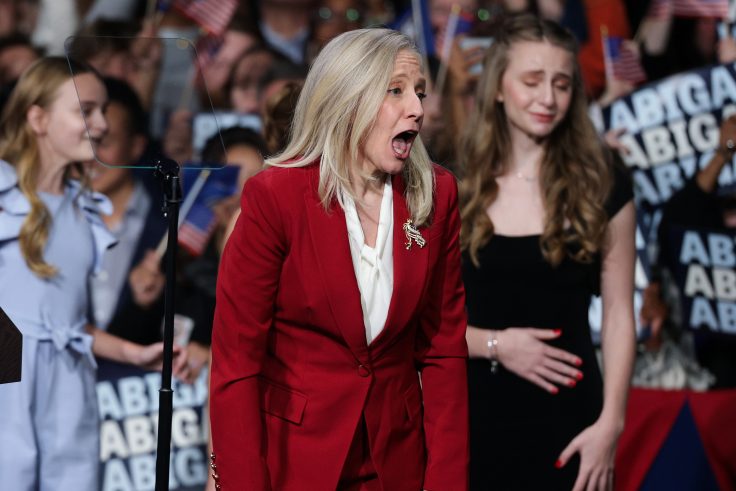
The Supreme Court of Virginia slapped down a proposed constitutional amendment that would have allowed Democrats to redraw the state’s congressional districts with a 10-1 advantage just months before the midterm elections, upholding a lower court’s ruling and delivering an embarrassing blow to Gov. Abigail Spanberger (Va.).
In Friday’s 4-3 decision, the justices agreed with Republicans’ arguments that Democrats illegally placed the redistricting referendum on an April 21 ballot, which passed with 51.7 percent of the vote, rendering it void. The Virginia constitution requires that proposed amendments pass the legislature twice before going on the ballot, with a House of Delegates election sandwiched in between—but early voting for November’s election had already begun when the General Assembly first passed the redistricting proposal.
The intervening election would have allowed voters to pick a candidate with a clear position on the amendment, but early voters "squandered that opportunity," Justice D. Arthur Kelsey wrote in the opinion.
"[E]arly voters unknowingly forfeited their constitutionally protected opportunity to vote for or against delegates who favor or disfavor amending the Constitution by not anticipating a legislative vote on a constitutional amendment four days before the last day of voting," he wrote.
"[A] wedding can last for hours, but the bride and groom are not lawfully wed until the officiant declares them so at the end of it. Equally so here," Kelsey wrote. "A general election can take place over many days, but it culminates and ends on Election Day."
The ruling is a devastating blow to Spanberger, who threw her unqualified support behind the gerrymandering effort after promising she had no plans to redistrict during her campaign last year. It comes at an already challenging time for the governor as she faces a historically low approval rating.
It’s also a hit to Democrats at the national level. It will likely prevent them from flipping four congressional seats and could play a critical role in determining which party controls the U.S. House of Representatives. On a financial level, Democrats dumped $64 million into Virginia’s gerrymandering effort at a time when the Democratic National Committee has less than $14 million on hand, but is $4.5 million in debt. The Republican National Committee, meanwhile, has a nearly $116 million war chest.
The legal battle launched even before the proposed amendment was officially headed to the ballot. GOP legislators, including Virginia Senate Republican leader Ryan McDougle, filed a lawsuit in October arguing that Democrats violated several rules dictating how proposed constitutional amendments are put forward. The case was fast-tracked to the Supreme Court of Virginia after a lower court ruled in their favor.
In dissent, Chief Justice Cleo E. Powell argued that the majority’s ruling creates an "infinite voting loop that appears to have no established beginning, only a definitive end."
"[T]he majority has broadened the meaning of the word 'election,' as used in the Virginia Constitution, to include the early voting period," she wrote. "This is in direct conflict with how both Virginia and federal law define an election."
"By focusing on the legislative history, dictionary definitions, and how legal scholars might interpret the term 'election,' the majority fails to apply the most basic tenet of interpretation of constitutional provisions: looking to the language of the constitution itself," she added.
The court also rendered additional challenges before the court moot. Other GOP-led suits that were pending before the court include arguments that Democrats misled voters about changes to the map and drew districts that violated a constitutional requirement for compact districts—one in particular has drawn criticism for resembling a lobster.