


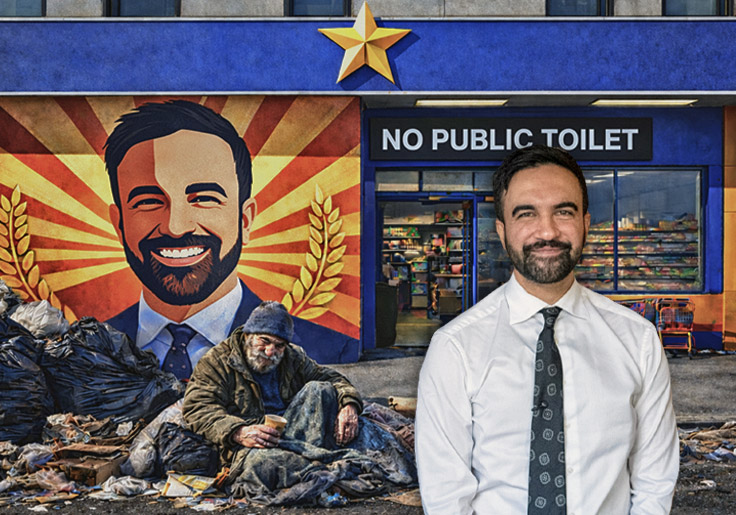
New York City mayor Zohran Mamdani recently unveiled his plan to build a massive government-run grocery store in Manhattan. Most self-respecting experts think it's a terrible idea—for obvious reasons. Rooted in the failed tenets of communism, the taxpayer-funded supermarket was a central component of Mamdani's campaign platform. So it's going to be pretty embarrassing when the project inevitably devolves into yet another bureaucratic boondoggle.
Here is everything you need to know:
When will it open? Mamdani wants to have five city-run stores operating by the end of his first term in 2029. The project he outlined over the weekend—the first to be formally announced—will take about three years to complete because it's being built from scratch.
How much will it cost to build? $30 million.
How much will it actually cost? Almost certainly more than that, given the reliability of government estimates. It's worth noting that industry experts told the New York Post that $30 million is about three times what it would typically cost to build a supermarket from the ground up. "Even a high end, gourmet store in the middle of Manhattan wouldn’t cost that much to build," said Anthony Pena, president of the National Supermarket Association.
Can the city afford it? Not really. Mamdani has until July 1 to resolve a $5.4 billion deficit.
How much will it cost to run? Mamdani has said each store—which won't have to pay rent or property taxes—would cost about $12 million annually to operate.
How much will it actually cost to run? Food policy experts estimate that operating the stores at "good union labor rates" would require at least $20 million annually per store.
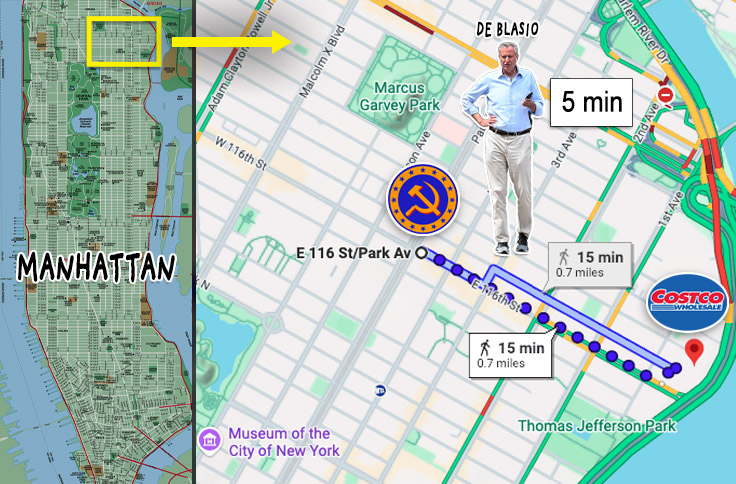
Where are they building it? Not in Midtown Manhattan, obviously. The first city-run supermarket will be located on what is now an empty lot in East Harlem at 116th Street and Park Avenue. The New York Times described the neighborhood as a "diverse community with high poverty rates."
Is that a good location for a government supermarket? Not really. One of Mamdani's stated aims was to combat "food deserts" where grocery options are limited. There are five grocery stores within a two-block radius of the proposed building site, though they will struggle to compete with a taxpayer-subsidized venture that is immune to rising property tax rates. It will also compete with local vendors at the nearby La Marqueta complex.
Shouldn't they just build a Costco instead? Probably, but there is already a Costo several blocks away, or 0.7 miles. Google Maps says it's a 15-minute walk, but a normal person could probably make it there in 10 minutes, while a freak such as Bill de Blasio could do it in 5 minutes.
This is starting to sound like a bad idea. It is. Mamdani says his goal is to provide discounts on basic groceries. Costco already sells affordable food, as well as clothes and other household items. Whitney Tilson, a Manhattan-based Democratic activist, calculated that for the amount of money Mamdani wants to spend on city-run grocery stores, he could instantly reduce the cost of living for New Yorkers by giving away a million free Costco memberships.
Have other cities in the United States opened government-run grocery stores? Yes.
Have they succeeded? Almost never. Kansas City opened a city-run supermarket in 2018 that closed last year after being "plagued with empty shelves and crime." Baldwin, Fla., closed its government-run grocery store in 2024 after five years due to unsustainable losses.
What did you mean by "almost never"? Atlanta opened a publicly funded, privately operated grocery store in 2025 that has been relatively successful, but that is not the model Mamdani is pursuing in Manhattan.
Have any big cities tried to do what New York is doing? The closest analogue is Chicago—a Democrat-controlled, union-dominated metropolis. Mayor Brandon Johnson proposed building a city-run supermarket back in 2023, but walked it back in 2025, announcing plans to open a year-round public market instead.
That sounds ominous. Any update? It's not going well. When the Chicago Tribune followed up in February, city spokesman Cassio Mendoza "did not directly answer" the paper's questions about the market's location, when it might open, and how it would be funded. Mendoza said the city was still compiling a report based on "listening sessions" with community members. The forthcoming report, he said, would include a "framework for identifying potential locations."
It's never going to happen, is it? Probably not.
OK, but Chicago is uniquely dysfunctional. Not uniquely, but point taken.
Does full communism ever work? No, it never does. I mean, these people somehow delude themselves into thinking it might, but...
But it might work in New York? Sure.