



The governor of New York and the mayor of New York City are joining together in America’s 250th birthday year to back a plan for taxation without representation—precisely the injustice that the United States of America was founded to oppose.
Governor Kathy Hochul, a Democrat who some had hoped would serve as a moderating influence on Mayor Zohran Mamdani, a 34-year-old socialist, used the April 15 tax filing deadline to announce a tax on people who own property in New York City but who are not New York City residents for income tax purposes.
"This is a targeted surcharge on second homes and investor-owned apartments worth over $5 million; homes that in many cases sit vacant for a large part of the year," Hochul said. "Those people are not part of our city."
"The people who own these pied-à-terres are not contributing in the same way that the 8.3 million New York residents do," Hochul claimed.
The people who own these properties are not New York City voters or in some cases even New York State voters, though they do pay property taxes already; if their primary residence is in Florida and they vote there, they don’t even have the ability to elect the New York politicians who are imposing taxes on them. That was precisely the same position that the North American colonists were in in the 1760s and 1770s when the British Parliament—where the colonies were not represented—were imposing taxes on the colonists. The colonists likened it to slavery and fought a revolution over it. The Declaration of Independence issued in July 1776 referred to it as "imposing Taxes on us without our Consent."
Details on the proposal were scant. A press release from the mayor’s office said, "It is projected to generate $500 million in annual revenue." That’s less than what the mayor needs to close an existing budget gap, let alone to fund his plans for new programs such as "free" buses and "free" childcare. I put "free" in scarequotes because these programs aren’t actually free, they are expensive. That is why New York, already the worst state out of 50 in the Tax Foundation’s 2026 State Tax Competitiveness Index, is busy finding taxes to increase rather than ones to reduce.
Mamdani went so far as to attack by name a Florida-based businessman, Ken Griffin, who has been purchasing New York City real estate. "Yesterday I was standing in front of I think it's 220 Central Park West. Ken Griffin owns a penthouse that he bought I think for $228 million. …This is the kind of wealth that is being stored in the city and it is a residence that is so often empty," Mamdani said at his own April 15 event, managing to get Griffin’s address wrong while vilifying an entrepreneurial and patriotic job-creator. Griffin, who left Chicago for Florida while criticizing Chicago’s business climate, was also singled out for demonization by name in the mayor’s press release.
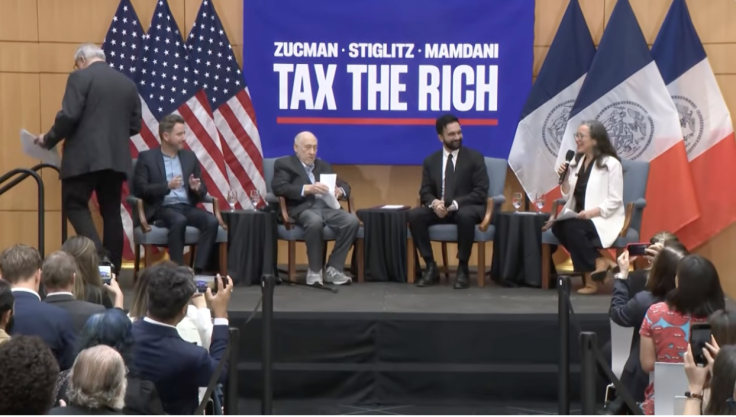
Mamdani’s event featured left-wing economists Gabriel Zucman of UC Berkeley and Columbia’s Joseph Stiglitz and was moderated by the city’s Commissioner of International Affairs, Ana María Archila, who before joining the Mamdani administration was co-director of the Working Families Party, a far-left alternative to the Democratic Party.
Collecting a tax on second homes and investor-owned apartments in New York City poses potential practical challenges from an enforcement perspective. Some New York City apartment buildings are organized as cooperatives; the co-op building pays the tax, and the shareholders in the co-op pay maintenance, a portion of which goes to pay the building’s taxes. In the case of condos, a couple or family could designate a lower-income family member as a New York City resident, and as the apartment owner, for tax purposes, and file a separate tax return for that person. The tax also might be subject to legal opposition on the basis of retroactivity or equal protection, though those efforts might face steep challenges. People could choose to sell the properties, accelerating the flight from New York.
A tax lawyer at Hodgson Russ LLP who has written about the issue, Timothy Noonan, told the Washington Free Beacon that without seeing the text of the new law, it’s hard to determine if there’d be any workarounds. He was skeptical of the spouse solution, "since spouses are generally presumed to have the same resident status under New York’s residency rules."
"My view generally is that any attempts to circumvent a tax like this will be difficult, and that the main way to get around the tax will actually be a lot simpler: taxpayers with this potential problem will just get rid of their place!" he said. "But in general, I do think it’s possible that a tax measure that provides preferential treatment to City residents and is targeted specifically to nonresidents could be subject to a legal challenge, perhaps on the privileges and immunities clause, for essentially imposing a penalty on a taxpayer for living somewhere else."
Advocates of higher taxes acknowledged the chance people would sell but suggested that’d be okay. "If a couple of billionaires were to leave New York or Massachusetts, is that a problem? That’s not clear," Zucman said on stage at the CUNY Graduate Center before a large "Tax the Rich" backdrop.
As is typical in such situations, the anti-rich, high-tax politics and the anti-Israel politics mix easily together. Zucman touted an upcoming meeting in Barcelona convened by Spain’s president, Pedro Sánchez, who has been hostile to Israel. The meeting, which Zucman said would attract 15 heads of state, is to impose a two percent global wealth tax on billionaires. Mamdani denounced what he called "images of our country bombing girls’ schools in Iran."
And Stiglitz claimed that America is spending "on weapons that don’t work against enemies that don’t exist, killing people" "more like a billion dollars in just ordnances every day, in, you know, the bombs." Though some early estimates were in that range, much of the costs relate to missile and drone defense—not "killing people" or "weapons that don’t work" but defending precious economic, military, and civilian assets against Iranian attacks. And costs declined as Iranian air defenses were defeated, making it easier for the U.S. to use cheaper and more common bombs that could be dropped from overhead rather than shot from afar. Anyway, it was telling that Mamdani and his favorite Columbia and U.C. Berkeley economists couldn’t even stay on message at a "tax-the-rich" event, they had to find some way to drift into criticizing the war effort. It’s all connected, and, watching, one got the sense that if Mamdani, Stiglitz, and Zucman had been around in 1776, they’d have been busy whining about the cost of muskets and powder instead of volunteering in the glorious cause of freedom.