

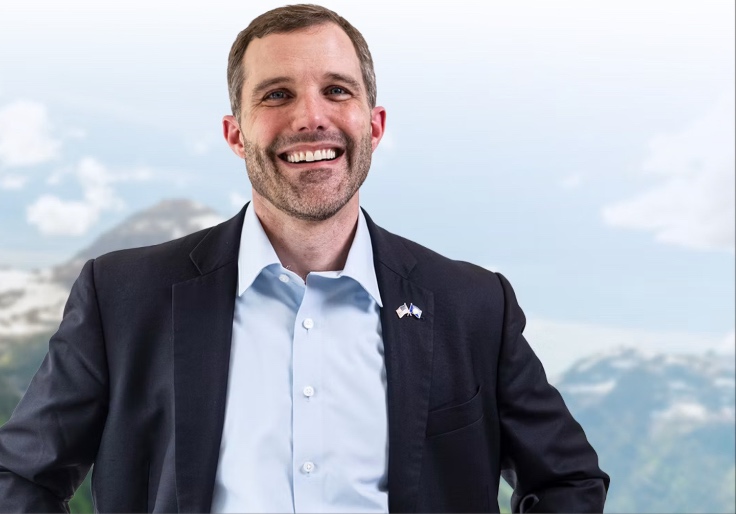
Seth Bodnar, the independent U.S. Senate candidate in Montana, has talked tough about China on the campaign trail. But while leading the University of Montana, Bodnar rebuffed concerns from Congress about the university's collaboration with an organization tied to Chinese foreign influence operations.
Former congressman Mike Gallagher (R., Wis.), then the chairman of the Select Committee on the Strategic Competition Between the United States and the Chinese Communist Party, demanded in December 2023 that Bodnar terminate the University of Montana's study abroad partnership with the Hong Kong-based China-United States Exchange Foundation (CUSEF). CUSEF has been accused by lawmakers and senior U.S. intelligence officials of playing a role in efforts to spread Chinese influence in the United States. The group registered as a foreign agent, was founded by a top CCP official, and employs a former Chinese general as a senior adviser.
Bodnar, who served as the University of Montana's president from January 2018 to January 2026, declined to respond to Gallagher's letter and instead gave his blessing to the university partnership with CUSEF, arguing in a statement that cutting ties with it would "shrink opportunity" for students. "It is our responsibility to expand learning experiences for our students so that America can compete and win around the globe," he said.
Bodnar, a former Green Beret with a gold-plated résumé, is running as an independent but has the support of such leading Montana Democrats as former senators Jon Tester and Max Baucus. Republican nominee Kurt Alme has a strong lead in the polls in a three-person race with Bodnar and Democratic nominee Alani Bankhead. But polls show a tight race in a hypothetical two-man contest between Bodnar and Alme. So far, Bankhead and Bodnar are both resisting calls for one of them to drop out and clear the field.
The CUSEF student exchange program Bodnar defended, which remains in place today, is offered through the University of Montana's Baucus Institute, run by former senator Baucus, who served as former president Barack Obama's last ambassador to China. Baucus also raised money for Bodnar's Senate bid and endorsed Bodnar in June, calling him "the kind of Independent leader who can pull us out of this mess and chart a new path for the state we love."
Despite Gallagher's concerns, the Baucus Institute moved forward with the trip in June 2024. CUSEF paid for 15 students to travel to Hong Kong, Beijing, and Shanghai, engaging in "people-to-people diplomacy and cultural exchanges."
During the trip, with Baucus and his wife in tow, students attended a CUSEF event in Hong Kong honoring the 15th anniversary of the organization founded by Tung Chee-hwa, a former chief executive of Hong Kong and former vice chairman of China's National Committee of the Chinese People's Political Consultative Conference. CUSEF's 15th anniversary celebrations culminated in a forum held months later that a Beijing think tank, overseen by the state-run Chinese Academy of Social Sciences, cosponsored. Lu Kang, a vice minister of the CCP, also delivered remarks during the event.
Students also visited the Hong Kong Stock Exchange and state-run China Securities Regulatory Commission and Tsinghua University, as well as a "cultural center" tied to China's United Front Work Department, which oversees Chinese foreign influence campaigns. While in Shanghai, the students visited the headquarters of Chinese social media giant Xiaohongshu, which established its own internal CCP committee years earlier, abides by strict Chinese censorship rules and is preparing to go public with the financial backing of a state-run investment bank, and electric vehicle maker NIO, which the Pentagon has identified as a Chinese military company.
Bodnar's defense of the trip and the University of Montana's partnership with CUSEF appears to conflict with the more hardline approach to China he has taken while running for Senate—for example, he warned that domestic mining projects are benefiting China and that the United States is "falling behind competitors like China" when it comes to energy production.
The Bodnar campaign did not respond to requests for comment. CUSEF, the Baucus Institute, and the University of Montana did not respond to requests for comment.
"Bodnar's defense of CUSEF is as ignorant as it is reckless," said former U.S. ambassador Joseph Cella, the president of the Secure Our States Coalition, a group founded to combat Chinese influence in America. "While CUSEF promotes itself as benign and dedicated to dialogue and mutual understanding, by its nature a clear and present threat exists manifesting through elite capture and narrative shaping; camping out in academic institutions to thieve intellectual property; shaping foreign policy narratives; as well as monitoring diaspora communities and promote CCP-favorable views."
Cella noted that Bodnar remained "all-in" with CUSEF even after a Chinese military surveillance balloon crossed through Montana airspace months earlier. "That should be a red flag for Montana voters as they consider his judgment and ability to engage the China threat," Cella said.
"China is on the hunt through the United Front, and often furtively through organizations such as CUSEF," Cella told the Washington Free Beacon.
During Bodnar's tenure, the Baucus Institute doubled down on its partnership with CUSEF and now dubs its study abroad program the CUSEF NextGen Initiative. According to CUSEF, the partnership organized additional visits to China in May 2025 and May 2026. Like the 2024 trip, students selected to join the trips received scholarships that cover visas, flights, international health insurance, lodging, and meals.
The CCP's Central Committee touted both the 2025 and 2026 trips. In 2025, the University of Montana study abroad students met with Liu Jianchao, the head of the CCP's International Department who once remarked that the United States seeks to "oppress and contain China," and, in 2026, the university delegation met with Lu Kang, the vice minister of the CCP. "China's policy toward the US remains stable and continuous. China always adheres to the principles of mutual respect, peaceful coexistence, and win-win cooperation to view and handle China-US relations," the CCP's Central Committee said after the Jianchao meeting with University of Montana students in 2025.
CUSEF, the Baucus Institute, and the university never publicly acknowledged those meetings.
CUSEF has maintained ties to the CCP. For example, it hired He Yafei, a former top Chinese diplomat, and Yao Yunzhu, a former Chinese military general, as senior advisers. And the organization's most recent annual forum was cosponsored by the Chinese People's Association for Friendship with Foreign Countries, which the State Department says is "tasked with co-opting subnational governments" and acts to "directly and malignly influence state and local leaders to promote [China's] global agenda." The Chinese ambassador to the United States, Xie Feng, and Hong Kong chief executive John Lee Ka-chiu, who was appointed to the position by the State Council of China in 2022 and is sanctioned by the U.S. government for his role cracking down on pro-democracy protesters, both delivered remarks at the event.
While Bodnar, the University of Montana, and the Baucus Institute have stood by the partnership, other U.S. institutions have cut ties with CUSEF over its connection to the CCP influence apparatus. In 2018, the University of Texas at Austin rejected CUSEF funding, and around the same time, the U.S. think tank Carnegie Endowment for International Peace also ended its partnership with CUSEF.
William Burns, the former president of the Carnegie Endowment, said in 2021 that he cut ties with CUSEF because he was "increasingly worried about the expansion of Chinese influence operations." Those comments came during his confirmation hearing after he was selected to lead the CIA, in response to questions from then-Senate Intelligence Committee vice chairman Marco Rubio (R., Fla.), who noted that CUSEF "showed a clear intent to influence policy toward China in the United States."
Still, several prestigious American academic institutions don't appear to have cut ties with CUSEF. On its website, the organization boasts that it has partnered with schools like Columbia University, Harvard University, the University of Chicago, Johns Hopkins University, and Georgetown University. In November 2025, Rep. John Moolenaar (R., Mich.), the current chairman of the Select Committee on the Strategic Competition Between the United States and the Chinese Communist Party, called on Columbia to sever its ties with CUSEF, noting influence operations targeting universities remain "serious threats to America."
"The facts are clear that China has invaded our university system and is waging a long-term indoctrination war against the United States to turn U.S. citizens against their own people," Rep. Ryan Zinke (R., Mont.), who signed Gallagher's 2023 letter to Bodnar, told the Free Beacon. "Universities must acknowledge this obvious threat, stop taking the money, and do more to counter the Chinese influence."
Also during Bodnar's tenure at the University of Montana, the Baucus Institute partnered with and received funding from the Future Wanxiang Foundation, a nonprofit led by Pin Ni, an auto executive identified in corporate disclosures as a member of the CCP. The Free Beacon recently reported that Ni's company Wanxiang America is a subsidiary of the China-based Wanxiang Group, a billion-dollar green energy company that boasts it "listens to the Party, follows the Party's lead, holds high the banner, and prioritizes Party building."
The Future Wanxiang Foundation gifted the Baucus Institute $165,000 between 2021 and 2024, according to tax filings. And, in July 2025, the institute "provided" 20 students from Montana to participate in a month-long study program at Wanxiang Polytechnic University in Hangzhou, a vocational school the company operates alongside the Chinese government.