
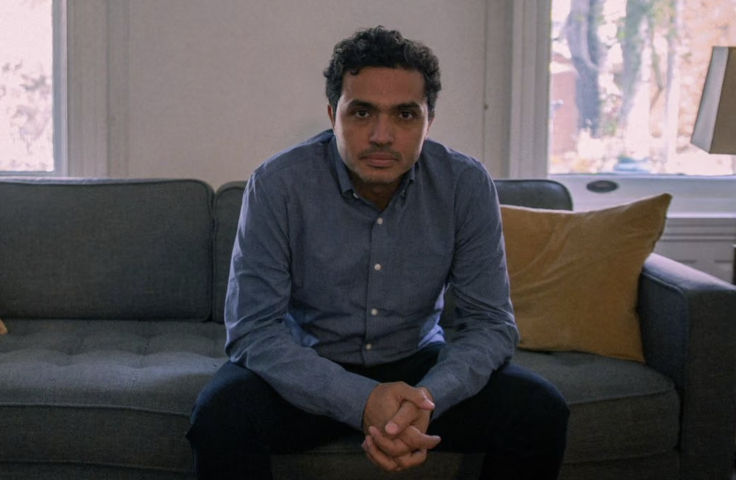
The first Pennsylvania Democrat to launch a primary challenge against Sen. John Fetterman is a Gaza-born writer and anti-Israel activist who has penned op-eds defending Hamas and Hezbollah and serves on the advisory board of a boycott Israel group with ties to Hamas and Palestinian Islamic Jihad, a Washington Free Beacon review found.
Ahmed Moor announced his campaign in an interview with the Philadelphia Inquirer, which described Moor as a "dues-paying member of the Philadelphia chapter of the Democratic Socialists of America" and a "Palestinian American writer who was born in Gaza."
The interview did not press Moor about several op-eds he has written, including a November 2010 piece in the Guardian, headlined "America's role in Lebanon," in which Moor describes Hezbollah—the terror outfit responsible for the deaths of more than 200 Americans in the 1983 Beirut Marine barracks bombing—as a "legitimate political party that reflects the aspirations of many Lebanese people."
Moor described Hamas in a similar manner in a July 2024 op-ed in the Guardian in which he outlined the "basic truths" of the "Palestine-Israel nightmare," writing, "It remains the case that many Palestinians view the Islamist parties Hamas and Islamic Jihad as among the only actors committed to their right to self-defense. That right is self-evident to the Palestinians and their supporters, no matter their views of either party. … Hamas’s assertion of Palestine’s right to self defense—in defiance of Israel, the United States, Britain and Germany—also acts as one of the few points of leverage available to the Palestinians after decades of a failed 'peace process.'"
Months earlier, in October 2023, Moor was quoted as a "Palestinian thinker" in a Guardian forum that asked him to describe the "set of emotions and experiences" he felt as Hamas carried out its Oct. 7 terror attack on Israel. "I experienced a commingled set of feelings," Moor responded. "You can't, as a Palestinian, as somebody of conscience, observe that bulldozer breaking through that wall and not feel a sense that 'the natives have broken free—good for them.' At the same time, I had a deep sense of foreboding." More recently, Moor has published his writing on Substack, including a March 2026 piece headlined, "Zionism continues to be the problem."
Moor serves on the advisory board of the US Campaign for Palestinian Rights (USCPR), an anti-Israel nonprofit "working to end all U.S. support for Israel's military occupation and apartheid policies toward Palestinians." The group is the fiscal sponsor of the Palestinian BDS National Committee (BNC), which is based in the West Bank and advocates for global sanctions against Israel. The committee's members include the Council of National and Islamic Forces in Palestine, which is made up of five U.S.-designated terrorist organizations including Hamas, Palestinian Islamic Jihad, and the Popular Front for the Liberation of Palestine. The fiscal sponsorship was the subject of an unsuccessful 2019 lawsuit arguing that USCPR provided material support for terrorism by lending its nonprofit status to the BNC.
Moor could become the latest anti-Israel radical to win the Democratic nomination for a competitive U.S. Senate seat, following in the footsteps of Michigan senator-elect Abdul El-Sayed, whom Moor cited as a source of inspiration in his interview with the Inquirer. He described his primary bid as an "uphill battle," given that Fetterman is expected to attract "a field of experienced candidates with more fundraising and political experience." The same could have been said, however, about El-Sayed, who narrowly prevailed in his own primary against congresswoman Haley Stevens and state lawmaker Mallory McMorrow after running to their left and campaigning against the U.S.-Israel relationship.
Indeed, Moor's résumé bears a striking resemblance to that of El-Sayed.
Both have ties to Egypt, where El-Sayed—the son of Egyptian immigrants who has claimed to hold Egyptian citizenship—spent his summers growing up and where Moor lived in 2011 while working as a freelance journalist covering the Egyptian revolution. The violent uprising culminated in the Muslim Brotherhood taking power through Egypt's former Islamist president, Mohamed Morsi, whom El-Sayed supported in a 2012 letter urging Morsi to "purge" media and police.
Both El-Sayed and Moor were 2012 recipients of the Paul & Daisy Soros Fellowship, which supports "one to two years of graduate study in any field and in any advanced degree-granting program in the United States" for students who are "immigrants and children of immigrants." El-Sayed used it to obtain a Ph.D. in epidemiology from Columbia University; Moor received a master's in public policy from Harvard University.
Like Moor, El-Sayed has published opinion pieces in the Guardian, including one that praised the British democratic system as superior to America's. Moor also regularly published anti-Israel pieces in HuffPost in 2011, the same year El-Sayed published a piece in the outlet arguing that if the Muslim Brotherhood was to take power in Egypt, "the ensuing state would look nothing like Iran." That overlap could explain why Moor tweeted in September that he's "known Abdul El-Sayed for a long time."
Unlike El-Sayed, Moor was not born in the United States but in "the Rafah refugee camp in the Gaza Strip," as he described it in a 2009 Electronic Intifada article. He moved to Philadelphia with his family as a child before returning to the West Bank in the late '90s and leaving "after the second intifada started in 2000," according to the Inquirer.
In the Electronic Intifada piece, Moor referred to Israel as an "apartheid state" that "rules over me in Gaza," though Israel withdrew from the strip four years prior and Moor worked in finance in New York at that time after graduating with a bachelor's degree from the University of Pennsylvania. He also explained, in his words, "why Zionism is racism and why Zionists are racists."
"In plain English, Zionism is the view that Jews have a right to the land of Palestine to the exclusion of non-Jews," he wrote. "Practically, that means that tracts of land that are inhabited by non-Jews need to be ethnically cleansed so that Jews may take their place."
Moor, whose campaign did not immediately respond to a request for comment, now says he's running for Senate "because of what he considers a series of national 'crises'—around corruption, the cost of living, constitutional authority, and foreign policy." His interest in domestic issues appears to be a new one—all of Moor's pieces in the Guardian center on Israel.
Fetterman, a staunch supporter of Israel, has not said whether he will run for reelection. Several Democrats are expected to run for his seat, including Pittsburgh-area congressman Chris Deluzio, who is seen as likely to enter the race in the near future. Moor could face competition among liberal voters from left-wing congresswoman Summer Lee, another rumored challenger.