


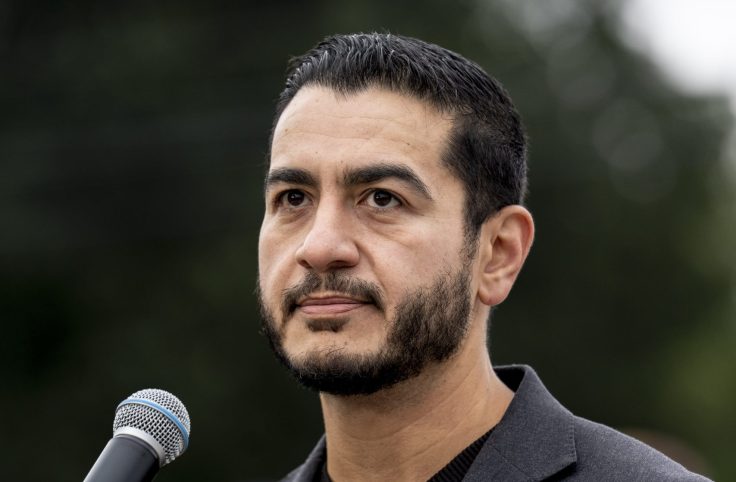
Michigan Democratic Senate candidate Abdul El-Sayed praised the British democratic system as superior to America's in a 2010 op-ed, arguing that the British system is better because it allows ethnic minority groups to concentrate more electoral power.
El-Sayed wrote the opinion piece for the Guardian headlined, "UK democracy has upper hand on US," about his experience attending a parliamentary candidate debate in East London.
"As an American, born, bred, and taught in school that American democracy was the greatest in the world, I was initially sceptical of this foreign brand," he wrote. "But what I experienced that evening [at the debate] was a ceremony in communal self-determination that I have yet to see in any federal American electoral institution."
El-Sayed said his experience made him "a tad envious" of British democracy and he wished he could vote in their elections. "What are the odds they'll allow an American [to] cast his vote on 6 May?" he wrote. El-Sayed added that one of the things that made the East London debate "so impressive" was that "all of the candidates at the [debate] were themselves Bengali."
"As an Arab-American, the likelihood of ever having the opportunity to vote for an Arab-American candidate for national office during my lifetime is minimal," he wrote.
El-Sayed argued that "ethnic minority and socioeconomically disadvantaged groups are more concentrated in British constituencies," as opposed to in the United States, where "the will of the majority drowns out the political voice of the disadvantaged."
Because of this, he claimed, the British national election "becomes a community exercise in cohesiveness and solidarity, antithetical to the American electoral climate."
Despite El-Sayed's claims about American politics, at the time of his op-ed at least 16 Arab Americans had already been elected to the U.S. House or Senate, including from El-Sayed's home state of Michigan, where U.S. senator Spencer Abraham (R.), a Lebanese-American, was elected in 1994 and served until 2000.
Other notable Arab-American politicians who had already held federal office included former Senate majority leader George Mitchell (D., Maine), John E. Sununu (R., N.H.), and Rep. Ray LaHood (R., Ill.), who went on to become transportation secretary under President Barack Obama.
Months after El-Sayed's op-ed was published in 2010, Rep. Justin Amash (R.), a Palestinian-American and Syrian-American, was elected to the U.S. House from Michigan.
El-Sayed also complained that U.S. politicians tend to focus on divisive issues in order to rally their bases—something he has been accused of during his election, as he has embraced overtly anti-American figures such as Hasan Piker and harped on the issue of Israel, accusing the country of genocide.
"US elections bring out the worst divisions in American society, as candidates focus on rallying their 'core', often blithely alienating everyone else," he wrote.