

Unprincipled triangulation and a stained blue dress notwithstanding, one of Bill Clinton’s more irksome legacies is that of presidential wannabes showcasing their personal tales of woe, as if leading the free world is an audition for a daytime talk show.
Clinton, you might recall, entered the national stage as a child of modest means devoid of a biological father who’d died in a car crash before the future president came into the world, spending his teen years defending his mother against an abusive stepfather (years later, Hillary Clinton would claim that it was Virginia Cassidy Blythe Clinton Dwire Kelley’s abuse of her son that accounted for the president’s wandering eye).
The same practice—"I’ve had it rough too"—continued with George W. Bush (life began at 40 when he quit boozing), Barack Obama (a bestselling book making sense of his mixed-race identity), and Joe Biden (in addition to a car crash that claimed the lives of his first wife and a daughter, overcoming a childhood stuttering problem).
Noticeably missing from this Oprahesque chain: Donald Trump, whose MAGA base thrives on envy, not empathy—the outsized lifestyle of money, mansions, and a supermodel wife; a flouting of political decorum that is brand-exclusive.
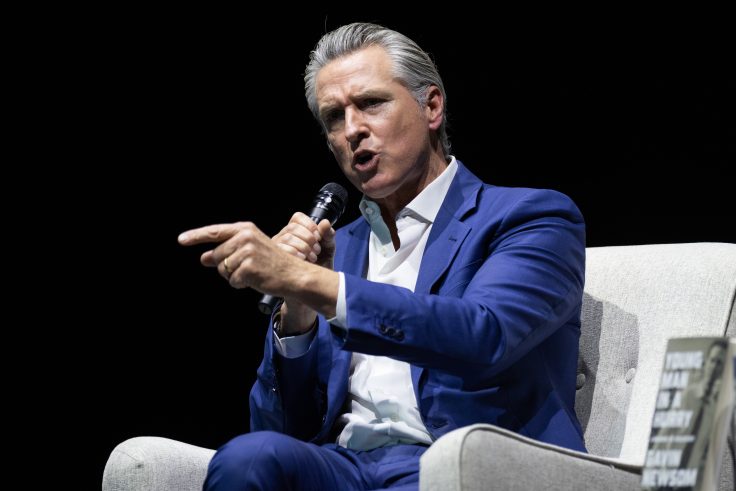
Now along comes California Gov. Gavin Newsom, presumably a presidential contender when he leaves office next January, and a new autobiography, Young Man in A Hurry (a reference to a headline when he first ran for governor, 17 years ago, at age 41)—a tale of Newsom’s upbringing and career arc that cuts off as he takes office in 2019 as California’s 40th governor (if you want to know what possessed him to dine at the French Laundry amid a COVID lockdown, you’ll have to wait for a second installment).
Is Newsom having us believe that he’s the Democratic version of J.D. Vance, who rose to pre-Trumpian fame with Hillbilly Elegy? Not exactly. Unlike Vance, Newsom didn’t grow up in hardscrabble Appalachia. San Francisco and neighboring Marin County were his nesting grounds.
But where Newsom "had it rough too": struggles with dyslexia that continue to this day and, as a child of divorce, navigating his father’s adjacency to wealth as a Getty family consigliere while his mother worked multiple jobs to make ends meet (California didn’t have child-support enforcement laws until 1975, four years after Newsom’s parents divorced; the author doesn’t note if his mother had a bad attorney or just didn’t ask for financial help).
To his credit, Newsom’s book flows smoothly, even if page after page of family history seems excessive and the narrative suffers from a "degrees of Kevin Bacon" insistence on name-dropping (I could have lived without knowing the Gettys partied with Mick Jagger, or that his San Francisco wine start-up was connected to JFK’s assassination).
Add to that the same bug-feature as in most any Newsom public appearance: a stream of 25-cent words. Newsom laments his old man’s "abrogation" of fatherly duty, when most people similarly gifted with a 960 SAT score would go with "didn’t have my back." It’s a fancy word that pairs well with a glass of reserve cab, but it comes across as the former wine salesman selling a little too hard.
And therein lies a shortcoming in Newsom’s memoir: selling too hard. Whereas Clinton marketed himself back in the day as "the comeback kid" following a near-death experience in a New Hampshire primary, Newsom wants you to feel his pain as a "double kid" (I’m stealing the line from The Departed)—a young man (not yet in a hurry) whipsawed between paternal Getty opulence and maternal Marin austerity.
The problem: For some reason, the story isn’t all that moving. But maybe that’s because, as one reads the story of hardship, it’s hard to escape the image of the adult Newsom—model handsome, millions in the bank thanks to success in wine and hospitality, plus a sartorial style that reeks of Bay Area beautiful-people privilege (which is why Newsom wrote the book in the first place—to dispel the notion that he’s a "spare" Getty).
A second problem: At times, the story is murky thanks to years of the governor and his minions (and lazy reporters) twisting the story.
Take the matter of the governor’s love affair with baseball, which Newsom credits as his ticket to college.
Back in 2004, Newsom threw out the first pitch at a San Francisco Giants game, with the then-mayor introduced as follows: "He played first base for the University of Santa Clara and was drafted by the Texas Rangers." In fact, Newsom never was drafted, nor did he play an inning of varsity ball.
Newsom’s book, in fact, plays into the mythology. As he tells it, the head coach of Santa Clara’s team shows up in his living room and, so moved by Newsom’s mad skills but late into the recruiting phase, can offer the first baseman but a partial scholarship. What the author doesn’t note: He also got letters of recommendation from former Gov. Jerry Brown and his father’s best friend, then a member of the university’s board of regents.
Newsom’s struggles with dyslexia likewise get twisted. Yale’s Center for Dyslexia & Creativity notes: "When Newsom was in fifth grade, he discovered in his mother’s office a stash of papers reporting on his dismal academic performance and describing something called dyslexia." In his book, Newsom writes: "Year after year, the word dyslexia never showed up in my school records. The actual name of the affliction I suffered from remained a mystery to the school and to me."
Other examples where Newsom gives a more idealized version of the past: Pages devoted to his granting same-sex marriages during his first year as San Francisco’s mayor include scant mention of the subsequent battle over Proposition 8 and defining "marriage" in California. Why the snub? Because an ad featuring a soundbite from an overbearing Newsom turned the tide against the same-sex argument.
When Newsom isn’t portraying the past in rosier terms, he’s looking to throw others under the bus for his own blunders—as with Clinton, mea culpa just isn’t in the extensive vocabulary.
An affair with a mayoral aide, the wife of a friend and deputy chief of staff, quickly turns to his battles with demon rum (there’s no mention of how his current wife, the women’s-rights champion Jennifer Siebel Newsom, slut-shamed her boyfriend’s paramour).
The first Mrs. Newsom comes across far worse. Kimberly Guilfoyle, it seems, is partly to blame for Newsom’s appearance in Harper’s Bazaar clad in a tux and spooning the future ambassador of Greece on a fine Oriental carpet in the Getty mansion. Somewhere in Athens, the former Mrs. Newsom must be fuming over a memoir in which she’s spun as needy, fame-hungry, and dissed by her ex-husband’s mother and sister.
As for Newsom’s father: Well, it’s complicated. Time and again, the son makes it a point to call out the late William Newsom’s shortcomings. Yet later in his second term as San Francisco’s mayor, the son came to a fork in the road—heed his mother’s dying wishes and get out of politics (thus becoming the ever-present father he never had) or try to please the old man by continuing the climb up the ladder. Newsom’s choice: honor thy emotionally distant father and run for the insignificant office of state lieutenant governor (the "young man in a hurry" had to wait another eight years for his current job). Should Newsom run and win in 2028, watch for Maureen Dowd to give the new president her obligatory Jungian treatment of leaders obsessed with their fathers.
That moment is telling for another reason: Newsom the officeholder suffers from the political version of restless leg syndrome. In his second term as mayor, he aimed for higher office—in doing so, seeming to lose interest in his day job. The same seems true today. As a lame-duck governor, Newsom thrust himself into the national spotlight be it going to comical lengths to defend Joe Biden’s "masterclass" of a presidency, trolling Trump on social media, and, this year, twice traveling to European summits to offer himself as something of a shadow government leader—in the process, paying less attention to a gubernatorial record that hasn’t lived up to its promises.
With a memoir now under his belt, the question turns to whether the personal reflection will make Newsom more likable. Clearly, there’s work to be done among his peers (New Hampshire Gov. Chris Sununu once observed: "I’ve got to be honest, no one cares for Gavin. Gavin’s just a prick—excuse me—he just is.").
And maybe some left-leaning media outlets as well. Slate’s review of Young Man in a Hurry reads: "It’s like Hillbilly Elegy but for middle-class alcoholics in the Bay Area with close ties to petroleum magnates." The New Republic calls it "a decently, if unexceptionally written narrative that does the worst job imaginable of convincing us the governor is not the preening elite that his haters say he is."
Which should be the biggest concern in Newsom’s camp as he continues to raise his national profile: To the extent there’s a sympathetic childhood with which to sway persuadable voters, does it get overshadowed by the man currently in a hurry to become the next Democratic nominee? Will the sliver of the electorate that doesn’t instinctively gravitate to X/Fox News or Bluesky/MS NOW look at Newsom and see a tale of dyslexia and determination, or a seasoned pol with slicked-back hair and overly slick presentations (one doesn’t recall Bill Clinton pushing as hard to prove that he can relate to America’s black experience)?
A final thought: Since he rode down the Trump Tower escalator nearly 11 years ago and announced an improbable presidential campaign, Donald Trump has changed many rules and standards of the game. Political discourse is cruder than it was in 2015. Politicians are more reliant on hot-heads on social media than more reflective speeches and lengthy interviews. Come 2028, we’ll see if voters prefer deeper (Newsom) or shallower (AOC) political résumés.
But has Trump’s style also rubbed off on the prerequisite that presidential candidates must be foisted upon the electorate through a sympathetic and filtered lens? Put another way, will the Democratic and Republican vetting be a competition to tug at heartstrings, or will the race go to the candidate who can trump the field with the Trumpiest of brickbats and braggadocios?
At the moment, Newsom is trying to have it both ways. His book wants you to feel the pain of a young boy with a bad haircut and physical limitations; the man peddling the book seems to think the road to the White House entails being a bluer version of the Orange Man.
The "double kid," it seems, once again has found a duality to his existence.
Young Man in a Hurry: A Memoir of Discovery
by Gavin Newsom
Penguin Press, 304 pp., $30
Bill Whalen is the Hoover Institution’s Virginia Hobbs Carpenter Distinguished Policy Fellow in Journalism and moderator of Hoover’s GoodFellows broadcast show.