




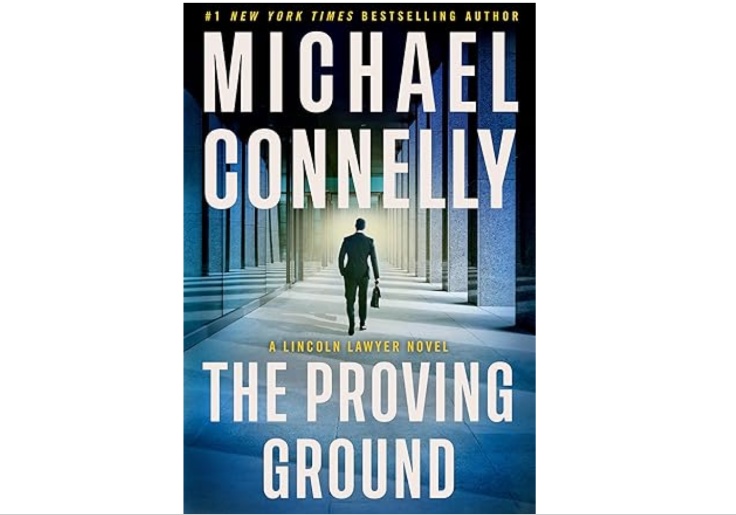
Michael Connelly has published a novel every year since his first Harry Bosch book, The Black Echo, won him an Edgar Award in 1993. Sometimes he has published two. Series are his thing. There are currently 25 books in the Bosch series, 3 featuring the reporter Jack McEvoy, 6 in the Renée Ballard series (counting the ones in which she teams up with Bosch), and now 8 in the Lincoln Lawyer series with the publication of The Proving Ground at the end of October.
The Proving Ground features a kinder, gentler Mickey Haller who has abandoned criminal law for civil court to make the world a better place by suing the pants off Tidalwaiv Technologies, whose AI chatbot may have encouraged a sexually frustrated young man to murder his former girlfriend. Haller represents the mother of the murdered girl who wants justice, not money, and Haller goes toe-to-toe with the Mason twins in court (and Tidalwaiv goons out of court) to get it. Tidalwaiv seems "able to do anything," Haller tells his office manager at one point before adding: "anything but stop me and this case."
And that’s the fun thing about a Connelly novel. Whatever their other faults, Connelly’s scheming lawyer and misfit detectives are tenacious. The courtroom is "the proving ground," but Haller prefers to call it the Octagon: "Two go in, one comes out the victor. No one is left unbloodied. No one is left unscarred." The courtroom drama is tight, as it always is with Connelly, even if Haller is a little too good at times. Yet, while battling the Mason twins, Haller takes on a second case that does wound him. Flipping between two cases is a common feature of Connelly’s more recent novels. It keeps the pace high and makes Haller seem ever the problem-solving mensch.
In fact, there is little Connelly’s protagonists do not know or cannot do, even if it has nothing to do with the plot. In Connelly’s first Lincoln Lawyer novel, Haller gets into his Town Car while his driver, Earl Briggs, is listening to rap:
"Who was that you were listening to?" I asked him.
"Um, that was Three Six Mafia."
"Dirty South?"
"That’s right."
Over the years I had become knowledgeable in the subtle distinctions, regional and otherwise, in rap and hop-hop.
When a body is discovered submerged in the main port town of Catalina Island in Connelly’s previous novel (and perhaps new series) Nightshade, our intrepid Detective Stillwell dives down himself to take a look. He guesses correctly how long the body has been underwater. "Stillwell knew the stages of decomposition in cold water," we are told. It just so happens he used to work as a body-recovery diver.
Connelly’s characters frequently appear in each other’s books. Bosch, who is Haller’s half-brother, was in the second Lincoln Lawyer novel, The Brass Verdict (2008), and several others since. Bosch and Ballard regularly work together, and Haller has appeared in five Bosch novels since the 2009 Nine Dragons.
In The Proving Ground, Haller is joined by McEvoy, who uses his tech expertise to help Haller process thousands of pages of heavily redacted, highly technical documents in order to find something he can use in court against Tidalwaiv. As Haller tells us, he may be "a killer" in the courtroom, but he needs "weapons to kill with."
McEvoy is different from Connelly’s other male protagonists. He is divorced, like them, but he lacks the swagger of Bosch or Haller. In The Proving Ground, McEvoy gets himself tied in a knot with a key witness, and Haller has to "step in."
But McEvoy also gets slightly more believable lines than Haller. Connelly’s dialogue is tight but hardly original. Haller is a fast thinker and a fast talker, so it makes sense that some of his lines are banal. "Don’t be sorry," Haller tells his client. "Just be yourself." He worries about the "ongoing trauma" in the life of one of his witnesses.
Haller isn’t the only one who gets saddled with the occasional cliché. When he is preparing for the first day of court, Maggie, his first ex-wife (who adds an extra twist to the novel), tells him: "Go get ’em, Tiger." When Haller tells one of the Mason twins, "Man, I could write your dialogue in my sleep," one is tempted to say the same thing of some of the other characters in the novel.
Like his other novels, Connelly gives The Proving Ground a contemporary setting, though it is more obsessively contemporary than his other books. He mentions Patreon, Substack, DoorDash, YouTube, Amazon Prime, TikTok, Siri, Alexa, alcohol-free Guinness (which Haller’s investigator finds surprisingly good), and even his own Lincoln Lawyer Netflix series. Very meta. He also mentions illegal immigration, Fox News, Donald Trump, Christian voters, incels, student loans, the National Rifle Association, and COVID-19 vaccines.
But Connelly never pesters us with his politics. He knows his job is to entertain us, and that’s exactly what he does—and nothing more—in The Proving Ground.
The Proving Ground: A Lincoln Lawyer Novel
by Michael Connelly
Little, Brown and Company, 400 pp., $32
Micah Mattix has written for the Wall Street Journal and many other publications.