

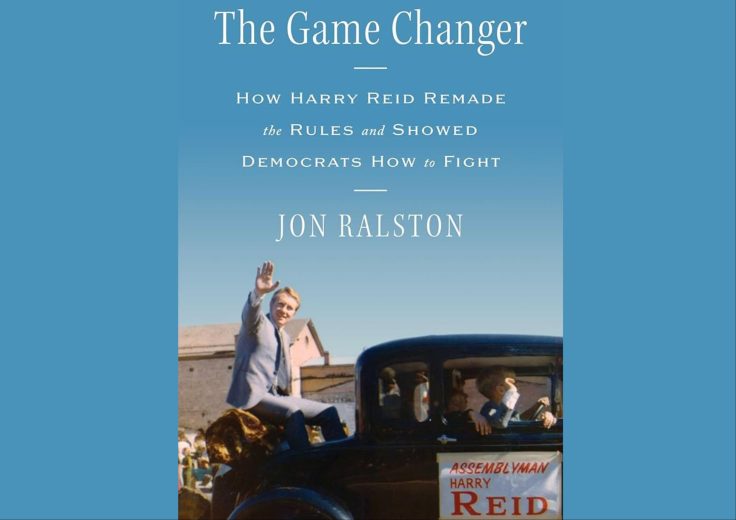
Power, not anchored to any larger principles, is a recipe for self-preservation over good governance. That's the picture that veteran Nevada political journalist Jon Ralston paints of the late former Senate majority leader Harry Reid and his worldview, in a meticulously reported if largely solicitous book about Reid's political life, The Game Changer.
The subtitle of Ralston's book is: "How Harry Reid Remade the Rules and Showed Democrats How to Fight." That is, indeed, Reid's legacy. Growing up in a rough, hardscrabble environment in the small mining town of Searchlight, Nev., Reid quickly learned how to amass power—starting in student government after moving to the Las Vegas suburbs—developing important political patrons early in his career, while using the ugly slash-and-burn political attacks against opponents that defined his later years as Senate leader.
Making baseless accusations of corruption about a rival's personal finances? Reid famously lied about Mitt Romney's taxes in 2012—and never apologized. But Reid adopted the tactic in his first campaign for the Senate in 1974 against Republican Paul Laxalt, falsely accusing the former governor of corruptly profiting from an investment in a Las Vegas hotel. (Reid lost the race by a whisker, after the vibrant state press corps called him out on his below-the-belt campaign—a level of press scrutiny that wasn't matched when he accumulated more power on Capitol Hill.)
Making impulsive decisions and not taking responsibility when they backfire? Reid's successful 2013 push to kill the filibuster for confirming President Obama's lower court judicial nominees led to the GOP's ability to more easily confirm Supreme Court justices when the partisan tables turned. There are echoes of that kind of political recklessness throughout his early political career—from refusing to concede after narrowly losing the 1974 Senate race while not paying debt owed to his political consultants to rushing into a follow-up campaign for Las Vegas mayor in 1975 when he lost in embarrassing fashion.
Notably, in shades of President Trump, Reid, shortly after his election to Congress, lambasted the FBI as politically compromised, calling for investigations into the investigators. The public didn't know at the time that Reid himself was under investigation by the FBI over alleged mafia ties.
Holding very few fixed principles other than winning and amassing power? Reid, notably, campaigned against the controversial Roe v. Wade Supreme Court decision protecting abortion rights across the country, even supporting a national right-to-life amendment. Running for mayor of Las Vegas, he decried "illegal aliens" depriving native Nevadans of jobs in the gaming industry. In his successful campaign for the House in 1982, Reid championed Ronald Reagan's tax cuts, criticized waiting periods for gun purchasers, and railed against violent crime.
To borrow from the late Raiders owner Al Davis, Reid's political motto was: "Just win, baby!"
Reid's Republican counterpart in Senate leadership, Mitch McConnell, is an example of a total contrast in leadership, standing up for conservative principles even when it ran against the narrow political interests of the moment. McConnell famously opposed ending the legislative filibuster even when it played into the GOP's short-term interests. He railed against campaign finance reform as a core issue even when it wasn't a politically popular thing to do. And he continues to speak up for a muscular national security, especially in defense of Ukraine, which has become a controversial stand these days within the GOP.
Reid's interest in positioning himself as a powerbroker over advocating core principles helped him build a long list of allies across the spectrum. He maintained a close personal relationship with his political patron (and high school history teacher), former Nevada Gov. Mike O'Callaghan, throughout his entire life. He ended up developing strong relationships with a number of Republican friends throughout his career, from in-state Republican elected officials like Laxalt to the iconic entertainer Wayne Newton, a conservative who successfully lobbied Reid for ownership in a Las Vegas casino when the Democrat served as a gaming regulator. (The gaming commissioner in Martin Scorsese's Casino is loosely based on Reid.)
Ralston's tome benefits from ample access to Reid in his final years, even though the two Nevada institutions had an often-contentious relationship with each other. In these interviews, which are sprinkled throughout the text, Reid, at times, was reflective over some of his excesses and was willing to share generously more about his tactical mistakes, youthful indiscretions, and campaign blunders. But he never confronts the more serious flaws in his governing and political record—particularly, his responsibility for the rise in coarseness that shadowed his career (and is highlighted in the subtitle of the book).
Ralston tags Reid as a game-changer for his role shepherding Obama's landmark health care law through the Senate by the barest supermajority, and quotes Reid as being driven by a longstanding goal to secure medical access for the needy. The author notes that Reid's parents never received medical care, and that an emergency procedure that Reid received as a child—the only time his family saw a doctor, Reid recalls—ended up saving his life. "What did not kill him gave him a strong belief that no one should be deprived of health care, no matter their financial circumstances," Ralston writes.
And while passing Obamacare through the Senate is certainly a major part of Reid's legacy, it's as much a consequence of using dealmaking and arm-twisting among Democrats to pass a president's priority on a party-line vote—accomplishing what any Senate leader of a president's party would be doing—than as a result of any idealism. The deals cut with moderate Democrats like Ben Nelson of Nebraska and Joe Lieberman of Connecticut to secure the law's passage were a testament to Reid's effectiveness within his Democratic caucus, even as he struggled to persuade Republicans.
It's also worth remembering that Obama's landslide victory in 2008 handed Reid a near filibuster-proof majority in the Senate, with Democrats holding full control of Washington for the first time in over a decade. Not being able to pass legislation with those majorities would be a sign of abject incompetence.
All told, Ralston's biography of Reid is an engaging tale of a partisan power broker who clawed his way to the top of Senate leadership through tenacity and a little ruthlessness. For political junkies, Ralston's narrative is a treat to read as he recounts in great detail all the strategic and tactical decisions that animated the biggest elections and decisions of Reid's career. The only shortcoming is that we don't see the author—or his subject—fully grapple with the rise of partisanship and coarseness that thrives in Washington, in part as a result of Reid's no-holds-barred political playbook.
The Game Changer: How Harry Reid Remade the Rules and Showed Democrats How to Fight
by Jon Ralston
Simon & Schuster, 400 pp., $30
Josh Kraushaar is the editor in chief of Jewish Insider and a Fox News Radio political analyst.