





On the eve of America's bicentennial, the American Enterprise Institute published Irving Kristol's lecture, "The American Revolution as a Successful Revolution." Kristol noted that at the time "the idea and very word, 'revolution,' are in good repute today; the American Revolution is not." Yet the American Revolution was "the only truly successful revolution" because it was able to "subordinate" human "passions to serious and nuanced thinking about fundamental problems of political philosophy." In other words, the revolution yielded, by its unique design, to a stable and flourishing republic rather than carry on the bloody work of eternal radicalism. Dyed-in-the-wool revolutionaries blanch at the idea that a well-structured republic could ever carry out the work of a once-vital revolt against the ruling order.
Our Founding Fathers understood better, Kristol argued, and displayed as much in speaking candidly "about the frailties of human nature and the necessity for a political system to take such frailties into account." Humans being fallen creatures, perpetual revolutions seeking to perfect the human condition would only result in bloodshed and tyranny.
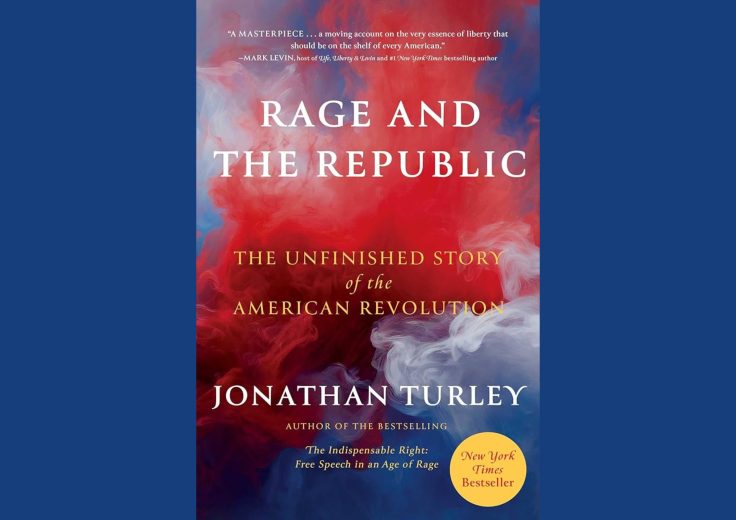
Now, on the eve of America's 250th anniversary, law professor Jonathan Turley has picked up the Kristolian thread and issued a stern warning against perpetual revolution, coupled naturally with a defense of limited, republican government. His Rage and the Revolution: The Unfinished Story of the American Revolution places readers back into history, showing how we Americans are not so far removed from our revolutionary origins. The embers of 1776 smolder, which is not a bad thing—as long as they are used responsibly. Misdirected energy can do a great deal of damage. Turley is borderline obsessed with the imagery of Saturn devouring her children, the prototypical myth of revolutionary excess later exemplified by the French Revolution first sending aristocrats to the guillotine—and then sending insufficiently radical revolutionaries to the same fate. The Bolshevik Revolution followed a similar trajectory. Yet the American Revolution succeeded. Or, at least, it has thus far. Our story is indeed unfinished. Can we maintain our success?
Turley directs readers to study the French Revolution, and particularly the fall from grace of erstwhile hero Thomas Paine—nearly devoured by his children, as it were, in France—who stirred his compatriots' rage in the nascent United States before his disillusionment overseas. Rage boiled in late-18th-century France, just as it did here, fanned in large part by Paine's pamphleteering and polemicizing. Yet Paine eventually became a pariah and narrowly avoided execution in France, after having been rejected—but never so threatened—by the Englishmen and Americans who thought him reckless. Edmund Burke, Paine's famously reformist British counterpart, got the better of the argument when "Paine's continued idealism and presumptions of the civic virtue behind the [French R]evolution" proved wrong with mobs pursuing him on the street and his arrest at the hands of the Jacobins. "Both Paine and Burke supported the American Revolution in their own ways," Turley summarizes. But "to Burke, France was a nation that dismantled every institution and tradition in a mad plunge into popular government and chaos."
Burke's judgment was keen. But Paine's misjudgment lives on. In reviving their story and connecting it to contemporary romanticization of popular government and institutional dismantlement, Turley offers a reminder that the zealous idealism which accompanies new political realities, and the lack of stable institutional structures in the aftermath of political rupture, can court disaster. He is not the first to make this point, but it always bears repeating that Americans should be on guard for the two forms of chaos that accompany revolutionary fervor.
The first form is mobocracy, exemplified by the mob that cornered Paine mistaking him for a nobleman. Large crowds full of zealous people convinced of their righteousness—and the inevitability of their victory—can commit heinous injustices in the name of their ideology. Condemning a lynch mob that murdered a black man in St. Louis, a young Abraham Lincoln echoed Burke in his 1838 Lyceum Address:
When men take it in their heads today, to hang gamblers, or burn murderers, they should recollect, that, in the confusion usually attending such transactions, they will be as likely to hang or burn some one who is neither a gambler nor a murderer as one who is; and that, acting upon the example they set, the mob of to-morrow, may, and probably will, hang or burn some of them by the very same mistake. And not only so; the innocent, those who have ever set their faces against violations of law in every shape, alike with the guilty, fall victims to the ravages of mob law; and thus it goes on, step by step, till all the walls erected for the defense of the persons and property of individuals, are trodden down, and disregarded.
Anyone who has observed the destruction of American cities by mobs chanting mindlessly about justice and peace or heard rationalizations for vigilante murders of CEOs or political activists knows too well how right Burke and Lincoln were.
The second is what Turley calls "democratic despotism," which deservedly gets more attention in Rage and the Republic because it is easier to sanitize. It is the tendency of revolutionaries to seek out and tyrannize those who opposed the revolution, did not adequately support it, or simply harbored skepticism about its ideals. Paine felt democratic despotism when the new ruling order imprisoned him on the thinnest of charges. New ruling classes, mistaking moral confidence for moral perfection, tend to tip over into extreme democratic faith. They believe the people who have effected the revolution at great risk to themselves can be trusted to act in the public interest.
America's Founders addressed this through constitutional structure, designed to inhibit democratic despotism through the structure of government. Bicameralism and presentment, checks on majority rule such as the Senate and Supreme Court, and robust federalism all protect against mob rule in its subtler form. This is precisely what frustrates today's revolutionaries, who agitate for Court-packing, abolishing the Senate (and Electoral College), and a national popular vote for president.
Turley addresses today's revolutionism by surveying the different estates of American society that have given up on the Constitution in letter and spirit. Politicians, media figures, and academics, overwhelmingly but not exclusively leftist in orientation, are rightly targeted. The argument comes out persuasive and well-established: Many Americans who ought to know better are cavalier about destroying crucial institutions in fits of democratic faith. They either have not considered, or don't care about, the problem of democratic despotism. That is a fatal mistake.
One weakness of Turley's analysis, though, is that he seems to conflate different kinds of threats to the American constitutional order. Put differently, he doesn't quite define the rage of our age. Sometimes the examples he cites seem to harbor genuine revolutionism. Other examples exhibit casual bloodlust. Most simply display disrespect or ingratitude for our Constitution. It would benefit the book to disambiguate between the different kinds, and explain which ones are in line with the "unfinished story of the American revolution," or part of our incremental effort to bring American life into increasing conformity with the lofty principles that animated our Founding.
That said, Turley's book is a valuable act of contextualization. We are not beyond the age of revolutions, nor are we so thoughtful and perfected that we could avoid devouring our own children if we did see major political, social, or economic upheavals. We are human beings with human frailties, and whatever political path we take, we will have to take those frailties into account, treading carefully and self-consciously lest our rage consume our republic.
Rage and the Republic: The Unfinished Story of the American Revolution
by Jonathan Turley
Simon & Schuster, 448 pp., $31
Tal Fortgang is a legal policy fellow and adviser to the president at the Manhattan Institute.