

The effects of Nicolás Maduro's sudden downfall are now rippling far beyond the Caribbean basin. To wit, the U.S. military toppling the Venezuelan dictator without breaking a sweat is a humiliation for the Chinese Communist Party, which cannot dominate even its immediate neighborhood because of American armed might. Xi Jinping seeks not only to drive our military out of the Western Pacific, but also to build his own globe-spanning forces. If he succeeds, China will inhibit America’s ability to defend its interests even close to its shores.
The evening of Jan. 2, Maduro lauded "the strong bonds of brotherhood and friendship between China and Venezuela." Six-and-a-half hours later, American commandos deposed him in a lightning raid. On the evening of Jan. 7, the president of the United States crowed that the new rulers of Caracas were "giving us everything that we feel is necessary."
Beijing could do little about it. Its foreign ministry sputtered about sovereignty and international law with, according to the Asia Society Policy Institute’s Neil Thomas, "rare, forceful language previously reserved for political assassinations and mass casualty events." But the CCP was unwilling to renew the trade war and has no significant military forces anywhere nearby, so it could do little. Latin America is still America’s backyard.
China’s situation is far different from America’s. The CCP cannot even gain control of Taiwan, which it claims as Chinese territory, thanks to the Taiwanese people’s determination to resist domination from the mainland and American might. Beijing cannot protect its faraway friends or prevent the United States from doing so. This asymmetry infuriates CCP leaders.
Less galling for them, but more disturbing, are the strategic implications of America’s global military. The most intense fighting in a war between China and the United States would likely occur around the first island chain, which stretches from Japan across Taiwan to the Philippines and around the South China Sea to reach landfall in Vietnam. But some of the most important action could occur far beyond Chinese borders. U.S. warships and aircraft around the world would swoop in on Chinese merchant vessels, choking Beijing off from the fuel and other raw materials on which its economy depends. Nowhere on the high seas would be safe for China-bound shipping.
Chinese leaders have spent decades trying to fix this vulnerability. Starting in the 1980s, Admiral Liu Huaqing developed a plan for a global navy. He hoped to control the seas inside the first island chain by 2000 and, by 2050, to have fully transformed the Chinese Navy from a hodgepodge coastal flotilla into an ocean-spanning force. This aligns with Xi’s subsequent goal of building a "world-class" military by 2049.
China has not yet reached Liu’s goal within the first island chain, but it is nonetheless making progress on developing a global reach. The first Chinese-designed aircraft carrier, the Fujian, finished its sea trials in May and is one of three controlled by Xi. He intends to acquire six more by 2035, according to the Pentagon’s annual report on the Chinese military. Those aircraft carriers began sailing beyond the second island chain, which includes American-owned Guam, this summer. Ukraine’s demolition of Russia’s Black Sea fleet demonstrated how lethal drones can be against conventional navies close to the shore, but aircraft carrier groups are still an important way to project power across oceans.
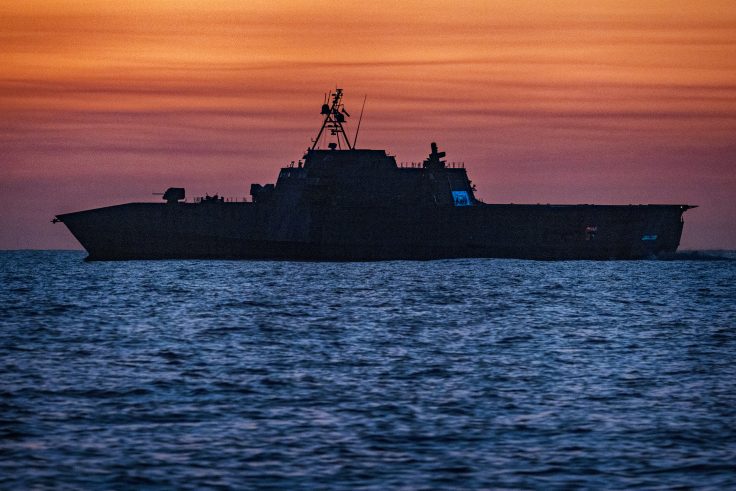
Trump understands the importance of ruling the waves, and he is addressing this problem with his trademark speed. Navy Secretary John Phelan announced the "Golden Fleet" initiative last month and intends to "launch the first hull in the water in 2028." The proposed Trump-class battleships have garnered the most media attention, but a more rapid buildup of other capabilities could frustrate Xi’s efforts to tilt the balance of power in his favor.
There are other ways to hem in the Chinese fleet. Most commanders shy away from exposing their most valuable forces in vulnerable positions, even in peacetime, so Indo-Pacific Command’s plan to turn the first island chain into a "hellscape" should force Beijing to keep its carriers close to home.
The Falkland Islands war in 1982 dismayed Soviet strategists. They knew that they could not match Great Britain’s ability to fight that far from home and concluded, correctly, that America’s ability to do so was even greater. As the Soviets despaired, rival Communists in Beijing decided to match this capability. They are closing in on their goal, and U.S. national security depends on meeting this new threat.