


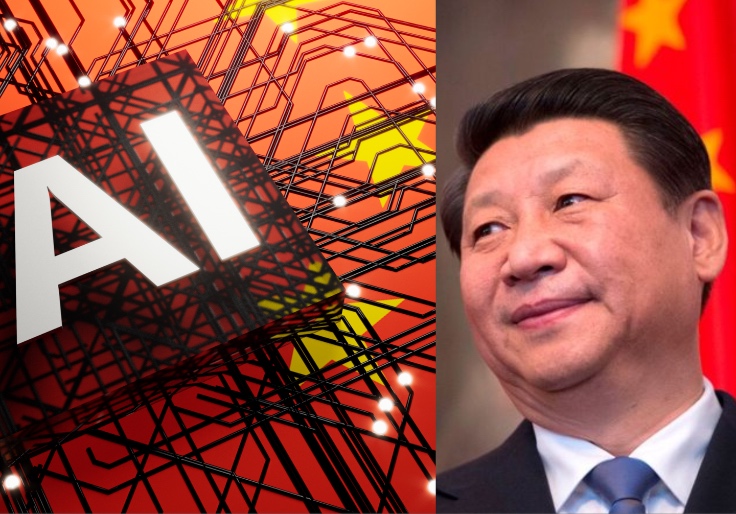
Propaganda outlets controlled by China—as well as Russia and Iran—are promoting campaigns in the United States to oppose the construction of new data centers, indicating that Beijing and Moscow are looking to impede artificial intelligence innovation in the United States. The campaign appears to have made inroads with at least one American lawmaker, Sen. Bernie Sanders (I., Vt.), who is participating in a discussion Wednesday with two Chinese academics on "the existential threat of AI."
From the CCP's English-language newspaper China Daily and its subsidiary Global Times to the English-language division of Beijing's state broadcaster, China Global Television Network (CGTN), and RT, formerly Russia Today, China and Russia are pushing the message—within the United States—that the data centers that power artificial intelligence are harmful.
An October 2025 CGTN video, for example, states that "energy-hungry data centers that have sprung up due to AI investments" are "sadly" causing a "major spike in energy prices," particularly "on the West Coast, Mid-Atlantic, and New England." Last month, a China Daily piece, headlined "AI boom sends electricity bills in US skyrocketing," quoted a Siena University economics professor, Aaron Pacitti, to argue that "electricity prices in the United States are emerging as a new source of economic strain" due to "surging power demand from data centers." China's Global Times followed suit earlier this month, lamenting data centers' "high energy consumption."
"Data centers, stacked with thousands of servers, are a major devourer of energy," a narrator that appears to be AI-generated says in the CGTN video. "This, combined with America's older grid and rebuilding cost, has raised prices."
The propaganda push comes as the United States and China compete "to achieve global dominance in artificial intelligence," as the White House put it in a July 2025 AI Action Plan. "Whoever has the largest AI ecosystem will set global AI standards and reap broad economic and military benefits," the plan states. "Just like we won the space race, it is imperative that the United States and its allies win this race."
China has sought to keep up with U.S. tech by engaging in "deliberate, industrial-scale campaigns" to steal American AI systems, according to the White House Office of Science and Technology Policy. At the same time, Beijing is encouraging U.S. movements aimed at voluntarily restraining American tech innovation—and is gaining momentum among progressives on Capitol Hill.
A group of lawmakers, including Sanders and Reps. Pramila Jayapal (D., Wash.) and Maxwell Frost (D., Fla.), are backing a proposal from the left-wing environmental group Food and Water Watch to enact a nationwide moratorium on new data centers, Politico reported. Sanders, meanwhile, is set to participate in a Wednesday discussion on "the existential threat of AI" that will also feature two CCP-backed academics. One of them, Xue Lan, is a professor at Tsinghua University, a CCP-affiliated school that conducts research for China's military. The other, Zeng Yi, serves as the dean of the Beijing Institute of AI Safety and Governance.
"Instead of harnessing American innovation, Senator Sanders is inviting foreign nationals to tell the United States how to regulate AI," Treasury Secretary Scott Bessent said in response to the Sanders event. "It would be like channeling Hugo Chavez to get advice on how to run our economy—oh wait, the Senator from Vermont did that 20 years ago, too."
Sanders's office did not respond to a request for comment.
China's warnings about AI to the American audience stand in stark contrast to the approach it is taking domestically. It offers tech companies subsidies that cover up to half of the energy costs associated with their data centers. And as Beijing's propaganda outlets malign U.S. tech companies, they also prop up Chinese competitors. A Global Times article published Sunday and headlined "From robots to EVs to AI, a week of breakthroughs highlights China's tech advances," for example, champions "China's recent achievements in the fields of humanoid robotics" and "large language models."
While China is widely considered to be America's primary technological competitor, it is not the only U.S. adversary feeding into the anti-data-center movement.
State-run propaganda outlets associated with Russia and Iran have published similar content. A recent article in the Russian propaganda outlet RT promoted campaigns to ban data centers in states like Maine, New York, South Carolina, and Oklahoma, stating, "Mega data centers for AI software are increasingly leading to conflicts with local residents. Many opposed the construction of new facilities, arguing that power grids would become overloaded and electricity prices would rise."
In Iran, a December article published in the Islamic Revolutionary Guard Corps-affiliated Fars News Agency blamed U.S. data centers' electricity consumption for keeping "old coal-fired plants running that had previously been scheduled to be shut down" and thus driving "increased use of coal and greater air pollution."
Domestic organizations that oppose AI development have engaged in similar tactics, funding AI coverage at outlets like NBC News, Bloomberg, Time, and the Los Angeles Times, Semafor reported in December. In one case, the salary of an NBC journalist who reported on the legal threats artificial intelligence giant OpenAI sent to nonprofit groups that oppose the company was paid for by the Tarbell Center for AI Journalism, a group that embeds journalists in news outlets to cover AI and is funded by anti-AI group Future of Life Institute.