



As the Iran conflict threatens to intensify and tech CEOs fret openly about their creations' potential to destroy humanity, now might not seem the time for an extended meditation on America's civilizational roots. But for Secretary of State Marco Rubio, these traditions are most valuable at times of great peril, like today.
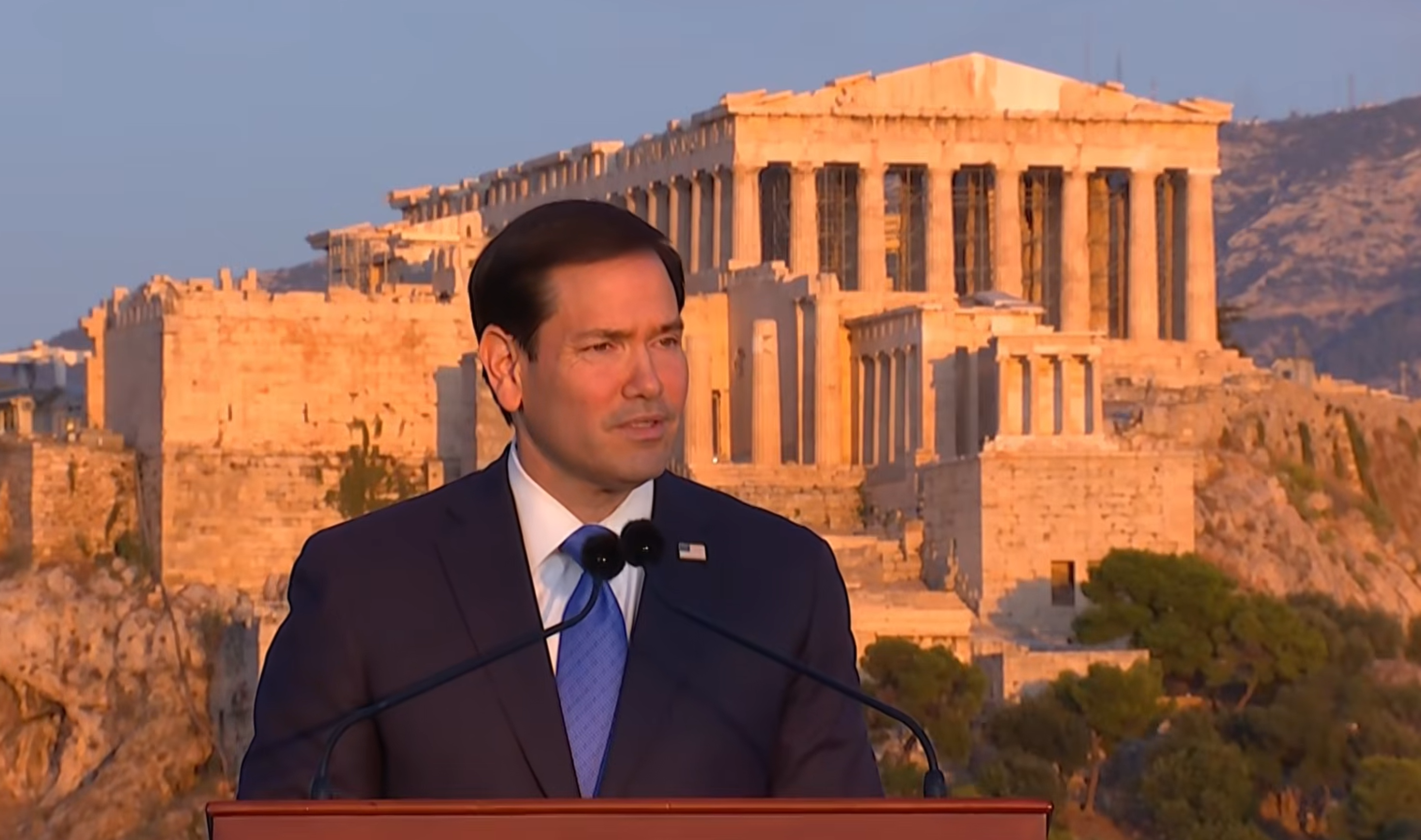
Standing on the Pnyx, the hilltop heart of Athens's ancient democracy, America's top diplomat warned Wednesday, "We are at an inflection point … not only in the history of my nation, but an inflection point in the whole of our civilization." In his speech, he argued that the United States and Europe can, through this inheritance, "rediscover the virtues, the courage, and the strength to confront the dangers that we face in our time." This legacy is becoming increasingly important for meeting today's and tomorrow's challenges.
Rubio drew a line from the ancient Greeks to the present, noting, "the greatest Americans of every generation have carried the unmistakable features of their forefathers—born in Athens, formed by Rome, baptized in Christendom, hardened in the furnace of medieval Europe, endowed with the English genius for liberty, and then carried across the Atlantic to be reborn on the shores of a new world." And that's not all. These "institutions and ideas were the outward expression of more fundamental qualities we see in the ancient Greeks—qualities that can't be reduced to any particular political system or theory."
This formulation—that the road to Philadelphia in 1776 runs through Jerusalem, Athens, Rome, and London—would have seemed like a tired cliché only a few decades ago. The controversy it engenders today is largely due to the failures of the educational establishment, which has expended enormous sums stunting the moral and intellectual growth of generations of Western leaders.
Some critics of Western civilization think the concept is too banal and its champions too bloodthirsty. They can spot in other cultures some of the "essential traits" that Rubio said "would come to define the West," such as "fierce individuality and relentless ambition; daring exploration and invention; a yearning for discovery, for adventure, risk and glory." And they have seen the gory consequences of nationalism smeared across Europe's 19th and 20th centuries. This seems just restrictive enough to provoke strife, but too vague to be otherwise useful.
The highest and greatest expression of Western values assuages those concerns. The Western identity is a fundamentally pluralistic one. Athenian philosophers and Jewish prophets disputed sharply about God and man, and their followers did not greet Roman legionnaires with open arms. There was plenty of conquest and slaughter, but over time, the potent mixture of their ideas produced the conditions for free people to govern themselves. Individuals strive for honor and glory, but as Rubio points out, "glory and fame, those things were won through striving, sacrificing, and achieving greatly for something larger than yourself."
The United States and its allies prosper when they embrace that heritage. Rubio correctly notes that Western virtues are "the characteristic of a people—expressed in their traditions, their stories, their imagination; in the qualities they demanded of their citizens; in the things they lived and fought and died for." This peopledom is not determined solely by ancestry. Few Americans today can trace their lineage back to the Athenians of yore, but they have an equal claim to the citizenship pioneered on the Pnyx.
Ironically, although most recent discussions about Western civilization focus on the implications for Europe, a civilizational view is more helpful for understanding other parts of the world. Many other countries, such as China and India, behave more like the heirs of distinct traditions than the kinds of nation-states formalized in the Westphalian system. Literature and liturgies are not magic decoder rings that unlock every secret in a society, but they offer important context.
Technological progress increases the value of ancient wisdom. As AI makes genetic modification easier and other biotechnologies more effective, free societies will have massive public debates about how they can be employed. The specific uses of each technology will be downstream of bigger questions, such as what humans are and how they ought to be treated. A deep grounding in a moral tradition will not automatically produce the answer to these questions, but it will go a long way.
Europe and the United States, which share the same foundational ideas and values, are likely to end up in the same place on these issues. But first, they must rekindle the thumos, "the fire of passion, strength, courage, pride" that Rubio observes "is the heart of great civilization."
"The course we take," he warns, "will determine whether the West maintains its place at the head of the world or resigns itself to a future of atrophy and servitude and decline." Igniting that thumos is the first step toward a brighter, freer future.