


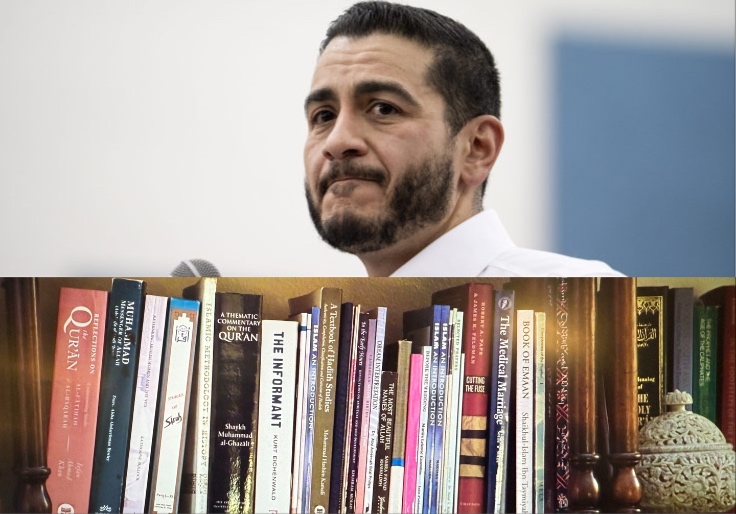
A bookshelf in Abdul El-Sayed's living room—which he sought to conceal from a documentary film crew in 2018—contained works by an unindicted co-conspirator of the 1993 World Trade Center bombing, a member of an Islamic group that sought to establish a Sharia-governed state, and a Muslim cleric whose writings have influenced al Qaeda and other major terrorist groups.
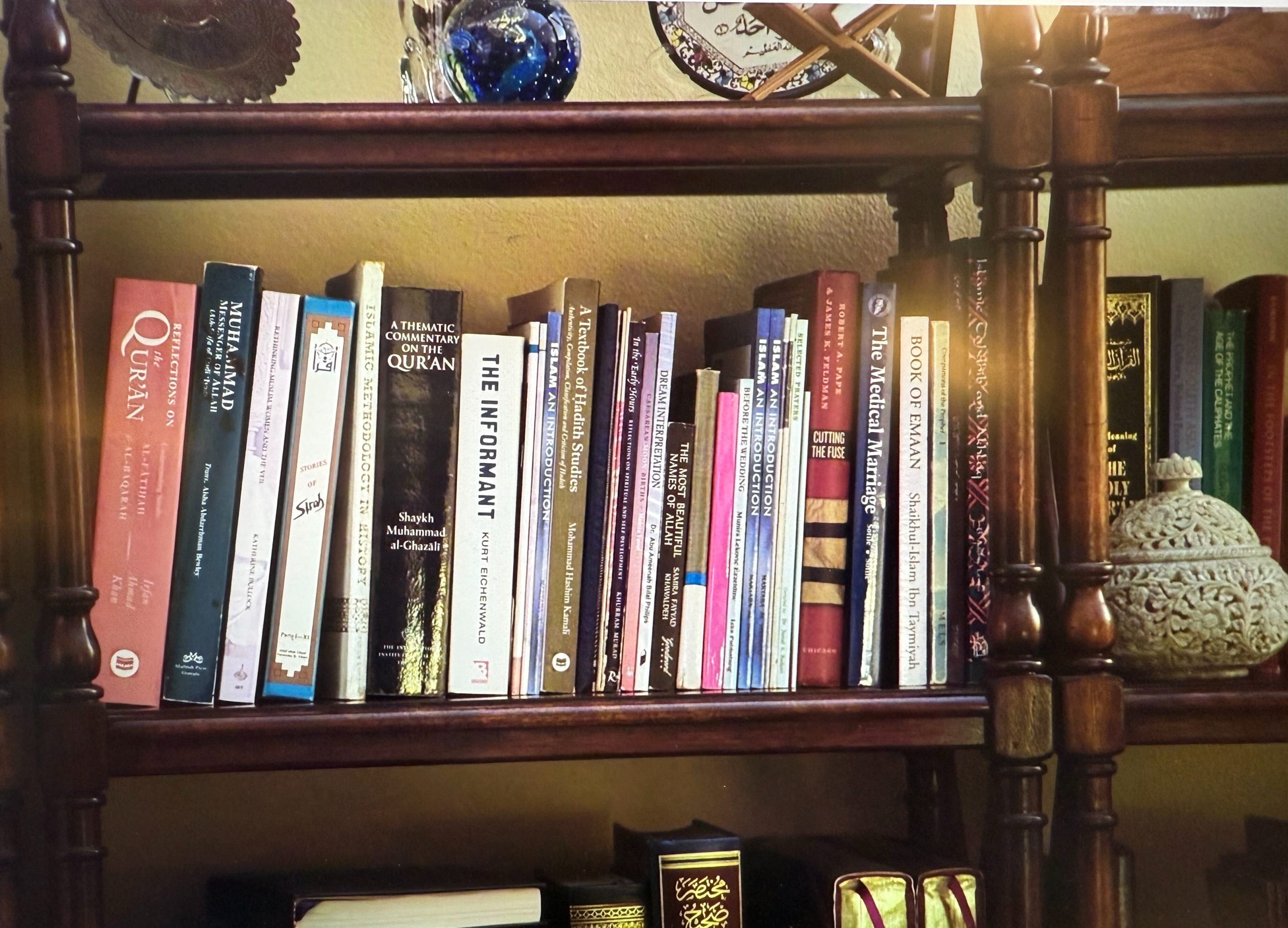
The living room bookshelf came into frame as El-Sayed—now the Michigan Democratic Senate nominee—showed off his wedding pictures during a scene in How to Fix a Primary, a documentary about his failed 2018 gubernatorial bid. During the scene, El-Sayed was filmed pointing to his bookshelf as he asked the filmmakers to "not get these things in the shot" because he wanted to "keep the shot secular." But the filmmakers ultimately provided a close-up shot of the bookshelf, which contained a copy of the Quran and about three dozen texts analyzing various aspects of the Muslim faith, several by Islamic extremists.
That includes Dream Interpretation According to the Qur'an, by Dr. Abu Ameenah Bilal Philips, a Jamaican-born Islamic scholar named by the United States as an unindicted co-conspirator of the 1993 World Trade Center bombing. Philips now resides in Qatar after being deported or banned from several nations in the Western world during the late 2000s and early 2010s, including the United States, the United Kingdom, Australia, Germany, and Denmark, over his extremist views, according to the Counter Extremism Project. Philips has defended the bravery of suicide bombers, touted AIDS as proof that "homosexuality is evil and dangerous," advocated that young girls are fit for marriage the moment they begin menstruating (which for some girls can begin as young as eight years old), and argued that husbands are permitted to beat their wives so long as the thrashing is "light" and the man's intention "is not to inflict pain but to bring the wife back to her senses and re-establish authority."
The collection of books on El-Sayed's bookshelf reflects his scholarly interest in Islam, including in the darker corners of Muslim theology. Though he is openly running as a Muslim man, El-Sayed has sought to distance himself from Islamic extremism, including from beliefs he expressed before he went into politics. For example, El-Sayed declared to the New York Times in 2009 his sacred obligation to follow Sharia law in all aspects of his life, but later denied ever saying he lived a "Sharia-compliant" life when asked about that statement during his 2018 campaign, the Washington Free Beacon reported.
El-Sayed's bookshelf also contained a copy of Reflections on the Quran by the late Irfan Ahmad Khan, who was a member of Jamaat-e-Islami, a movement founded in British India in 1941 that sought the establishment of an Islamic state governed by Sharia law. The government of India has banned Jamaat-e-Islami twice, first in the 1970s and again in 1992, due to allegations of challenging the nation's sovereignty. Those bans were overturned by the Supreme Court of India, and the movement now seeks the establishment of Islam "in all aspects of human life."
Another book on the shelf, A Thematic Commentary on the Qur'an, was written by Muslim Brotherhood member Sheikh Mohammed al-Ghazali, who said "the refusal of implemenation [sic] of sharia is apostasy" as he testified during a 1993 trial in defense of 13 Islamic terrorists who gunned down an Egyptian professor who had called for the separation of church and state in Egypt, the Washington Post reported.
El-Sayed's campaign told the Free Beacon last week he believes in the separation of church and state and "opposes any effort by any religious community to write their faith laws into the laws of our country." During periods when he was not running for office, however, El-Sayed has sharply criticized legal efforts to ban the implementation of Sharia law in conservative states. In 2022, he equated a 2010 ballot measure to ban Sharia law in the state to notorious Oklahoma atrocities such as the Trail of Tears, the Tulsa race massacre, and the Oklahoma City bombing, the Free Beacon reported.
Also visible on El-Sayed's bookshelf was a copy of the Book of Emaan, a late 13th or early 14th century text by Shaikhul-Islam Ibn Taymiyya, who is often portrayed by Islamic extremists as the "spiritual father of (Sunni) revolutionary Islam," according to the Georgetown University Center for Security Studies, which noted that both al Qaeda and ISIS based their principles of jihad on Ibn Taymiyya's writings.
The writings on El-Sayed's bookshelf are resurfacing amid reports that his birth mother, Fatten Fathy Elkomy, once worked for the Islamic American Relief Agency, a designated terror group that provided hundreds of thousands of dollars to 9/11 mastermind Osama bin Laden in 1999, according to the Midwesterner.
Sandwiched in with the books written by Islamic extremists on El-Sayed's bookshelf were works by more moderate authors such as Islamic Methodology in History by Fazlur Rahman Malik, whose work has been criticized as "excessively liberal" by conservative Islamic scholars, and Caesarean Moon Births, a book that addresses how the lunar calendar determines the start of Ramadan, by Hamza Yusuf, a white convert to Islam who has sharply condemned religious justifications for terrorist attacks, including 9/11.
El-Sayed's bookshelf indicates he has taken an interest in studying the most minute aspects of Islam. Another book spotted on his bookshelf was Muhammad, Messenger of Allah translated by Aisha Abdurrahman Bewley, whose personal website features an essay analyzing the purity of breast milk in the context of Islam. "Human milk, even from an unbeliever," Bewley wrote, can be pure dependent on "certain preconditions," which are not named.
Also spotted on his bookshelf was a copy of Rethinking Muslim Women and the Veil by Katherine Bullock, a hijab-wearing convert to Islam and lecturer in Islamic politics at the University of Toronto Mississauga. Bullock wrote in a 2025 book review that Hamas "has embraced democratic participation" (Hamas has banned all elections since winning the 2006 parliamentary elections in Gaza). In 2014, during the height of ISIS, Bullock came under fire for arguing that there is "absolutely nothing radical about wanting Caliphate or wanting Sharia" from an Islamic point of view.
Nearly 36 hours after deadline and close to a day after this article's publication, El-Sayed campaign spokeswoman Roxie Richner claimed in an email to the Free Beacon, "This was not Abdul's bookshelf," before defending its contents.
"Abdul is a doctor and Rhodes Scholar who reads widely, including authors whose views he may disagree with," Richner said. "A book appearing in the background of documentary footage is not an endorsement of its content nor a reflection of his beliefs."
Richner did not say to whom the bookshelf belonged, nor did she say if El-Sayed disagreed with any of the authors whose works were pictured on it.
Update August 20, 5:03 p.m.: This piece has been updated since publication.