


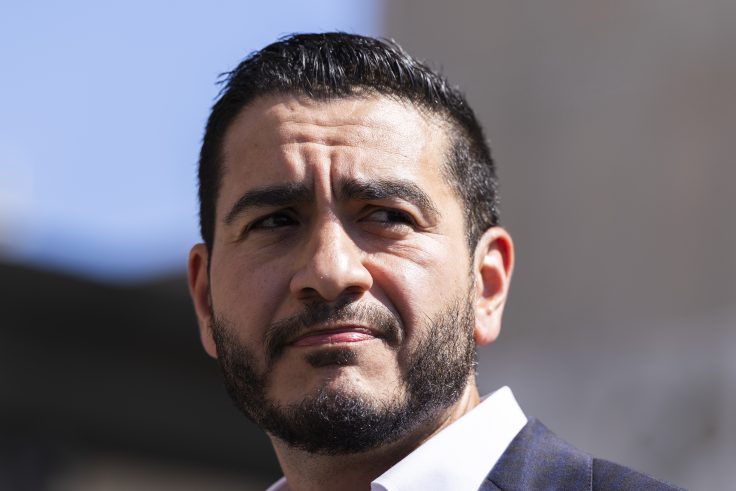
Michigan Democratic Senate nominee Abdul El-Sayed once declared his sacred "obligation" to follow Sharia law in every aspect of his life until he meets his maker on the day he dies, according to unearthed comments he made to the New York Times in 2009 as a young man buying his first home.
"Ultimately, the question is, when I die and I stand before God and go through everything I did in my life, I don't want to say I did it the easy way instead of the Shariah-compliant way. Not because of fear but because of obligation," said El-Sayed, who the Times identified at the time as a 24-year-old medical student and Rhodes scholar who had just taken out a "Sharia-compliant" mortgage to purchase a $123,000 condominium in Ann Arbor.
Sharia, or Islamic religious law, sets strict rules for living that include harsh restrictions on women and gruesome, medieval-era forms of criminal justice. Sharia law also prohibits the paying or earning of interest, a restriction that has led some banks to offer special mortgages for devout Muslims, like El-Sayed, which tack onto the principal what a typical borrower would pay in interest across the life of the loan.
The young El-Sayed's expression of lifelong devotion to Sharia law takes new meaning following his narrow primary victory last week and raises the question of how much Sharia law continues to guide him.
El-Sayed has played a delicate balancing act on the campaign trail when it comes to his personal faith. While he has embraced his status as a Muslim man before voters, the progressive Democrat often frames his faith in broad brush strokes to avoid specifics. In October 2025, for example, El-Sayed told Religion News Service that his faith "orients me to try and be a better person" and to "treat people — all people — with dignity and humanity and respect."
But El-Sayed has bristled when pressed on the topic of Sharia law. During his failed 2018 campaign for Michigan governor, El-Sayed denied ever saying he was "Sharia-compliant" during an interview with the Jewish conservative journalist Laura Loomer—a strong critic of Islam—before cutting the interview short and scolding his staff for not stopping it sooner.
El-Sayed also rejected allegations that he intended to subvert the Constitution and implement Sharia law. A documentary about his 2018 gubernatorial bid shows him telling the filmmakers not to shoot a bookshelf in his home that contained the Quran and controversial works about Islam, including Cutting the Fuse, a 2010 book that argues that suicidal terrorism is driven by foreign military occupation, not Islamic extremism.
El-Sayed's private bookshelf also contained a copy of A Thematic Commentary on the Qur'an written by Muslim Brotherhood member Sheikh Mohammed al-Ghazali, who said "the refusal of implemenation [sic] of sharia is apostasy" as he testified in defense of 13 Islamic terrorists who had gunned down an Egyptian professor who called for the separation of church and state in Egypt. Al-Ghazali testified during the 1993 trial that the slain professor was "without doubt" an infidel and said most Islamic scholars would agree that such apostates should be killed, but that he personally believes the professor should have received a life sentence instead, the Washington Post reported.
"You're going to want to not get these things in the shot," El-Sayed said in the documentary, How To Fix A Primary, as he pointed to his bookshelf which contained al-Ghazali's writings. "We're trying to keep the shot secular."
There's a wide range of diversity in how Muslims across the world apply Sharia law, with many employing it strictly as a personal code of conduct for their private and family lives. But Sharia is also used as the basis for the repressive governing codes in several Muslim-majority countries, including Taliban-controlled Afghanistan, which mandates that women cover their entire faces and bodies in public at all times, and Iran, where its morality police infamously beat to death 22-year-old Mahsa Amini for failing to fully cover her hair in public.
Saudi Arabia is also governed by Sharia law, and beheadings are carried out by sword, sometimes in a public square.
El-Sayed continues to comply with Sharia law in his personal life, his campaign spokeswoman Roxie Richner told the Washington Free Beacon.
"Abdul believes in the separation of church and state," Richner said. "While he personally lives by the rules of his faith, as many Americans of various faiths do, Abdul opposes any effort by any religious community to write their faith laws into the laws of our country."
It's not the first time El-Sayed has claimed to be a strong believer in the separation of church and state. He told Religion News Service he wants to "protect the kind of America where everybody can pray how they choose to pray, or choose not to pray at all."
But El-Sayed has also sharply criticized legal efforts to ban the implementation of Sharia law in conservative states. During an October 2022 speech before the Oklahoma chapter of the Council on American-Islamic Relations, for example, El-Sayed equated a 2010 ballot measure to ban Sharia law in the state to notorious Oklahoma atrocities such as the Trail of Tears, the Tulsa race massacre, and the Oklahoma City bombing, the Free Beacon reported.
"You cannot understand the challenges we face today without understanding white supremacy," El-Sayed said. "I don't have to tell you that the same exact forces that drove native peoples from their land two centuries ago, destroyed Black Wall Street a century ago, bombed a building decades ago, and tried to ban Sharia law not a decade ago, that those forces are alive and well today."
El-Sayed's obligation to Sharia law is well reflected in his personal and financial affairs. El-Sayed was described as a "particularly devout" Muslim in the Michigan Daily in a 2006 story covering his relationship with his wife, Sarah Jukaku, who wears a hijab, is rarely seen at campaign events, and did not even attend El-Sayed's primary watch party on Tuesday.
"Islamically, there are no premarital relations of any sort," El-Sayed told the paper to explain why he proposed to Jukaku when she was a college freshman and he was a junior. "No touching, no nothing. Given that, the logical solution is to get married."
El-Sayed courted and married his wife according to Islamic law—which included a traditional, "two-step" marriage that saw the couple living apart and remaining chaste for the first year of their union.
"Getting ice cream is the number-one thing we do together," El-Sayed said in 2006 about his married life with Jukaku.
Jukaku now operates a private psychiatry practice that does not accept Medicaid, Medicare, or any other insurance—a policy that invites her husband's criticism of such bans as perpetuating "long-held deep racism and structural racism." The couple has two young daughters. El-Sayed has not made any public comments about whether he will expect his daughters to comply with Sharia law regarding courtship, marriage, and modesty.
El-Sayed is also heavily invested in so-called Sharia-compliant investment funds managed by Amana Mutual Funds, whose late cofounder and chairman, Yaqub Mirza, was identified in a 1988 FBI memo as one of several "members and leaders of the IKHWAN," which is shorthand for the Muslim Brotherhood. El-Sayed reported in his latest financial disclosure that he and his wife own between $150,000 and $425,000 in Amana's funds, which excludes investments in companies that earn more than 5 percent of their revenue from "haram sources" including interest, gambling, alcohol, tobacco, pornography, and pork.
In 2002, federal antiterrorism agents raided Mirza's home as part of a wider antiterror operation against the Safa Group, a cluster of Islamic entities based in Virginia, the Wall Street Journal and Washington Post reported. No charges were filed, and Amana Funds itself was spared serious scrutiny during the probe, according to a local report.
Sam Westrop, the director of the Middle East Forum's Islamist Watch project, told the Free Beacon that the State Department's designation of the Egyptian Muslim Brotherhood in January "should theoretically have made Safa (and thus Amana) a law enforcement target again," but added that federal authorities have expressed a lack of interest in Safa since the raids in the early 2000s.
Update 3:45 p.m.: This post has been updated to include a comment from the El-Sayed campaign.