




The son of Sri Lankan immigrants, Randy Boyagoda grew up on the northern shore of Lake America, in the soon-to-be-annexed Territory of Mar-A-Lago North. In addition to teaching literature at the University of Toronto, he is a celebrated novelist and essayist. He is also a lifelong Catholic, whose third book was a biography of Richard John Neuhaus. Similar to Neuhaus in the past, Boyagoda today is living proof that religiously oriented public intellectuals are not extinct.
Still, a man who wears multiple hats can sometimes forget which one he is wearing. In 2024, Boyagoda published a column in the Toronto Star about being daunted by his new job as "advisor on civil discourse" to his university. To illustrate, he recalls being asked by "a person in healthcare … how to deal with anti-vaxxers … when they're completely wrong about the science." His advice, quoted in the column, was "to begin by not assuming they were wrong about everything."
So far, so good. To be civil is to credit your antagonist with being right about something, and to take it from there. The hope, writes Boyagoda, is that "More and more people will find the humility, and the fellow humanity in their interlocutors." But then he turns sarcastic, quoting himself quipping that anti-vaxxers were "likely wrong, probably wrong, mostly wrong, but maybe not completely wrong" (emphasis added).
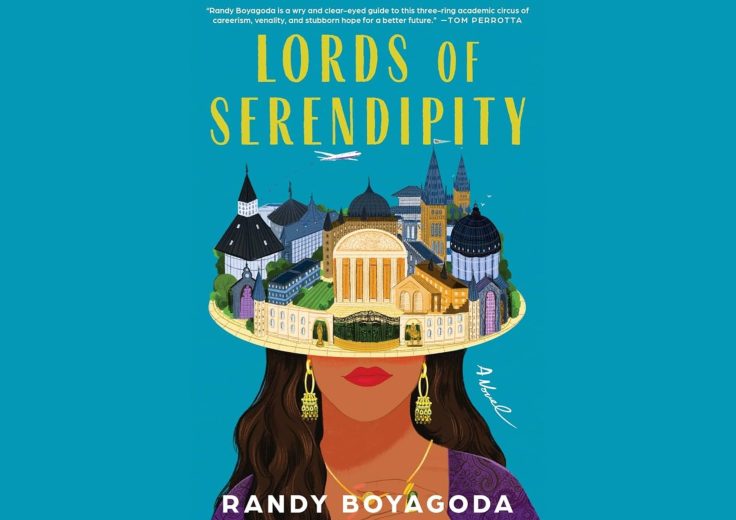
With its four repetitions of "wrong," this quip reads more like a parody of elite condescension to the brainwashed masses than a shining example of civility held up to the good people of Toronto. Indeed, it would fit right into Boyagoda's new novel, Lords of Serendipity, a 352-page exercise in shooting satirical barbs into the already wounded body of higher education.
What distinguishes this campus novel from many others is its international scope. Or rather its bi-national scope, since it is chiefly set in Sri Lanka and the United States. Canada is mentioned only twice, which is odd, given that most of Boyagoda's satirical barbs could just as well be aimed at Canadian universities. Even odder is the absence, in a novel targeting the wokeness, cheating, and corruption pervading academia, of certain ham-handed overcorrections imposed by the current U.S. president.
To be fair, most of the satirical barbs in Lords of Serendipity hit their targets. In Sri Lanka, these include the expected—and unexpected—barriers facing Devi, a studious but impoverished young woman who dreams of attending an elite Anglophone university. Devi's mother tries to bring her back down to earth with the belittling acronym "Ochpys" (Oxford-Cambridge-Harvard-Princeton-Yale-Stanford). But her father works against that by inflating his daughter's hopes as ridiculously as he previously inflated his own.
In America, the barbs are aimed at two East Coast universities: the "barely ranked" Arcadia Tech and the highly ranked Haven, a "woodsy Gothic paradise." At the former, an associate professor of statistics named Jack accepts a Sisyphean course load in order to keep his daughter Katrina at the latter. When Jack sees a severed pigeon wing on the ledge of his office window get blown off by the wind, then snatched in mid-air by an eagle, he is inspired to ask his bored class to calculate the odds of that happening. A lively discussion ensues, but two students tattle to the dean that their professor "made repeated references to graphic acts of animal cruelty," which he "forced students to discuss."
Meanwhile, at Haven, the annual Christmas performance of the 14th-century chivalric romance Sir Gawain and the Green Knight is disrupted by the cast members wrapped in black cloaks declaring that as "THE LAST GENERATION OF THE ANTHROPOCENE" they resist a play that "PERPETUATES SPECIESIST, SEXIST, RACIST, ABLEIST, AGEIST, AND CHRISTIANIST IDEOLOGIES THAT ARE ALSO DEPLOYED IN SUPPORT OF SETTLER-COLONIAL ZIONIST APARTHEID FASCIST REGIMES."
Mercifully, this disruption is disrupted when two cast members drop their cloaks and in full costume perform a scene from the play. To Jack's delight, one of the rebels is his daughter Katrina (as Reynard the Fox) and the other is Cham, her wealthy Sri Lankan roommate (as Sir Gawain). Unlike Devi's, Cham's life has been one of privilege, but as the novel gradually reveals, she was not born to privilege but rather gained it through tragic sacrifices made by her parents. That part of the novel is strongly felt and beautifully written in a way that stands out from the rest.
These three young women, Devi, Katrina, and Cham, are the most sympathetic characters, but even they catch a few authorial barbs. Overall, Boyagoda skewers more characters than he spares, and I don't mean that as a compliment. Satire works best when wielded by a master longbowman picking his shots, as opposed to a hail of arrows bouncing off the armor of an advancing army. Ideally, the satirist has enough humility to see his own flaws as well as those of his targets, and to aim not at the community at large but at the sickness, morbidity, and stupidity that threaten it.
In recent decades, satire has come to dominate the space formerly filled by something far more generous and capacious—humor. As noted by Boyagoda in the aforementioned newspaper column, we live in a "hard loud world" of diffuse anger seeking an outlet, any outlet. So a lot of what passes for comedy is misfired satire with no clear target, no humility, and very little humor. The word for this is snark, derived from the Low German snarken, meaning to be irritable and bad-tempered.
Lords of Serendipity is too funny to be accused of snark. But just as Boyagoda was unable to resist quipping that anti-vaxxers are wrong in three ways out of four, he seems unable to resist practicing his archery on random targets. For example, when Jack the statistics professor asks the attractive associate dean (who is also an old flame) about her day, she offers to "skip the latest about the ongoing student encampment around the Immunology Department's dormouse glirarium."
Googling glirarium, I learned that it's "a terracotta container used for keeping edible dormice … considered a delicacy … in the Roman Empire." "Perforated to allow the passage of air, polished on the inside to prevent escape, and with a lid to seal the top," it is designed to fatten the dormice by inducing "hibernation via darkness and confinement." Struck by the resemblance between a glirarium and an elite American university, I looked forward to what Boyagoda was going to do with it. But I soon realized he wasn't going to do anything with it, just as he wasn't going to do anything with dozens of other satirical bits. If they were dormice, they would starve.
My hope, therefore, is that Boyagoda will deepen the emotion in his next novel, for two reasons: First, he is good at it, as demonstrated in his telling of Cham's story. And second, emotion is the key to humor in the sense so well expressed by the great comic filmmaker, Marcel Pagnol: "Laughter is a human thing, a virtue belonging only to humanity and God, that perhaps God gave to humans as consolation for having made them intelligent."
Lords of Serendipity: A Novel
by Randy Boyagoda
Mariner Books, 352 pp., $30
Martha Bayles is the author of Through a Screen Darkly: Popular Culture, Public Diplomacy, and America’s Image Abroad. She teaches at Boston College and is working on a book about the importance of informal speech norms in the digital age.