




Growing up as a pink diaper baby, and then studying Russian in college, I graduated as an anti-Communist leftist. Unlike my fellow antiwar protesters, I did not regard Communists as "liberals in a hurry" or as the left-wing of a common socialist movement, but as an enemy, whose values differed fundamentally from my own. As I knew from my study of the USSR, Leninists also considered themselves fundamentally different and so regarded other socialists as "useful idiots."
Communists triumphed in Russia not because of a popular uprising, but because a small group of disciplined and armed intellectuals, ready to use maximal violence, staged a coup. They could do so because liberals, anarchists, populist socialist revolutionaries, and other Marxists resisted them, if at all, only when it was too late. "Condemn terror?" indignantly asked Kadet leader Ivan Petrunkevich. "That would be the moral death of our party!" "No enemies to the left!" was an article of faith that Lenin, who was unprincipled on principle, knew how to exploit.
In the 1960s and '70s, I was surprised my liberal friends would rather side with Communists, who rejected their core beliefs, than with conservatives, who differed only on details of policy. Better those a mile to one's left than an inch to one's right! It was a matter of identity: If you grow up regarding yourself as the opponent of conservatives, it becomes psychologically impossible to join them. Is that why liberal Democrats back Hasan Piker, who praises Stalin's USSR and Mao's China? More terrifying than Abdul El-Sayed, Graham Platner, and Zohran Mamdani is the readiness of those who are neither totalitarians nor antisemites to support them. It is that support that may enable their eventual triumph.
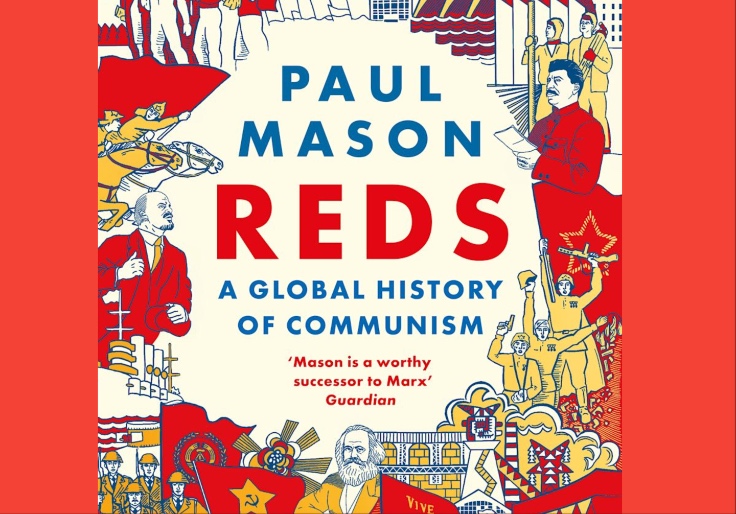
Are there any leftists willing to condemn totalitarians? Paul Mason's new book shows there is at least one. Offering a selective, but not irresponsible, history of Communist and revolutionary ideas, Reds pleads with the author's fellow socialists not to repeat the mistakes that cost the lives of millions. Although he celebrates Marx, Mason summons his fellow leftists to contemplate Communist crimes so they are not repeated. How many failures does it take before the argument that real communism has not yet been tried ceases to work?
"There is no guarantee this [Communist disaster] can't happen again," Mason urges. "Join any left-wing protest march in the West … and you see a minority of people who think China's system is better than ours. Worse, while Communist parties during the Cold War denied the crimes of the Soviet regime, some of today's neo-Leninists openly defend them." The Communists of my childhood refused to believe in Stalin's and Mao's murders. Piker admits and supports them.
Understanding why totalitarianism happened, Mason observes, is "our best guarantee that it does not return." "The Soviet Union … in the 1930s was a moral abyss that our twenty-first century brains struggle to comprehend," he adds. "The point of retelling this story should be obvious: to stop it from happening again."
The problem is that "few surviving Communists have evinced interest in the history of the system they once supported. For to delve into the primary sources is to confront one's own moral failure." Even non-Communist leftists fail to grasp that "there is no guarantee that this can't happen again."
Mason's history differs from most others because it is written by someone who is both reasonably well informed and intellectually honest, yet sympathetic to Marx. Like others "who want to see the end of inequality and needless hierarchy," he hopes that something—perhaps powerful computers or artificial intelligence?—can form "the basis for a transition beyond the market and private property" without leading to totalitarianism. Despite his humane intentions, Mason has not recognized that without private property and the market, power is so concentrated in a single set of hands that its abuse is unavoidable.
The early portions of Reds examine pre-Marxist utopian socialists to determine the mistakes that later proved catastrophic. Saint-Simon's idea that well-educated intellectuals and technocrats should organize the economy and society strikes Mason as especially fraught with danger, a point that Bakunin and other anti-Marxist anarchists were to stress. But for Mason, the Marx Bakunin faulted and the Soviets canonized was not the true Marx. He favors what the Soviets called Marx's "pre-Marxist" phase—for example, the Economic and Philosophical Manuscripts of 1844—when Marx could still speak of a human essence not entirely determined by economics and could still assume that individual freedom is desirable.
As there is such a thing as wishful thinking, there is also wishful reading. Far from a dogmatist, Mason's Marx "continually challenged his own conclusions and refused to build a finished system. … From 1844 onward, Marxism was a project of individual freedom. It was not, despite Marx's claim, the negation of Enlightenment philosophy but its latest expression." Despite Marx's claim: Qualifications like this testify to how much Mason's Marx differs not only from the Marx of Marxist regimes but also from Marx himself.
Mason applauds Walter Benjamin's view that Marxism "is best seen as the secular continuation of the Judeo-Christian demand for a just conclusion to human history." But what about all those specifically Marxist ideas that distinguish it from other inheritors of the Judeo-Christian tradition, like liberalism? For Mason, they are not important: "Its [Marxism's] mental tools—the dialectic and the materialist conception of history—are puny compared to today's systems theories and computational methods." But why call oneself a Marxist, or even bother to read Marx, if everything that distinguishes him from other Judeo-Christian or Enlightenment thinkers is so "puny"?
Mason's answer seems to be: A few specifically Marxist ideas are valid. He embraces Marx's labor theory of value (true value is the amount of labor to produce something) and his concept of "surplus value" (what is unjustly taken from the worker by the capitalist), which together establish an objective definition of "exploitation," as "mainstream economics" does not. "When we put a price on a commodity," Mason observes along with Marx, "what we are really trying to do is guess the amount of labor time needed to produce it. But price and value are different things: when we buy something we know the price; but the price is only a guess at the amount of value embodied in it. … Marx calls this the 'law of value.' … He shows how 'surplus value' is extracted through coercion." Shows how: Mason regards Marx's argument as proven.
Mason therefore struggles to understand the failure of the Soviet economy, in which planners indeed set prices based on Marx's labor theory of value. So long as the labor to produce a good did not change, neither could prices, which meant that shifts in demand could not redirect supply. Thus the endless warehouses filled with goods no one wanted while people lined up to satisfy basic needs. Without a market, which Mason would abolish, no other result is possible.
By the same token, Mason can assert that "as a description of capitalism, the [Communist] Manifesto's relevance is undeniable, even today: we, too are faced … with every human relationship reduced to the 'naked cash nexus.'" Every human relationship?
If Mason were consistent in his anti-Stalinism, he would not regret, as he does, that Stalin's foreign policy reduced support for the French Communist Party since, after all, it shared Stalin's ideology and, like almost all Communist parties, was directly controlled by Moscow. Mason cites Soviet economic figures as if they were the least bit reliable, when in fact, the constant self-defensive lying at every stage of reporting left the Soviet leaders themselves in the dark.
Despite these shortcomings, I admire Reds. It is so much easier to fault the other side! When that happens, errors not only remain uncorrected but are magnified. If the Hasan Pikers (or Tucker Carlsons) are to be stopped, it must be because other leftists (or rightists) overcome their reluctance to criticize them and develop the courage to face the opprobrium of their friends.
Reds: A Global History of Communism
by Paul Mason
Scribner, 544 pp., $32
Gary Saul Morson is a professor of Slavic languages and literatures at Northwestern University and author, most recently, of Wonder Confronts Certainty: Russian Writers on the Timeless Questions and Why Their Answers Matter (Harvard).