


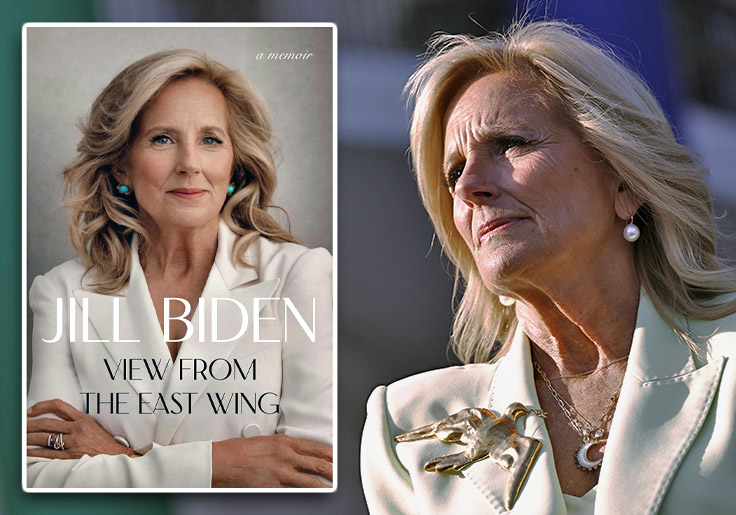
In her new memoir, Dr. Jill Biden, Ed. D., fondly recounts the moment she had "never felt prouder to be an educator." You might assume it happened in a classroom. But that's not how the good doctor rolls.
The former first lady's proudest moment as a professional teacher took place in the White House State Dining Room, where she hosted the first-ever Teachers of the Year dinner. In the book, View from the East Wing, she boasts of curating an exquisite menu of celery root salad, lobster ravioli, and a dessert trio of coconut custard cake, apple mousse, and strawberries with cream.
She could "hardly contain" her excitement when the U.S. Army Chorus and Strings strolled in and proceeded to belt out "Brave" by Sara Bareilles, the girl-power anthem best known for its enduring connection to Hillary Clinton's doomed 2016 campaign. "Take out your phones!" she squealed, beaming with pride for her profession.
A few weeks later, Jill's husband—the nominal president of the United States—shuffled onto a debate stage and bragged about beating Medicare. This is the part that interests journalists and others who follow politics too closely. What did Jill Biden know, and when did she know it? Fielding these questions on her press tour is simply the price she must pay for one last slurp at the influence trough.
The answers are predictably underwhelming, and almost certainly not true. They are barely coherent. She thought her husband was having a stroke. When the debate ended, she rushed to his side to tell him how badly he "f—ed up," then took him to Waffle House. Granted, most of us aren't doctors, but that seems ill-advised. The Bidens have always maintained a strict "veil of discretion around personal health," she writes. They hid Beau Biden's cancer diagnosis from the public. She went through menopause without ever mentioning it to Joe.
Dr. Jill also claims to have supported the idea of Joe taking a cognitive test and releasing the results so voters could be "assured of his competency." At the very least, it's inconsistent and strains credulity. She recalls that when she begged Joe to stop jogging on stage at rallies, he stubbornly kept doing it to "prove that he could." This is the same person Jill suggests would have had "the humility to admit" his brain had ceased to function.
At the end of the day, the first lady doesn't really know what happened to her husband on the debate stage. Never mind how the team of doctors treating the president of the United States never thought to check for prostate cancer. Her explanations do not inspire confidence in her assessment of Joe's abilities.
Maybe he was suffering from "overtraining syndrome," a condition most often associated with Olympic-level athletes. He could have accidentally "drugged" himself with sleeping pills or cough syrup, a little whoopsie any one of us might make after years of being followed around by something called the nuclear football.
"Had he grown too old for the job and I hadn't noticed?" Jill asks. "I didn't think so, but could I be objective enough to be sure?" These are some of the (perfectly fair) questions she posits in the book—before promptly changing the subject.
She claims to have written the book "for the sake of history," which is also hard to believe. Plausible alternatives include shoring up the family's shoddy finances, or a simple f— you to all the Democrats who wish the Bidens would just shut up and go away forever. Even Andrew Bates, for crying out loud—the former White House spokesman who shilled his heart out to the bitter end.
Dr. Jill is clearly trying to salvage her husband's reputation—and her own—by playing the hapless victim. At the same time, she seems determined to vindicate the critics who cite her obsession with "the trappings of the most elite levels of Washington power," as the driving force behind her husband's decision to run again. "She likes power," presidential historian Douglas Brinkley said of Jill in February 2024. "She wants to stay."
As a credentialed writing instructor with a doctoral degree from the University of Delaware, few people on the planet are more equipped than Jill Biden to appreciate the craft's enduring maxims. "Show, don't tell." "Write what you know."
She tells us the critics are wrong, but shows us otherwise in her besotted descriptions of the trappings of elite Washington power, especially when it comes to entertaining friends and family on the taxpayers' dime. It is clearly where her passion lies. It's what she knows.
"The grandeur of the front hall made me catch my breath," she recalls upon entering the White House as first lady. She relishes the glass of Cabernet that would always be waiting for her in the residence after an event, and swoons upon hearing Bono recite poetry and giving her a shoutout at Sphere on her birthday. She fondly recalls helping Ellen Susman, an accomplished equestrian and ultra-wealthy Democratic donor, outfit the residence with priceless art.
"Opening the White House wider and wider to more people mattered to me," Jill writes. "Sometimes events would also yield remarkable friendships." This is how she introduces an anecdote about the time fashion icon Ralph Lauren told her she reminded him of his wife, and how the two women "formed an instant connection" at a White House event.
Other highlights include the time Barbra Streisand called her "honey," the private concert Marcus Mumford performed for her daughter Ashley's 40th birthday, and the "flakiest almond croissants" she'd ever tasted at an airport lounge in Paris before meeting up with Tom Hanks and Steven Spielberg—not to mention the "long champagne-colored Reem Acra dress" she wore to the Jordanian crown prince's wedding at Zahran Palace.
"As a rule, I preferred less buzz around me than more," Jill tells the reader. She insisted on making her own coffee, for example, and even "bought a purple lunch bag" to carry the gourmet salads prepared by the kitchen staff.
Camp David was an especially decadent perk. The Bidens famously fled there after the debate—not to regroup and shore up support among panicked Democrats, but to have their portraits taken by celebrity photographer Annie Leibovitz. "We'd walk into the Aspen Lodge to the sound of our favorite music playing softly in the background," Jill gushes. "The fire would barely be dying down when the staff would appear with an armful of logs."
The family never missed a chance to hit the Camp David gift shop and load up on branded merch, she recalls. Later in the book, when describing the "intricate ballet" of hosting a state dinner, Jill unloads with sneering condescension at the near-elites and other mere guests who insist on pilfering "anything with the presidential seal on it."
Some even had the audacity, she tells us, to complain about not being able to bring their families to the state dinner. Throughout the book, Jill shows us that such perks are the rightful province of true elites—meaning herself and the family members who constantly accompanied her on international junkets or used the White House as a wedding venue.
To paraphrase the unofficial campaign anthem of another highly credentialed female pioneer, Jill Biden has bravely said what she wants to say, and let the words fall out. Those words reflect—however unwittingly—a wounded soul still mourning a tremendous loss, a hole that no amount of Camp David swag could ever fill.
View from the East Wing
by Jill Biden
Gallery Books, 274 pp., $32