




Writing a novel after spending years writing nonfiction is no easy trick. Trust me, I know. My hard drive is littered with stories never shared. My next book, if I do finish it, will be another nonfiction tome. Completing a novel, or even a novella, feels to me a bit like becoming a ballet dancer after spending decades running cross country.
Yes, I admit, writing about actual people, places, and things provides excellent grist for the fiction mill. That is why so many first time novelists produce thinly disguised roman à clefs. "Write what you know" is the old saw, and young fiction writers almost inevitably follow it. With time, suffering, and exertion, a budding novelist can ripen into a writer with a rich imagination.
Max Watman is not a young fiction writer. He is 54 years old and published the first of his three nonfiction books in 2005. The subjects of Watman’s book have included horse racing, small-scale farming, and moonshine-making. If there is one word that describes his written work it is "reportage." His books are loaded with facts and help readers see, hear, smell, and taste reality. Watman is a man who lives to experience things, which he has done as a farmer, silversmith, tutor, greenskeeper, warehouseman, cook, and musician.
So I was a little skeptical when I heard he had written a novel, and my dubiety rose higher when I learned it was historical fiction. I know, I know, Mr. Faulkner was correct when he declared, "The past is never dead. It's not even past." And, sure, Watman does live in an ancient house in Powhatan County, Virginia, where General Robert E. Lee spent some time after his tail-whupping by Ulysses S. Grant.
But come on now, how could his fact-focused, contemporary reality-explaining brain imagine people who never existed living in antebellum America?
And yet somehow Watman has done just that.
Tomorrow, the War is a nearly 400-page epic filled with fine grain details that pull the reader into a world that was as imagined by Watman. Mostly it is the tale of two young men from Virginia forced to find their way.
It starts in 1846 with Jed, an adolescent living on Stokes Mountain, which is comprised of "three houses and a graveyard." Jed’s family situation was complicated. As Jews, they were segregated from their downhill neighbors, and word was that Jed’s father had taken up with his wife’s sister and maybe she had done the same with his brother.
He was "a good boy, bright," according to Preacher Thom, who Jed occasionally visited for lessons. Other neighbors thought he was feral. Preacher Thom, who had a soft spot for Jed, did not disagree. "The boy lived without intent. He lived within patterns." He was like the other poor children in the area: "Superstitious savages who live in a world over which they have no agency and upon which they can have no effect."
Less enviable still is the position of Raleigh, a teen slave living on a 1,000-acre tobacco plantation. His family life also is complicated. Unbeknownst to him, Raleigh and his sister Temple were fathered by Oliver Bodkin, the cold, calculating master of the house.
Master Mister Bodkin, as he was called, lorded over this empire and lived opulently off the backs of 200 black Americans. Raleigh and everyone else were terrified into obedience lest they end up like Little Edward. He slipped away from Bodkin’s property. He was returned in a ghoulish spectacle. Two men rolled a hogshead barrel
"right up to the house and called everyone around. … Them men were grinning and spitting, dirty, smelling like whiskey. They cracked the top of that barrel off and poured Little Edward out onto the ground in a pool of blood, dead as a stone. They’d smashed all the whiskey bottles into the barrel, ’fore they shoved poor Little Edward into it. They nailed him shut in there with all that broken glass and rolled him along the road."
Fate ejects both Jed and Raleigh from the only places they have ever known. Jed dreams of an adventurous life—backwoods Virginia’s equivalent of d’Artagnan of Alexandre Dumas’s Three Musketeers. He journeys to Richmond and on a lark joins the military to fight in the Mexican–American War. Glory eludes him. Jed sees no combat and goes AWOL with another soldier. They try becoming entrepreneurs by shooting and harvesting bison, but end up doing a lot of drinking and thieving.
Raleigh, for his part, aspires to survive, which is no easy thing for a young black man in a slave state. He makes his way to Louisville and finds work as a piano player on a riverboat. Life is better yet not fully his own. He earns money for his labor, buys what he likes, lays with a woman, and falls in love with another. But part of the deal for getting the gig required him to pretend to be someone else: Walter Raleigh Babenberg, who grew up in the courts of Europe.
Along the way, Jed and Raleigh each meet characters full of character: Percy the dissolute ne’er-do-well, Red Joe the elegant American Indian, Hyman the jaundiced entertainment troupe leader, Booth the burly barkeep, and Hale the pointy-headed Army captain.
Eventually, the separate threads of Jed’s and Raleigh’s lives intertwine in 1860, and they join forces to rescue a damsel in distress. (I won’t say more and spoil the story for you.)
In structure, Tomorrow, the War is a convergence narrative and a heroic quest with a just-deserts core. Each of the two protagonists face challenges and experience triumphs. But Watman does not peddle moralistic schlock. Decent men die. At a deeper level, the novel illustrates a Heraclitian truth: Change is relentless, thus each of our lives must contain multiple lives. "Nothing is set," as Temple puts it.
We leave one life to start another. Sometimes fate forces it; sometimes our choices instigate the change.
Jed was a parochial, lonely, stunted youth; Raleigh lived in a gilded cage ignorant of who he was. Their identities evolved as they left their nest, experienced new things and challenges, and figured out what was meaningful to each of them. "I’ve been looking for my own life for a long time," Jed observes, when asked why he risked his life to help two strangers.
This rebirth in life also happens for some of the book’s minor characters. Marie, for example, was a lustful, rebellious teenage girl who later "shed girlhood like a skin she’d outgrown." Later in life she molted again. For years she "danced around what she knew" about her awful husband and their life. She refused to face facts in order to "preserve a way of life"—the life of the old, genteel South and her own posh life in it. Revelation brought rebirth. Marie left him to make her life anew.
Max Watman spent decades as a nonfiction writer. Now he is a novelist, and a very good one at that.
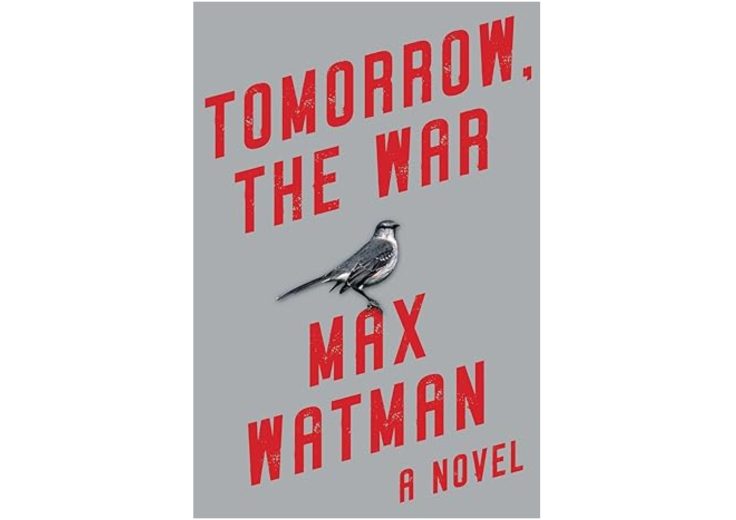
Tomorrow, the War
by Max Watman
Heresy Press, 408 pp., $32
Kevin Kosar is a senior fellow at the American Enterprise Institute and the editor of Beverages, Books, and More.