



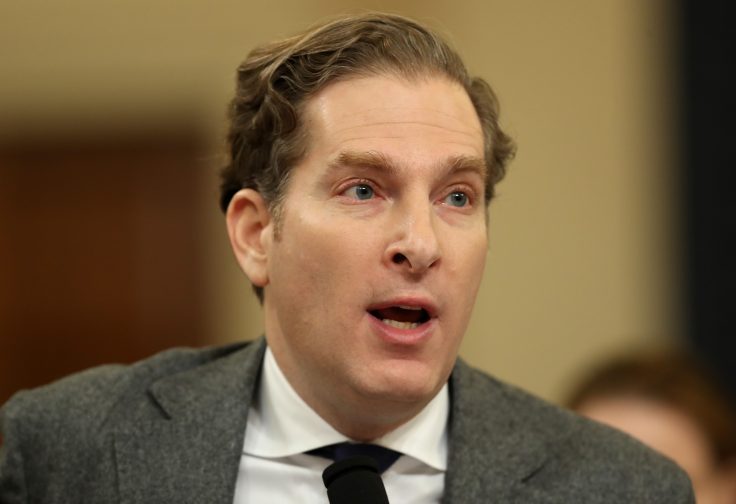
The Harvard professor who co-chaired the university's institutional neutrality working group, which concluded that the university should not "issue official statements about public matters that do not directly affect the university's core function," has started a new Substack in which he exhorts readers to "participate in … resistance" against the Trump administration.
"The takeaway is that you need to participate in sustained, sustainable resistance," the column says. "If ICE hasn't yet deployed where you live, that resistance can include speaking out online and to your friends and neighbors. It can include donating money to organizations that are supporting protestors. The main thing is not to be silent. The main thing is to keep sending a clear message that what's going on isn't normal, isn't okay, and won't be tolerated."
The professor, Noah Feldman, is the first signer of the May 2024 Harvard "Report on Institutional Voice in the University," which cautioned the university against speaking out on political issues.
"The integrity and credibility of the institution are compromised when the university speaks officially on matters outside its institutional area of expertise," the report said. "If the university adopts an official position on an issue beyond its core function, it will be understood to side with one perspective or another on that issue. Given the diversity of viewpoints within the university, choosing a side, or appearing to do so can undermine the inclusivity of the university community."
Many universities have adopted similar stances, sometimes known as "institutional neutrality," as part of the higher-education reform efforts fueled in part by a bipartisan belief that universities mishandled the response to the Oct. 7, 2023, Hamas-led terrorist attack on Israel. The presidents of Harvard, Columbia, the University of Pennsylvania, and Northwestern all resigned under pressure.
The Harvard Institutional Voice report says, "The principles articulated and recommended here should apply to any person or body authorized or purporting to speak on behalf of the university or its component parts. That should include the president, provost, and all deans as well as heads of departments, centers, and programs." Feldman is director of Harvard's Julis-Rabinowitz Program on Jewish and Israeli Law, according to the program website, so the principles would appear to apply to him.
Feldman also on February 10 posted a video to his "Professor Noah Feldman" Substack in which he describes the Trump administration's immigration enforcement as "un-American."
"I mean, it is un-American in the most literal sense of the term. We've never had in the history of the United States a group of people purporting to exercise governmental authority who ignore the function of the law in this way," Feldman said. "We've never before in history seen this. It's the president trying to make the truth into a lie while we watch."
"We're seeing that the Trump administration over a year has every day gone a little further in violating the law," Feldman said. "We will reach a point, probably before too long, where the system just revolts, and the people and the legal system just say to Donald Trump, enough is enough is enough."
Feldman said his comments were consistent with the Institutional Voice report, which he said was "super clear that it applies to deans and provosts and presidents and NOT to professors speaking in their personal/academic capacities."
"The latter are protected by academic freedom—and implicitly even encouraged to speak publicly in their areas of expertise (like con law for me). The reason is also explicit in the IV policy: the search for truth is best pursued by studying, developing expertise, and applying it," he said in an email to the Washington Free Beacon. "Deans in their official capacities have no inherent expertise in matters of public concern and so shouldn't speak about them. So to answer, I don't think there is any tension between me being chair of a faculty committee that recommended the deans not speak on matters of public concern and me as a con law professor speaking out on matters of public concern."
Pressed on the program director point, he said that "program directors are not allowed to speak on behalf of their programs and I don't." He said a more restrictive Harvard policy restricting deans from speaking out as individuals on most things does not apply to program directors.
Feldman's broadside against the Trump administration comes five weeks after Harvard University president Alan Garber said political activism on the part of faculty members has gotten out of hand.
Paid subscriptions to the "Professor Noah Feldman" Substack include, for $84 a year, the ability to "ask questions and engage directly with Noah in 'Ask a Professor' live videos." That fee is approximately $84,316 a year less than the tuition-paying students at Harvard Law School are paying for the privilege of asking questions and engaging directly with the professor. That is, if he's even there: Feldman's Harvard faculty website lists him as teaching three courses, all of which are in the fall semester.
Pay for most Harvard professors is not publicly disclosed, but Sen. Elizabeth Warren's (D., Mass.) husband, Bruce Mann, who like Feldman teaches at Harvard Law School, earned $432,194 in salary from the university in 2024, according to the senator's publicly disclosed tax return. In October 2025, Harvard announced that Feldman had been promoted to Arthur Kingsley Porter University Professor.
"University Professors embody the academic excellence that Harvard seeks to nurture in every generation," Garber said in announcing the promotion, saying that Feldman and the others named to the distinction "are outstanding colleagues and superb University citizens. They represent not only the potential of individual scholars but also the timelessness of our mission to expand the frontiers of knowledge for the benefit of humanity. It is an honor to acknowledge their achievements and to celebrate their contributions to academia and to our community."
Feldman is at least the second Harvard faculty member with the "university professor" honorary title to start a Substack recently. Danielle Allen also has a Substack called The Renovator.
In addition to the Substack, Feldman writes a frequent column for Bloomberg Opinion.
Feldman’s personal website also lists him as available for consulting via a firm called Ethical Compass Advisors LLC. The cofounder and CEO of Ethical Compass Advisors, Seth Berman, says on his law firm website bio that he "teaches a Cyber Crime Law class at Harvard Law School," though his LinkedIn bio says his stint as a lecturer at Harvard Law School lasted from September 2017 to December 2019.
"Noah and the team at his consultancy firm design innovative, bespoke governance solutions to improve decision making and manage enterprise risk," Feldman's personal website says. "Feldman’s consulting clients have included leading AI companies like Anthropic, biotech firms like Ginkgo, e-commerce sites like eBay, and media platforms like TikTok and Facebook/Meta, for whom he helped develop the Facebook Oversight Board." The site also includes a button to "request consultation."
Neither Feldman nor Berman replied to the Free Beacon's question about the timing of the engagement with TikTok, which Sen. Tom Cotton (R., Ark.), the chairman of the Senate Select Committee on Intelligence, described on Jan. 19, 2025, as "communist-controlled." Bipartisan legislation banned the social media app from the United States until China ceded control to U.S.-based owners, a process that the Trump administration delayed but eventually announced had been implemented.
Feldman has been a magnet for press attention dating back to his days as a law professor at NYU, during which he was profiled by Men's Vogue, which pictured him wearing a smoking jacket. The Professor Noah Feldman Substack offers to answer questions on topics such as "style, appearance, and presence: including men’s fashion, particularly professional dress," as well as "dating dilemmas."
In 2007, Feldman wrote an article for the New York Times complaining that his Orthodox Jewish day school had cropped his non-Jewish girlfriend out of a photo in a newsletter.
In 2020, he was profiled in Harvard Magazine, which wrote, "Assessing this body of work, some who follow Feldman closely don't want to be quoted as saying what they believe: that he has squandered his talent, becoming a public intellectual too young, without developing his craft as a scholar and doing work worthy of his gifts; or that, in writing about so many topics, he has failed to fulfill his promise to reshape some field of knowledge. Aside from some comments about Feldman's arrogance and impatience, the harshest criticism is that he hasn't developed a theory about constitutionalism as the unifying theme of his work, to rival schools like originalism and textualism that have been influential in the past generation."
In December 2023, amid an uproar about anti-Semitism on the Harvard campus, he was quoted in the Times as having "said he had 'never once' experienced antisemitism on Harvard's campus, even during the years when as an observant Jew, he regularly wore a kippa."
Feldman is far from the most radical among the Harvard faculty. In 2020, he supported Trump’s nomination to the Supreme Court of Amy Coney Barrett, who was a Supreme Court clerk to then-justice Antonin Scalia when Feldman was clerking for then-justice David Souter. What's illuminating about the whole situation is that even the faculty members with reputations for moderation or mild center-leftism are devoting their time and energy to public anti-Trump vehemence.
The federal government demanded in April that Harvard commit to "reducing the power held by faculty (whether tenured or untenured) and administrators more committed to activism than scholarship." Harvard responded by filing a lawsuit against the government, denouncing what the school called "assertions of power, unmoored from the law, to control teaching and learning at Harvard and to dictate how we operate."