




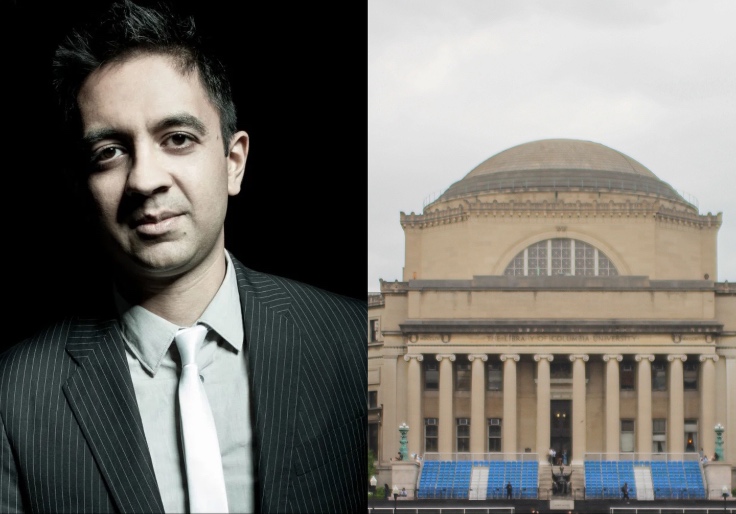
Columbia University attempted to distance itself from the Pulitzer Prize Board's newest member, Harvard professor Vijay Iyer, after a Washington Free Beacon report revealed his strident anti-Israel activism and membership in a faculty group that published an anti-Semitic cartoon.
"The Pulitzer Prizes are housed at Columbia University, but the Pulitzer Prize Board is independent of the University and operates as such," the university said in a statement on Wednesday. "The members of the Pulitzer Board are selected through their own process and neither the University nor any of its employees played any role in the Board's most recent selections."
The statement came less than 24 hours after the Free Beacon report and elides Columbia's deep connection to the prizes. Deliberations over the prizes take place on the Columbia campus in Pulitzer Hall, which houses the Columbia School of Journalism. The university also manages the investment portfolio used to fund the Pulitzers.
Columbia's president is a "permanent voting member" of the prize committee, and Columbia Journalism School dean Jelani Cobb has been a non-voting member since 2022. The prizes are also administered by Columbia employees Marjorie Miller and Joseph Legaspi, Miller's assistant. Miller is also a non-voting member of the Pulitzer board.
New board members are recommended by a nominating committee, according to the Poynter Institute, a journalism nonprofit. The full board then votes on the recommendations. When Poynter reported on the board's inner workings in 2018, it noted that the board's "Columbia brass has no more say than anyone else," indicating that Pulitzer board members affiliated with Columbia vote on new additions.
Columbia acting president Claire Shipman did not vote on Iyer's board membership, according to a university spokesman.
Columbia's attempt to distance itself from Iyer and the Pulitzers comes in the wake of a prolonged battle with the Trump administration over the school's failures to rein in campus anti-Semitism. As part of an agreement in which Columbia will pay over $220 million to the federal government, the university is subject to independent monitoring by a third party who will oversee its compliance. A Tuesday report in the Free Press indicated that the university refused to turn over data to the monitor that would allow him to determine whether the school was complying with the agreement.
Iyer, described by the Pulitzer Board as "an influential composer, pianist and scholar in jazz and contemporary art music," has a long history of anti-Israel activism. He wrote on social media in November 2023 that "the most powerful people on the planet [are] doubling down on their evil, deranged state-sponsored terror." That spurred a complaint from a Harvard student who noted, "Israel is far from the most powerful country on Earth; the insinuation is not the current Israeli government, but the Jewish people."
Iyer is also a member of Harvard Faculty and Staff for Justice in Palestine, which posted a cartoon of a hand with a Jewish star and a noose. Harvard president Alan Garber described it as "The Antisemitic Cartoon."
The Columbia Spectator reported that Iyer performed his song "Kite (for Refaat Alareer)" at a May 2024 "People's Graduation" event. Alareer was a Gazan poet who posted messages like "Are most Jews evil? Of course they are" and "Zios are the dirtiest little snitches."
Iyer's anti-Israel activism also predates Oct. 7, 2023. He signed a May 2021 Harvard faculty statement demanding that Harvard "divest from companies that aid in Israeli colonization, occupation, and war crimes," according to the Harvard Crimson. That same month, Iyer also signed a statement criticizing the Museum of Modern Art in New York for being "directly involved with support for Israel's apartheid rule" and "artwashing not only the occupation of Palestine but also broader processes of disposession [sic] and war around the world."
Iyer's ascension to the Pulitzer Board isn’t the first time the body has courted controversy. The board awarded last year's Pulitzer Prize for Commentary to Mosab Abu Toha, a Palestinian "poet" who defended the atrocities of October 7 and derided the Israeli victims of those attacks. Miller went on to attack Free Beacon editor in chief Eliana Johnson for posing questions to board members about the deliberations surrounding the award.