


On its face, Orano Federal Services, a North Carolina-based nuclear fuel cycle company, is a plausible partner for a $900 million Department of Energy contract to produce uranium for America's nuclear plants. But the firm's parent company, the French majority state-owned Orano Group, works with two Chinese military companies to boost Beijing's nuclear power industry, something experts and industry officials warn should disqualify the firm from receiving U.S. taxpayer dollars.
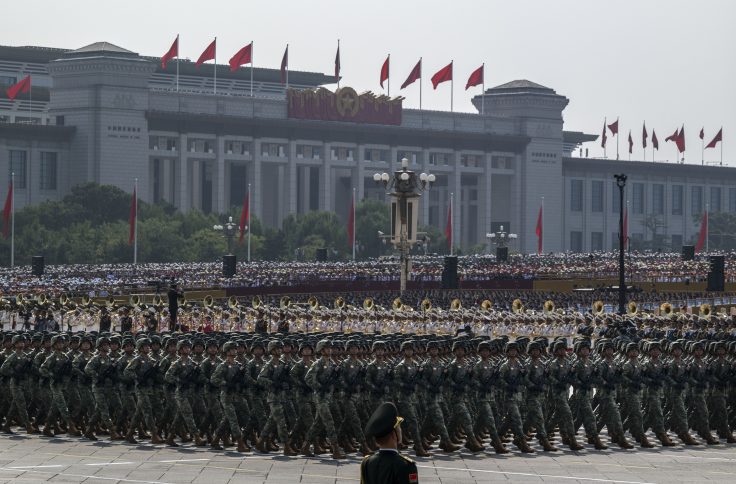
According to Orano, the company has a long-standing uranium supply and technology transfer partnership with the China General Nuclear Power Corporation as well as a number of active contracts with the China National Nuclear Corporation, both of which are state-run entities the Pentagon classifies as Chinese military companies. "Orano is supporting durably the development of the Chinese nuclear industry," the company touts.
Earlier this month, the French government signed an agreement with China to further cooperate on "nuclear fuel supply, nuclear equipment manufacturing, and the security of uranium resources." That agreement will almost certainly leverage Orano, in which France owns a 90-percent stake.

While Orano's partnerships with the Chinese entities are on their face designed to boost civilian nuclear uses, the Chinese Communist Party has for years pursued a military-civil fusion strategy using private intellectual property, research, and technological advances to further China's military aims. That's why the DOE took action to prevent China from using American civil nuclear technology for military purposes in 2018 and why the U.S. Nuclear Regulatory Commission cut ties with China General Nuclear Power Corporation in 2021.
Orano Group's pursuit of federal funding, then, raises serious national security questions and appears to undercut the very reason Congress created the program Orano is bidding to participate in.
As part of bipartisan legislation passed in 2023 and 2024, the DOE is required to purchase domestically sourced low-enriched uranium to reduce the influence foreign adversaries, namely Russia, have on the U.S. nuclear power industry.
Under the program, the DOE is expected to soon offer procurement contracts worth $900 million each to two of the six companies the Biden administration selected for eligibility in December 2024. The money would serve as a critical boost for the companies' planned projects to develop nuclear enrichment facilities in the United States.
For its part, Orano seeks to build a billion-dollar enrichment facility in Oak Ridge, Tenn.
"Department of Energy grants should not be used to develop Communist China's nuclear industry," Sen. Tom Cotton (R., Ark.), the chairman of the Senate Select Committee on Intelligence, told the Washington Free Beacon in a statement. "Companies tied to the Chinese military should never see a cent of American taxpayer dollars."
Cotton, along with the House Select Committee on Strategic Competition between the United States and the Chinese Communist Party, released an investigative report Wednesday revealing how Chinese state-run institutions have used DOE funding and research capabilities to fuel China's military and technological rise. The report concluded that the U.S. funding provides back-door access "to the very foreign adversary nation whose aggression these capabilities are necessary to protect against."
A former high-ranking U.S. official familiar with the issue suggested that the U.S. funding Orano is vying for, even if directed to its project in Tennessee, could free up capital for Orano to invest in its ventures with Chinese military companies.
"The last administration started down this path," the former official told the Free Beacon. "Now this administration has the opportunity to avoid sending U.S. taxpayer dollars to a foreign government-owned enterprise. Fundamentally, it's a national security issue and it is imperative that the United States build a domestic capability to enrich uranium."
An American nuclear fuel company executive added that it is "astonishing" the DOE would consider awarding Orano the contract.
"I think Energy Department officials have to proceed very carefully," said Paul Saunders, the president of the Center for the National Interest and a senior adviser with the Energy Innovation Reform Project. "In the situation that we're in today with the U.S.-China relationship, I think many people would have questions about providing taxpayer funds to a firm involved in [the] Chinese nuclear fuel cycle."
In a statement, Orano spokesman Curtis Roberts said the company serves 200 customers worldwide, has supported America's nuclear energy industry for 60 years, and that the DOE funding would be important for the development of its project in Tennessee. Roberts denied that Orano assists China's military.
"Our agreements with China specifically involve their commercial nuclear energy market and do not support any military activities," he said. "Orano continues its commitment to strict compliance with global sanctions regimes and U.S. export control policies."
Nuclear reactors, meanwhile, generate about 19 percent of America's total electricity, according to federal data. Those reactors, however, are fueled primarily from imported uranium, including 20 percent which is imported from Russia.
It's why the Trump administration and lawmakers have identified shoring up domestic supplies of enriched uranium as a central national security and energy security priority.
"Across the whole nuclear supply chain, so much has either gone abroad or just atrophied," Energy Secretary Chris Wright told reporters last week. "The Trump administration is all in on a nuclear renaissance. We need to address all avenues of the nuclear supply chain, the technology, the reactors, fuels, and fuel at the end of life."
"Thanks to President Trump, the Energy Department is fully committed to strengthening America’s energy security. That’s why the Department is acting swiftly to restore domestic supply chains for critical minerals and materials, including enriched uranium," DOE spokesman Ben Dietderich said in a statement.