




RAFAH, Gaza Strip—As Israeli forces have ramped up their assault on Gaza City, leveling high-rises from the air and pushing deeper into the northern Hamas stronghold on the ground, another prong of the war has quietly intensified to the south.
The Gaza Humanitarian Foundation, the upstart aid organization backed by the United States and Israel, has been distributing aid to Gazans on a daily basis, part of an effort to break Hamas's control over the population of Gaza. The Washington Free Beacon was there in late August as GHF distributed 18 truckloads of food to thousands of Gazans at its Secure Distribution Site 3 in southern Gaza.
"What you’re going to see today is controlled chaos," GHF spokesman Chapin Fay told the Free Beacon, but even so, none of the organization’s aid trucks have been looted.
Over several months of trial and error, GHF has achieved what once seemed impossible. The organization began distributing aid in late May and is now unloading two to three dozen truckloads a day without interruption, officials said. At the same time, it has begun preparations for a major expansion of operations, including the construction of two additional distribution sites near the existing ones.
U.N. aid delivery in the Gaza Strip was plagued by endemic problems, chief among them Hamas’s systematic looting of the aid trucks. Since mid-May, when fighting in Gaza resumed, nearly 90 percent of aid trucks that have entered Gaza through the U.N.’s distribution system have been looted, according to U.N. data. On Thursday, four UNICEF trucks carrying baby formula were robbed at gunpoint.
GHF is an attempt to break Hamas’s control of food in Gaza, which is in turn critical to the terrorist organization’s power, governance, and control of the population. That may help explain why Hamas’s interior ministry has denounced the organization, warning Gaza residents in July not to cooperate with GHF. "It is strictly forbidden to deal with, work for, or provide any form of assistance or cover to the American organization (GHF) or its local or foreign agents," a statement from the interior ministry said, threatening "the imposition of the maximum penalties stipulated in the applicable national laws."
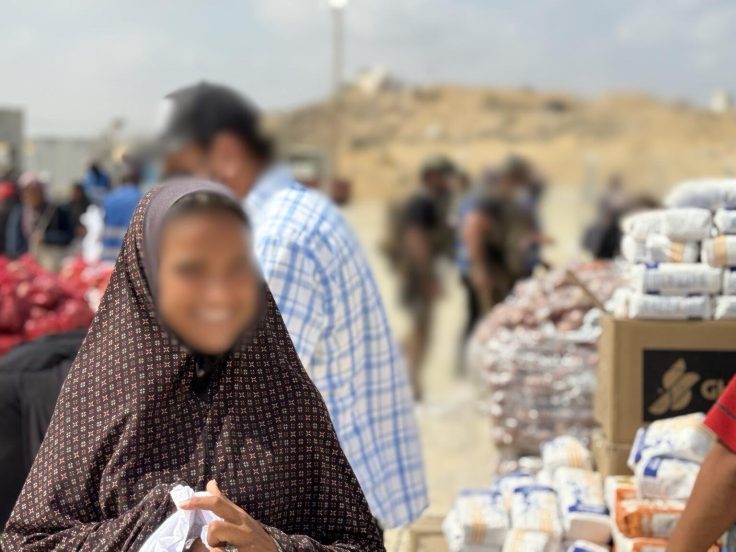
But many Gaza residents are ignoring those threats. This reporter watched as GHF raised a green flag over the aid site, signaling to Gazans in Khan Younis and nearby tent encampments that aid distribution had begun. Within minutes, several hundred motorcycles, rickshaws, donkey carts, and bicycles descended on the site, followed by about 8,000 young men and boys on foot. Plastic and cardboard flew as the crowd tore into hundreds of pallets of food aid—potatoes, onions, pasta, lentils, nuts, tahini, flour, sugar, and children’s supplements—that had been placed in a sandy, baseball field-sized distribution area.
It took less than half an hour for the Gazans to clean out the aid, along with every scrap of wood, cardboard, plastic wrap, and packing tape.
With the men gone, about 3,000 women and girls filed into the aid distribution site and GHF security contractors brought out a second round of food aid, which had been hidden in a staging area at the southern end of the distribution site. The idea is to prevent the men from overrunning women, which happened when women and girls were allowed in first. The group has worked to make such improvements in a challenging situation.
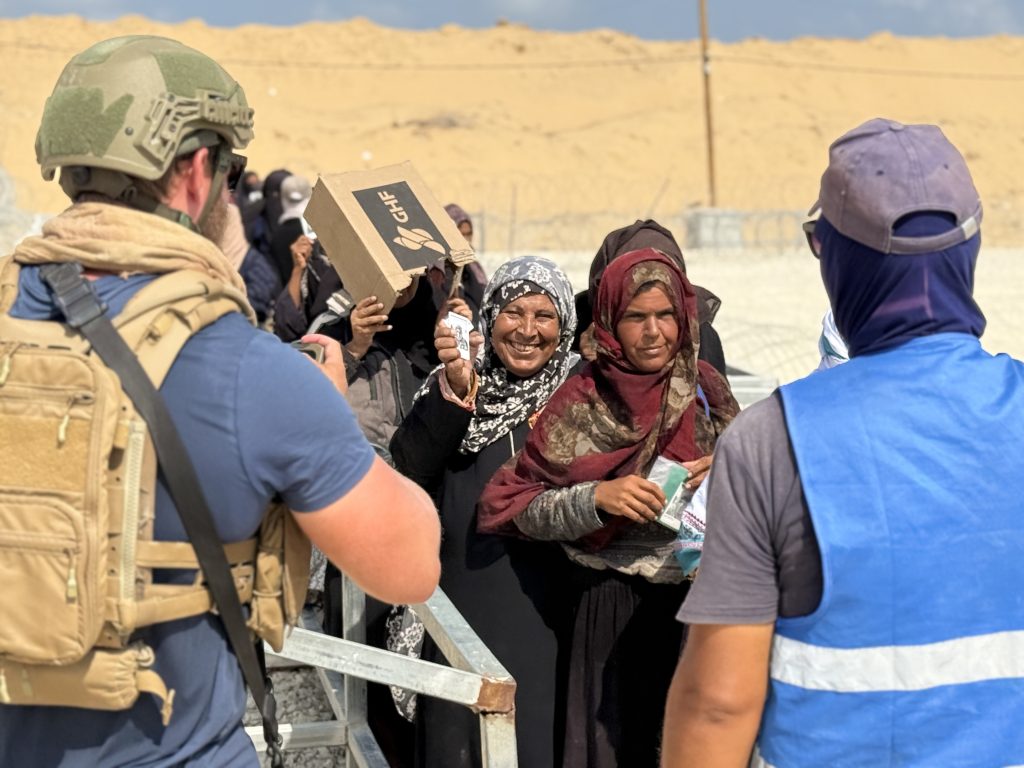
The women formed two lines at the southern end of the aid distribution area: one for roughly 1,000 who carried GHF-issued photo IDs indicating they had registered to reserve aid in advance, as part of a pilot program, and the other for everyone else. Gazan GHF workers wearing blue vests handed out potatoes, onions, and flour to the women as they exited.
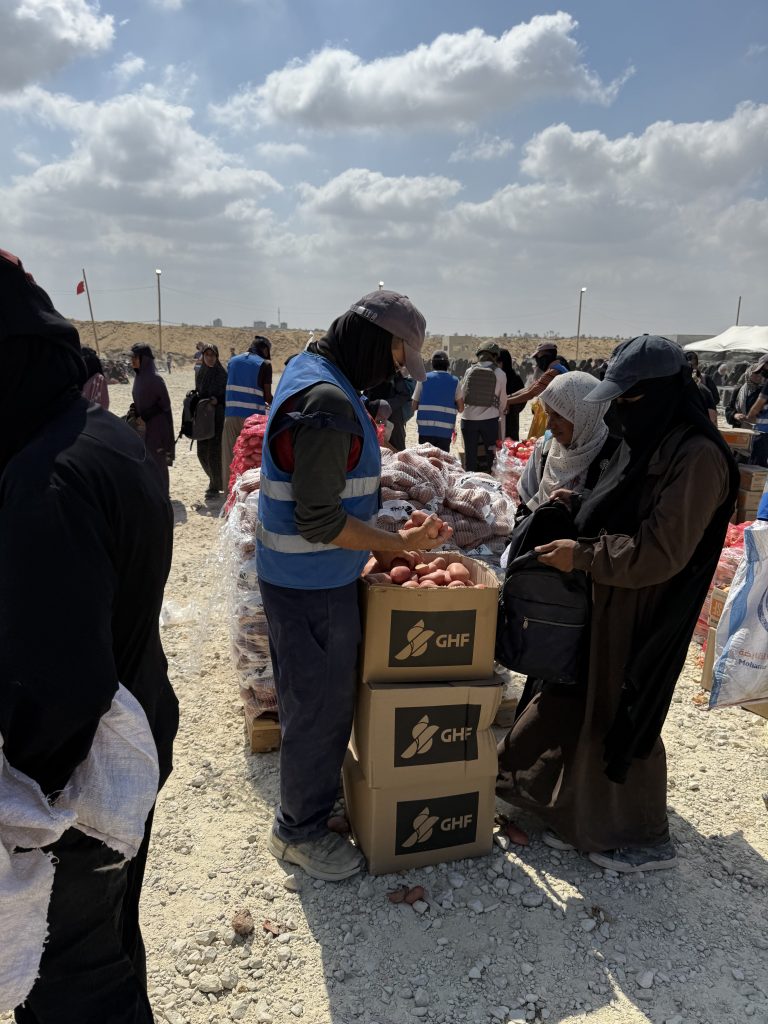
Five weeks earlier, during the Free Beacon’s previous visit to the distribution site in mid-July, GHF attempted a similar women-only distribution only to have it overrun by a crowd of thousands of Gazan men.
Several of the women said GHF was their only reliable source of food aid. One of them, a 47-year-old mother of five, said she had visited the site every other day for the past three weeks, walking about an hour from the Al-Mawasi tent camp, where she relocated with her husband and children during the war. "To be here means I am safe. I am good. I can eat today," she said. "I will go back to my home so happy because I can feed my sons."
The woman, whom the Free Beacon agreed not to identify for her safety, said the only way she could get U.N. food aid was by joining in the looting of the aid trucks, which she described as exhausting, dangerous, and often futile. "Look at me," she said, gesturing at her burka-covered body. "I cannot be jumping on the trucks."
If Israel is to defeat Hamas, efforts like GHF will have to triumph alongside soldiers on the battlefield. The operations officer of the IDF’s Gaza Division, Yaron Buskila, described GHF as "50 percent of our chance to defeat Hamas."
"It’s 50 percent our army," he said, "and 50 percent disconnecting Hamas from society."