


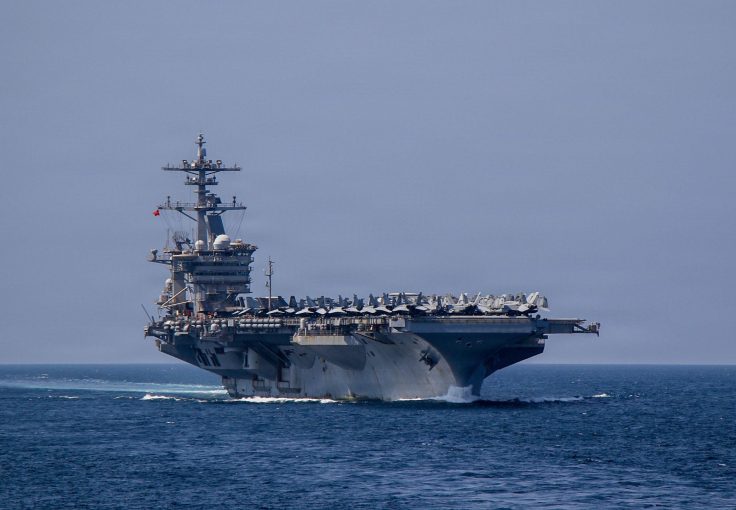
Not a single ship has breached the United States' naval blockade in the Persian Gulf since it began Monday morning, according to United States Central Command (CENTCOM), severely damaging the Iranian regime's ability to export billions of dollars in oil and sustain itself financially.
"During the first 24 hours, no ships made it past the U.S. blockade and 6 merchant vessels complied with direction from U.S. forces to turn around to re-enter an Iranian port on the Gulf of Oman," CENTCOM announced Tuesday afternoon, slightly more than a day after the United States military began its operation to obstruct the critical shipping lane Tehran uses to export its crude oil to countries like China.
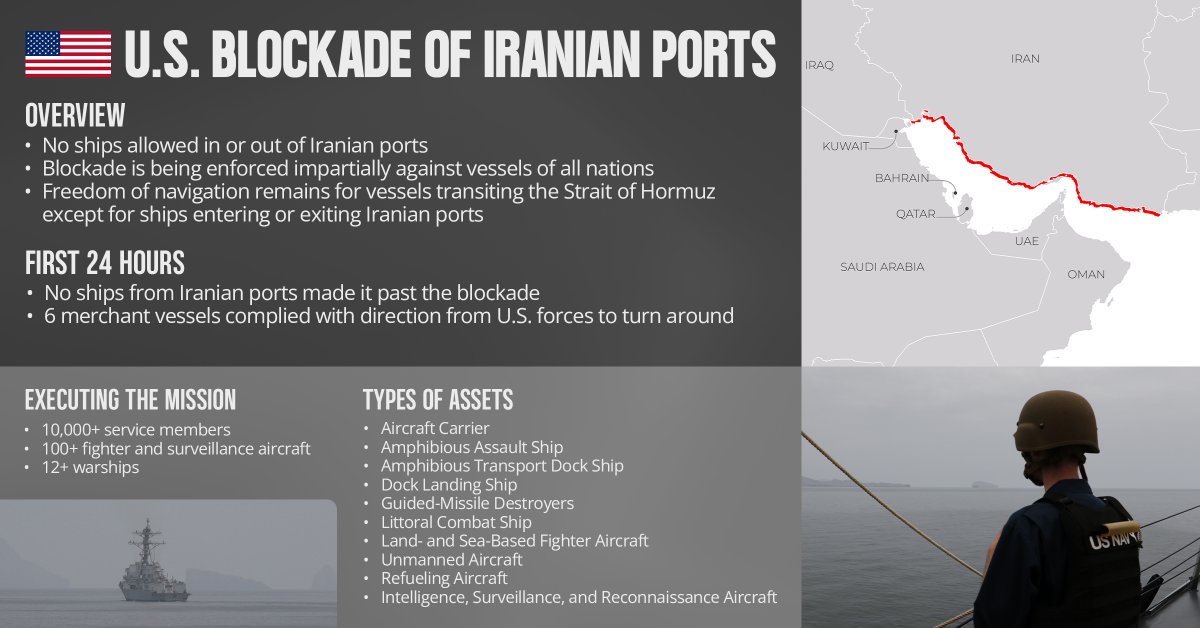
More than 10,000 U.S. service members are enforcing the blockade "along with over a dozen warships and dozens of aircraft," according to CENTCOM. "The blockade is being enforced impartially against vessels of all nations entering or departing Iranian ports and coastal areas, including all Iranian ports on the Arabian Gulf and Gulf of Oman."
The blockade has the potential to deprive the Islamic Republic of billions in revenue it generates from illicit oil sales to U.S. adversaries like China, which imports roughly 90 percent of Tehran's crude. Once the cash from these sales dries up, Iran's already ailing economy will experience further turbulence and apply greater domestic pressure on the hardline regime, experts believe.
Brookings Institution senior fellow Robin Brooks wrote on X that the blockade is meant "to collapse Iran's oil exports and, as a result, collapse its means to import all the stuff it buys from abroad. That means severe shortages in Iran, deep recession, devaluation and hyperinflation."
That collapse will be significant if Iran is unable to penetrate the blockade, former Treasury Department official Miad Maleki noted. The Islamic Republic stands to lose around $435 million per day in "combined economic damage" across its imports and exports, or about $13 billion a month.
"More than 90 percent of Iran's $109.7 billion in annual seaborne trade transits through the Strait of Hormuz," Maleki wrote in a policy brief the Foundation for Defense of Democracies—where he serves as a senior fellow—published on Monday. "Iran will be forced to shut down its oil wells, leading to permanent damage. The blockade makes continued resistance economically impossible."
Maleki added in further posts that "Kharg Island, which handles 92% of crude exports, sits deep inside" the Persian Gulf. The blockade eliminates nearly all of the $139 million per day that Iran's exports bring in, he explained.
Iran's ailing economy spurred shopkeepers across the country to revolt late last year, resulting in a nationwide protest movement that threatened the hardline regime's grip on power. Iranian leaders responded by killing more than 30,000 civilians as they sought to quash the unrest. Should Tehran's economy crumble further, it could create the conditions for anti-regime advocates to once again take to the streets.
President Donald Trump issued a direct warning to crews of any smaller Iranian ships that might approach U.S. vessels in a Monday Truth Social post.
"Iran's Navy is laying at the bottom of the sea, completely obliterated - 158 ships," Trump wrote. "What we have not hit are their small number of, what they call, 'fast attack ships,' because we did not consider them much of a threat. Warning: If any of these ships come anywhere close to our BLOCKADE, they will be immediately eliminated, using the same system of kill that we use against the drug dealers on boats at Sea. It is quick and brutal."

CENTCOM also said that, though the United States has prevented ships from leaving Iranian ports, the U.S. military has facilitated "freedom of navigation" for other commercial vessels "transiting the Strait of Hormuz to and from non-Iranian ports." Trump wrote in a separate Monday Truth Social post that 34 ships have successfully traversed the Strait, "by far the highest number since this foolish closure began."
Trump announced the blockade on Sunday after ceasefire talks with Iran failed to make headway on the nuclear issue and the Islamic Republic attempted to extract tolls from ships traveling through the Strait. The president said on Truth Social that "IRAN IS UNWILLING TO GIVE UP ITS NUCLEAR AMBITIONS" and that the country's diplomatic team was "very unyielding as to the single most important issue."
Richard Goldberg, who served in national security roles in both Trump administrations, told the Washington Free Beacon that more than a month of war had annihilated the majority of military targets in Iran, allowing the U.S. military to shift its focus toward a naval blockade.
"Admiral Cooper, the head of Central Command, has likely told the president we're near the end of the target set that we came in with, and now it's time to turn to the remaining issues: the Strait of Hormuz and the remaining nuclear threats," Goldberg said. "That's likely why the president felt comfortable entering into a ceasefire, using that ceasefire to move naval forces through the Strait of Hormuz as we saw over the weekend, and then dedicating our naval armada to a new mission: denying Iran's ability to import and export by sea."
The message to Tehran is clear, Goldberg told the Free Beacon: "You don't get to import or export anything unless we allow it."