





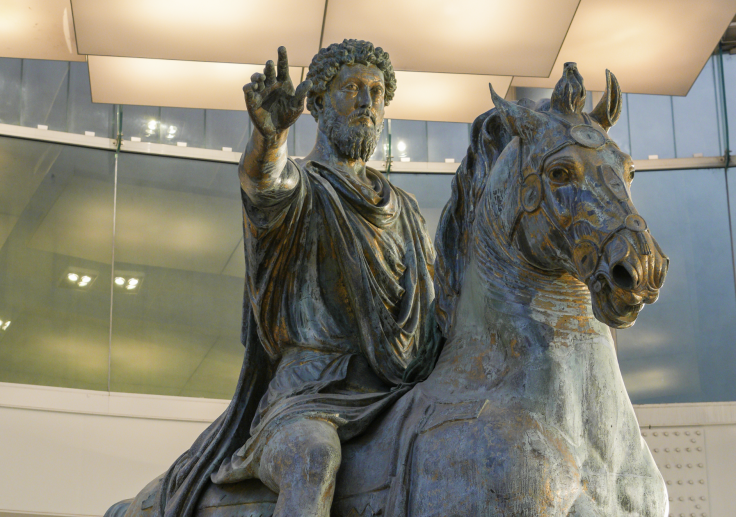
History has been kind to Marcus Aurelius, emperor of Rome from 161-180 A.D. Born to a patrician family in 121 A.D., his father died when he was three or four, but his mother Domitia Lucilla, a woman of remarkable intellect, saw the high potential in her son and acquired the best tutors for him. Marcus' intellectual gifts became evident early—the Emperor Hadrian referred to him as Verissimus, or most truthful one. The mercurial Hadrian, who spent his last years in illness and paranoia, took on an extraordinary man, Antoninus Pius, almost his exact reverse in talent and temperament, to help rule the empire. Antoninus in turn adopted Marcus, which assured his own rise to the emperorship after the death of Antoninus in 161.
Marcus Aurelius would go on to become the closest the world has known to the Platonic ideal of the philosopher-king: "States will never be happy until rulers become philosophers or philosophers become rulers," Plato wrote in The Republic. Marcus' status as philosopher is founded above all on his Meditations, a work, part autobiography, part self-help book, part Stoic instructional manual. Written in Greek, the language of philosophers, Marcus initially titled it Himself. He is said to have composed it between 165 and 170 while at battle against Germanic tribes and during what became known as the Antonine Plague (165-180).
Book One of Meditations begins with 12 pages of its author's acknowledgments of debts, emotional and intellectual, owed to family, friends, and the gods. By far the longest list of debts are those owed to Antoninus, Marcus' adoptive father and later co-emperor. Included among them are "His acceptance of fortune's abundant gifts, the good things in life, in so humble and apologetic a way that he could nonchalantly enjoy them when they were present and not miss them when they were gone." His "veneration for true philosophers without reproaching or succumbing to the other kind." His "lack of irritability, harshness, and impetuousness." And, to descend from the lofty to the mundane, his "habit of taking his daily bath at a reasonable hour." In this lengthy list Marcus is acknowledging Antoninus as the model on which he would hope to conduct his own rule over the Roman Empire.
Book One of Meditations concludes with Marcus Aurelius thanking the gods for his good fortune. Along with his being thankful for his family and education, included here are such items as "that I have attained vivid and frequent mental impressions of what it means to live one's life in accordance with Nature" and "that, fervent as I am for philosophy, I never fell in with a mere manipulator of words or wasted my time scribbling histories and scrutinizing syllogisms or the movement of heavenly bodies."
What Marcus Aurelius is expressing here is his gratitude for having early found the school of Stoicism, according to whose dictates he attempted to live his own life. Stoicism, with a capital S, differs from stoicism, with a lower-case S, in being a philosophy with a clear doctrine, while lower-case stoicism means the ability to endure pain or difficulty without complaint. Stoicism the philosophy happens also to be about endurance, but within a philosophical framework.
Pleasure and pain, fame and power, above all death, Stoicism the philosophy, as set out in the pages of Meditations, is about dealing with these. Moral at its core, Stoicism was opposed to slavery—no easy position to take in a Rome whose population is said to have been one quarter slave and whose economy was based on slave labor. Marcus Aurelius the soldier, in conquering various Germanic and other tribes, preferred whenever possible not to send, in the spirit of the day, the vanquished troops off into slavery, but instead enlisted them in his own army or set them up in agriculture in the far reaches of the empire.
In the introduction to his excellent new translation of Meditations, the classical scholar Aaron Poochigian notes that, along with being a philosopher, Marcus Aurelius was also a literary artist, a point he underscores: "He received extensive training in Latin and Greek rhetoric under the guidance of Fronto and Herodes Atticus, two of the most prominent stylists of his day." Poochigian adds that in the entries in Meditations, "Marcus indulges in wordplay and artful syntactic arrangements. Paradox appeals to him, and he utters addresses to his own soul and to Nature through the highly rhetorical figure of apostrophe. … His own frequent critiques of different types of people range in tone from the gentle satires of Horace to the more savage sort written by Juvenal."
A not uncharacteristic sentence from Meditations: "How preposterous and outlandish is anyone who sees anything that happens in his life as surprising." The sentence occurs late in Meditations, when we are not surprised even by it, for by then Marcus has instructed us that at the heart of Stoicism is acceptance of life in all its radical variety. This means above all living by the dictates of Nature, a word that in Meditations always appears with a capital N. "Everything that Nature does and everything that furthers its aims are good for every part of it," Marcus writes, then, later, adds, "Nature never burdens you with more than what you are built to endure." And: "Nature, also known as the Truth, is the source of all true things in the universe."
Marcus Aurelius holds that "there are two reasons, then, why you should welcome what happens to you: 1. The occurrence is for you—it was prescribed to you and in a way is specific to you because primordial forces long, long ago wove it into your destiny. 2. The power that runs the universe makes sure that whatever happens to each of us as individuals also serves to advance, perfect, and sustain itself." This is why you must always forget your own insignificance, but "remember how minuscule a smidgen you are of the whole of existence. … How limited a part you play in the run of destiny." And, the crusher: "The whole Earth is just a speck of the universe, anyway."
You must remember, the Meditations reminds us more than once, that you could leave the earth at any moment, and "let that truth rule your thoughts, words, deeds." Over and over Marcus reminds us that man is "an animal that must die." He takes things a step further by insisting that it doesn't truly matter when we die, a short life ultimately being no worse than a lengthy one. "Why," he asks, "do you think death is a big deal?"
All this being so, it is foolhardy to seek praise. The desire for fame is even emptier. To have fame beyond one's life, he argues, is as silly as "being miffed that people didn't praise you before you were born."
In the end, for the Marcus Aurelius of Meditations, there is only one thing in this world that is worth anything: "living a just life, a good life, with sympathy even for liars and criminals." Here he adds that "perfection of character comes down to this: living each day like it is your last, without hysteria, without apathy, without histrionics." Marcus advises that "the closer you come to dispassion, the closer you come to strength." In the end, "real good fortune consists of good habits in your soul, good motives, and good actions."
Did Marcus Aurelius live up to the philosophical Stoic prescriptions set out in Meditations? For the most part, it is good to report, he did. His was not an easy reign. He was forced to fight many battles, including a successful one against Parthia, Rome's long-time enemy, and always treated the troops he conquered in a humane way. During his years in power, Christians in the empire felt at ease, and he showed respect for Jewish Talmudic learning. His emphasis on death in Meditations was doubtless owing to the many deaths he himself suffered among his own family: those of his mother, his brother Lucius, and his favorite son Marcus Annius Verus. (Toward the end of his own life, he suffered regrets about his remaining son, Commodus, who would follow him as emperor and who early on showed signs of bad character.) After a long illness, Marcus himself died, it is thought of plague, on the night of March 17, 180, an easeful death, in his own bed, covers pulled over his head.
In The History of the Decline and Fall of the Roman Empire, Edward Gibbon wrote: "If a man were called upon to fix the period in the history of the world during which the condition of the human race was most happy and prosperous, he would without hesitation, name that which elapsed from the death of Domitian to the accession of Commodus." The time, in other words, chiefly during the reigns of Antoninus and Marcus Aurelius.
Meditations
by Marcus Aurelius, translated by Aaron Poochigian
Liveright, 288 pp., $21.99
Joseph Epstein is the author, most recently, of The Novel, Who Needs It? (Encounter Books).