



The celebration of the nation's 250th anniversary is now very nearly upon us, as the signal date of July 4th approaches. Of course, to be technical about it, and as many Americans are well aware, July 2, 1776 was the actual day that the Continental Congress approved the resolution proposed on June 7 by Richard Henry Lee of Virginia, the act that would make the rebellious British North American colonies into "free and independent States." Writing to his wife Abigail on the 3rd of July, John Adams got carried away with enthusiasm, declaring that the 2nd of July would be "the most memorable Epoca, in the History of America," the "Day of Deliverance by solemn Acts of Devotion to God Almighty"; it would be "solemnized with Pomp and Parade, with Shews, Games, Sports, Guns, Bells, Bonfires and Illuminations from one End of this Continent to the other from this Time forward forever more."
Well, Adams was right on the substance, but wrong on the date.
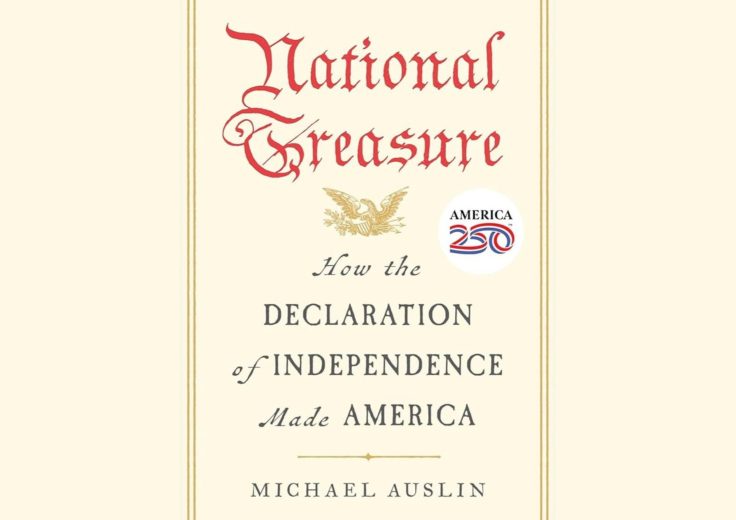
But why, then, do we raucous Americans choose to celebrate our Independence on the fourth rather than the second? Simply because the fourth was the date when the Continental Congress adopted the Declaration of Independence, the document that, in the act of declaring to the world the justification of the American cause, also declared ourselves to ourselves, as a people among the peoples of the earth. "Something we were withholding made us weak," wrote Robert Frost, "Until we found out that it was ourselves/ We were withholding from our land of living." Lee's resolution was negative; it stated only what we no longer were. But the Declaration, which was mainly the handiwork of Adams's rival Thomas Jefferson, laid a foundation for the new thing that we were becoming. It was, as Michael Auslin argues in his provocative title, the document that "made America."
Which is not to say that everyone has always agreed on the meaning of the Declaration, or even on its importance. Opinions have always run the gamut, and still do today. The biographer Walter Isaacson has just published a book whose title asserts that Jefferson's Declaration contains "the most important sentence ever written." But the late and very distinguished historian Pauline Maier countered that Jefferson was "the most overrated man in American history," and that the Declaration, far from being foundational, enjoyed a brief moment in the sun, was largely forgotten after the revolution, until it was revived by certain politicians, notably Abraham Lincoln, who saw fit to impart to it the quasi-sacred status it enjoys today.
It is the singular virtue of Auslin's fine and immensely readable book that it does not wade into these struggles as an interested party, nor does he try to referee the debates. He also devotes a relatively small portion of the book to the actual composition and adoption of the Declaration in the context of its times. Instead, his book wants to tell us the whole story of the Declaration's journey through the past 250 years—a history of its reception, if you like, but written for the educated general reader, not the specialized scholar—and how our readings of it at various times have both reflected and influenced those times, and yet left the document itself intact and inexhaustible, as numinous and multilayered as a great poem or great text of holy Scripture. The Declaration remains, Auslin states in his conclusion, "the purest expression of what it means to be an American," words that echo Jefferson's own description of the Declaration, nearly 50 years after he composed it, as "an expression of the American mind."
It is also an account of the Declaration that takes a keen and concrete interest in the physical aspects of the story: how the document was made, how it was signed at various times, how its contents were conveyed to the broad public, including its being read to cheering crowds in Boston and Philadelphia, and then how it became rolled up and stowed away for safe keeping during the Revolutionary War itself, and on into the early history of the new nation, and so on, leading up to its current disposition in the National Archives and the deep vault into which it is lowered at nights, away from the public view. That part of the story runs through his book like a rondo theme, popping up and recurring throughout the nation's history.
There is some truth in Maier's contentions about the Declaration's recession. By the time of the bitterly divisive presidential election of 1800, the Declaration was rarely invoked by either of the contending parties, although the historian Mercy Otis Warren, in her fascinating and much-neglected 1805 history of the American Revolution, extolled it to the skies, calling it "a palladium" of which Americans "should never lose sight." But hers was a singular voice, a lone Jeffersonian among the Federalist-inclined ranks of early historians of America, and for the most part, the Declaration's ideas remained as invisible in public discourse as its rolled-up and stashed-away parchment remained inaccessible to the public eye.
This had changed by 1823, as the parchment version became accessible and immediately acquired a public mystique it has never since lost. The Declaration was regaining its high place in American culture, even as the lions of the revolution were dying off, including both Jefferson and Adams, on July 4, 1826. With the death of Charles Carroll in 1832, the last of the Founders, the Declaration had already outlived all of the men who had signed it into effect.
And its cultural power only continued to grow. Elizabeth Cady Stanton's witty and spirited "Declaration of Sentiments" in 1848 parodied the Declaration of Independence's phrases and cadences in making a powerful (and then-revolutionary) case for women's "sacred right to the elective franchise." The Declaration was roundly affirmed in Frederick Douglass's bitingly critical 1852 speech, "What to the Slave Is the Fourth of July?" And it reached a new pinnacle in the oratory of Abraham Lincoln, who sought to answer the defects of the Constitution by insisting that the Constitution must be read through the lens of the more foundational Declaration—the apple of gold for which the Constitution was the frame of silver. His Gettysburg Address, perhaps the greatest speech in our history, was among other things a recapitulation of the Declaration, presented as the nation's ground of being.
Moving on to the years after the Civil War, Auslin proceeds to give an account of the shifting status of the Declaration, both the interpretation of its ideas and the ever-more-careful maintenance of the material document that expressed them. He rightly gives attention to the disdain for the Declaration shown by Woodrow Wilson and other progressives around the turn of the 20th century, and the vigorous and memorable rejoinder by Calvin Coolidge in his great 1926 speech on the 150th anniversary of the Declaration, which affirmed the central truths of the document as "final." In the post-World War II era, the Declaration has become a potent tool for the promotion of civil rights, especially in the hands of Martin Luther King Jr., and a model for the promotion of human rights in the world. And Hollywood even managed to make it into a cult classic movie, bearing the name National Treasure.
So Auslin's book is a story too, a kind of multigenerational treasure hunt, and it is not over, not by any means. We are in the middle of that story. But the book concludes with the hope that the Declaration, not only by virtue of its tenets of liberty and equality and self-rule, but also by virtue of its near-continuous presence through all of our national life, can be a unifying force in a fractious time. In other words, the story will continue. There is reason to believe he is right. The mystic chords of memory, as Lincoln put it in his First Inaugural Address, cannot help but draw us back to this Declaration that is so much a part of us as Americans, even when we interpret it and quarrel with it. Perhaps especially then.
National Treasure: How the Declaration of Independence Made America
by Michael Auslin
Avid Reader Press/Simon & Schuster, 368 pp., $30
Wilfred M. McClay is Professor of History at Hillsdale College, where he holds the Victor Davis Hanson Chair in Classical History and Western Civilization. His most recent book, coauthored with Stuart Halpern, is Jewish Roots of American Liberty: The Impact of Hebraic Ideas on the American Story (Encounter Books).