





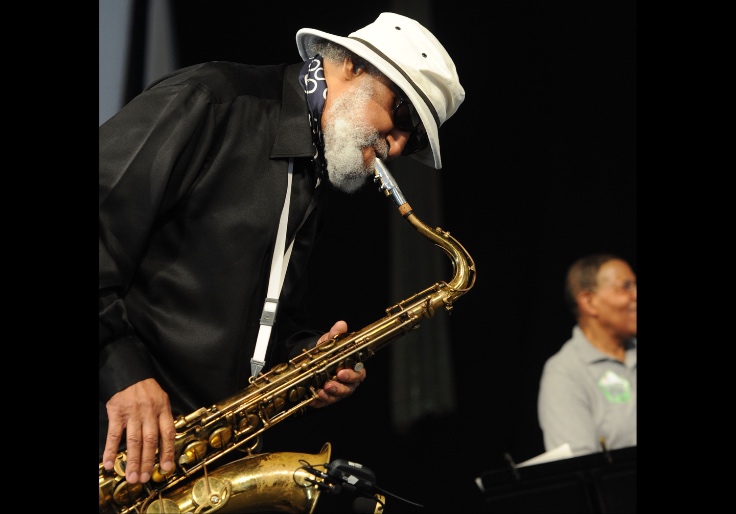
Sonny Rollins, the tenor saxophonist who died on May 25 at the age of 95, was a jazz musician's musician. The last of the big boppers, Rollins was the marathon runner of the chordal labyrinth. But the Theseus of the tenorists was more likely than most of the great jazzers to be seen than heard. For most people, jazz looks better than it sounds. The listening public's visual taste in Blue Note sleeve designs and black-and-white photography always outstrips its aural appetite. The obituaries emphasized the legend of Rollins's occultation of 1959, when he was neither seen nor heard for two years on a stage or studio while he reworked his method by practicing amid the girders of the Williamsburg Bridge. When you did hear Rollins, it was likely to be second-hand, in the phrasing and strategizing that lesser players had copped from him. But when you did hear the full strength of Rollins's musical mind, you knew it. And if he was in full flight, you felt it, too.
It took strength to play like Rollins did. Extended improvisation is an endurance test of the embouchure, teeth, lungs, legs, and fingers. But the really taxing stuff lies beyond the physical demands, in the mental laboratory of improvisation. In his life and music, Rollins shifted from one kind of musical strength to another. His playing, and the Notebooks that were published last year, record his seven-decade effort to incorporate the two. The burly junkie who did 10 months on Rikers Island for his part in an attempted armed robbery, a second stretch for heroin possession, and a voluntary third term taking the methadone and hard-labor cure at a federal facility in Kentucky became a health-hacking, mind-cleansing meditator.
When Rollins took it to the Bridge, his playing epitomized the hard-bop helter skelter, which takes a lot of muscle and fills the canvas with 16th notes and substitutions. When he returned to action in 1962 with an album called The Bridge, he sounded like himself, only more so. He played more in that he pursued his ideas to extinction with greater fluency and purpose, but now he started to play less, too. He was using what the painters call "negative space." His eloquence in sound was already peerless among the tenors. The pre-pontic Rollins had a slicker technique than Coltrane and a stronger ear for melody; only Johnny Griffin could play so much and still surprise you. Post-pontic, Rollins deployed the eloquence of silence. No one apart from Miles Davis was as good at playing the soundless parts in between.
Rollins was born in Harlem in 1930. His father had been born on Saint Croix, and his mother on Saint Thomas, at a time when the Virgin Islands were under Danish control; Rollins was, in his fashion, the greatest Scandinavian jazzer. He started on alto because he loved Louis Jordan, then switched to tenor after discovering Coleman Hawkins. You could fill a Blue Note session with Rollins's bandmates at school: the altoist Jackie McLean, the pianist Kenny Drew (who left the States for Copenhagen and became a Danish citizen), and the drummer Art Taylor. Rollins turned professional in 1948, and worked with Charlie Parker and Miles Davis in the early 1950s.
On Christmas Eve, 1954, Davis's quintet, augmented with a phial of liquid cocaine, recorded a Prestige session that came out as half of the Bag's Groove album in 1957. Three Rollins originals were on the album, and all became standards. "Oleo" is a Parkerish run through the changes of "I Got Rhythm," "Airegin" is an angular bopper with a chromatic middle section, but "Doxy" is different, a slow march whose simple chording and surprisingly obvious melody suggests the future trajectory of Horace Silver, who was on piano that day.
Rollins and Silver broke through with their own groups around the same time. Like Davis, they started to work through the chordal overload of bop and recover the virtues of melody and space. Davis worked through the blues toward the modal revelation of "Kind of Blue" (1959). Silver leaned toward the R&B-like structures of "soul jazz." Rollins introduced similarly straightforward chord sequences, but from a wider range of sources. After the blasting bop of the Tenor Madness album with John Coltrane, Rollins's next album, Saxophone Colossus (1956), opened with another future standard, the calypso-feel "St. Thomas."
A Bahamian folk song, "St. Thomas" was originally called "Sponger Money." Rollins heard it at his mother's knee in the Virgin Islands as the Danish-language "Det var en lørdag aften" ("It was a Saturday Evening"). The chords of "St. Thomas" invite you to play passing blue notes, but only for a couple of beats. Mostly, they suggest you stick to the C scale. The bouncing bass and drums force you to play with the rhythm, and the generally stable harmonies of the chording pushes you to play for sonority. This melodious game would recur in Rollins's subsequent calypso tunes such as "Don't Stop the Carnival," and also in the country songs he picked for his next album, Way Out West, such as Johnny Mercer's "I'm an Old Cowhand."
Way Out West supplied another visual (Rollins in cowboy rig), but it also debuted Rollins's strategy of negative space by having no piano or guitar, just sax, bass, and drums. When we listen to the piano-less Rollins, we hear the difference between his pre- and post-pontic methods. On A Night at the Village Vanguard (1958) he fills every gap. On The Bridge, however, Rollins uses a guitarist, Jim Hall, one of the great understaters of the six-string, but still leaves plenty of space. Rollins was now balancing intellect and feeling, or, as a Georgian pianist called it, sense and sensibility.
Jane Austen practiced her piano with the kind of daily discipline that Rollins admired. She ranged similarly across the songbook, in her case from Handel and Haydn to pre-pop hits of the day such as "Crazy Jane," the 1800 folk ballad on which W.B. Yeats would later improvise. In Sense and Sensibility, Elinor Dashwood is what the Georgians called "sense": a rationalist, advancing by self-control and strategy. Her sister Marianne is all feeling ("sensibility"), and this leads to suffering. As the post-pontic Rollins's solos sometimes come unstuck because their sensibility pushes their sense toward nonsense and a recovery of sense via rhythm and restatement, so in Pride and Prejudice we know that Elizabeth Bennet's sincere fumbles at the piano are preferable to the flashy fingers of Caroline Bingley the social climber.
Imperfection and error are the record of Rollins's explorations. The palpable misses count as much as the intellectual hits. Keats, writing to his brothers in 1817, describes Shakespeare and the "Man of Achievement" as possessing "Negative Capability, that is, when a man is capable of being in uncertainties, mysteries, doubts, without any irritable reaching after fact and reason." Take away the piano or guitar, and you multiply the harmonic uncertainties and mysteries. Rollins took up melody as his lamp, rather than just falling back on the facts of harmony and the reason of a chord sequence.
Consider the 1966 studio recording of "Alfie's Theme." (This is the 10-piece version recorded under Oliver Nelson's direction, not the soundtrack of the Alfie movie itself; Rollins and a British group featuring Ronnie Scott, Tubby Hayes, and Stan Tracey spontaneously composed the soundtrack on a London sound stage as a cut of the film played in front of them, but that session has yet to be released as an album.) The rhythm section enters in tiptoeing half-time, with Rollins's statement of the melody sliding to one side and then the other of the pulse. The first solo, from the guitarist Kenny Burrell, is straightforward Bb minor blues, and the second, from pianist Roger Kellaway, is in the late 1950s' style of Bobby Timmons work with Art Blakey. When Rollins steps up, we are almost exactly a third of the way into this near-10 minute recording.
Kellaway ends on 10-fingered rolling chords that overflow the sound picture, then lays out. The chordal frame dissolves, and Rollins picks up the baton at 3:10. He juggles the conventional four-note theme, which is more of a blues lick than a melody, but does it desultorily. He appears to run out of air or interest. He plays nothing at all for six seconds. It feels longer than that, because the negative space is painful to hear. Having reset our sense of time, he again flutters on the opening phrase of the theme, touches a high harmonic, and flickers around in the lower-middle range as if feeling out the dimensions of his space. A rising scale, and he's under way. The density of the notes builds with a logic that shows its workings (4:30), and by 5:10 he is touching the outer edge of his harmonic possibilities. He descends via some percussive honks, working with the drums to anchor himself again.
We are now at the halfway mark in the solo. Rollins states the theme for a third time at 5:28, but now it is mangled and stuttering. He feints at the opening phase of "Summertime" at 5:45 but rejects it (same four notes, but too obvious). He restates the theme once more at 6:00, and this time busts his way through the roof with a stack of fourths. Back down with some slalom-descending runs, a pivot on a clotted phrase that sounds like a man throttling a goose at 6:30, and then he's aloft again for a whole two minutes, flipping back and forth between a simple blues phrase and its latent principles of atonality. It is as though we are passing back and forth through a double-sided mirror. As Keats wrote, "with a great poet, the sense of Beauty overcomes every other consideration, or rather obliterates all consideration."
Dominic Green is a Wall Street Journal contributor, jazz guitarist, and fellow of the Royal Historical Society.