





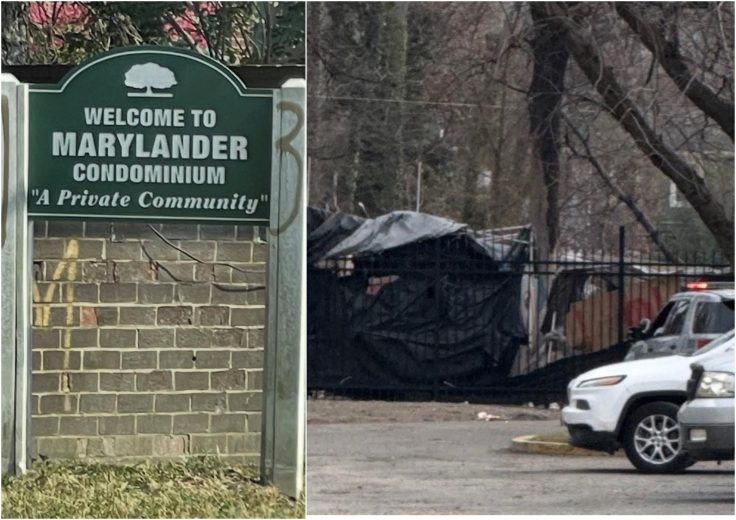
Residents of the Marylander Condominiums, in Prince George’s County, Md., have been without heat since November after vagrants from a nearby homeless encampment allegedly vandalized the boiler room.
Now, many of those residents will be homeless themselves after a judge greenlighted the county’s efforts to start a forced evacuation of the condominium complex.
Maryland district judge Bryon Bereano gave the county permission on Thursday to enforce an eviction order against half the property, which affects roughly 100 units. The county had deemed those units "unfit for human habitation" due to the heating failures allegedly caused by the encampment, to which the county itself had been delivering food.
Those deliveries—exposed by a Washington Free Beacon report on Thursday—were part of a broader pattern of inaction and enabling that allowed the camp to evolve into a 50-person shantytown.
"We’re not criminalizing the unhoused," police major Thomas Boone said of the encampment at a town hall in January, a statement that put an exclamation point on the reluctance of local law enforcement to deal with the problem.
The county will instead push hundreds of legal residents out of their homes.
Bereano, the judge, did say that he would not hold the condo in contempt of court if some residents refused to leave. At that point, the burden of evicting them will fall on the county, which Bereano warned would face an uphill battle. Based on past experience, he said, only 30 percent of residents could be expected to comply.
The mood in the courtroom was bleak as tenants at the Marylander pondered their next steps. Several joked that they might find shelter in the homeless encampment that had effectively displaced them, and which, at one point, included a shack with a generator.
"They’ve been living better than us," said Jason Van Horne, whose unit has no heat or electricity after space heaters fried the building’s circuitry. His condo, which he shares with his 73-year-old mother, also flooded this week after the pipes burst.
The Van Hornes moved to a hotel after conditions in their unit became unbearable. So did Chris Barber and his mother, Linda, who has owned her condo for 43 years.
Both families say that they cannot afford hotel rooms, which begin at $90 a night, for much longer. But thanks to the damage caused by the encampment, they also cannot sell their units, a Catch-22 that has many residents vowing not to pay their condo dues until things improve.
That will exacerbate a separate issue that the condo’s property management firm, Quasar Real Estate, blames for forestalling almost $5 million in planned repairs: The Marylander has no money in its account after damage from the encampment scared away the banks.
Bereano acknowledged the conundrum even as he gave the condo 14 days to drag itself into compliance with various safety codes. "You can’t get blood from a stone," he said. "If the money’s not there, the money’s not there."
Thursday’s hearing followed months of inaction by county officials as conditions at the Marylander deteriorated. Police refused to arrest vagrants from the encampment who broke into buildings, smoked crack in stairwells, napped outside doorways, and left the halls strewn with urine and human feces—all while drug dealers cruised the condo’s parking lot in high-end vehicles.
The encampment, which popped up more than two years ago, transformed a once-placid property into a den of squalor. "You used to look out the window and see kids playing in the snow," Linda Barber said. "Now we see people smoking crack."
The drugs appear to be supplied by local gang members who frequent the camp, some of whom were arrested last month. The county finally conducted a sweep of the camp—after years of dispatching social workers to deliver food to its inhabitants—on January 21.
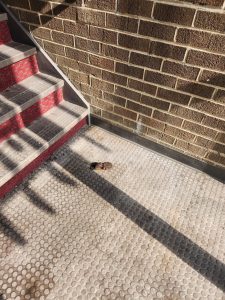
By the following evening, some camp members had already returned and started a fire behind the Marylander. And the squalor hasn’t improved in the weeks since: On February 4, Van Horne visited his building and found fresh feces on the stairwell, according to images shared with the Free Beacon.
Meanwhile, the condo’s finances have plunged even deeper into the red. After residents began using space heaters to heat their homes, Quasar installed wires above ground to cope with the strain on the grid. That got the complex placed on fire watch, forcing it to pay for hourly maintenance patrols.
In a phone call explaining the citation, Aaron White, the county’s assistant fire chief, told Quasar that the patrols would help contain the fires frequently started by encampment members. He backtracked when asked for comment, telling the Free Beacon on Wednesday that those fires were not a factor in the citation. But he appeared to contradict himself again at Thursday’s hearing, testifying that the wires were more likely to be vandalized—and thus more likely to start fires—given their proximity to the encampment.
Based on that testimony, Bereano said the condo would remain on fire watch between the hours of 6:00 p.m. and 6:00 a.m. But he added that the county should do more to address the risk of vandalism from the encampment.
"I think that that is something that the county kind of needs to lend its resources to with the police department," Bereano said. "That [should] be a special focus of emphasis to make sure that does not happen."