


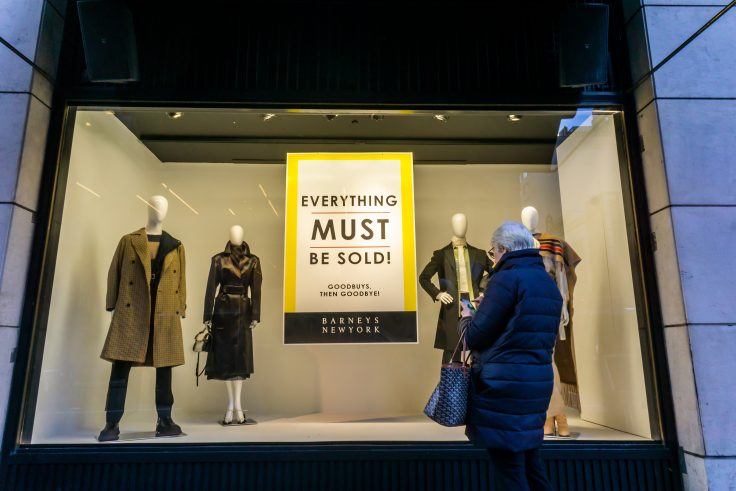
To become a man in the Jewish tradition, a 13-year-old boy must have a bar mitzvah, a puberty rite in which a rabbi declares a child's adolescent faculties fully developed. And if the bar mitzvah boy lived in New York in the later 20th century, chances are he bought his suit at Barneys.
Once a retail mecca with luxury brands that Michael Jackson and the Sultan of Brunei patronized, Barneys traces its genesis to 1923, when Barney Pressman pawned his wife's engagement ring for $500 to finance a down payment on a 500-square-foot men's discount clothing shop on Seventh Avenue.
They All Came to Barneys details the store's history told by Barney's grandson Gene Pressman who barely cranes his neck when reflecting on the empire's miraculous conception and his role in its demise; he's onto the next.
The book's intrigue, instead, is in Pressman's cheaply hidden hubris. Behind the dizzying number of haute couture names on each page is a solipsistic account of how he "modernized" his grandfather's dynasty—and bankrupted it.
"We were … drunk with the possibilities of expansion," Pressman writes, yet he'd have gone even bigger if given a second chance. "I would have added things like a concert hall or a food hall, and opened condos and resorts and hotels," he said during an interview about his memoir. His pro forma compunction feels like the faux leather of a SoHo street vendor's Prada handbag.
Pressman throws other perfunctory rhetoric at the reader addressing his privilege, as if to excuse his arrogance. He acknowledges he's won the zygotic lottery, calling himself "the luckiest person on the planet," then wastes no time in discussing his rotation of runway girlfriends, consumption of Quaaludes, or "disco biscuits," and front-row seats to fashion shows in Milan and Paris.
"I was young, single, and rich—I invited several girls I was seeing all at the same time and brought what must've been a gallon-sized bag of Quaaludes and an ounce of cocaine," Pressman recounts of his Halloween party aboard JFK's yacht, the Honey Fitz, with a hundred others. "I think seventy-five of them were models, and the other twenty-five were guys."
An unabashed member of the lucky sperm club, Pressman worked his "way through the Sports Illustrated girls of northern Europe" and the star-studded scenes of Manhattan's 1970s nightlife. After the arrest of his friends who owned Studio 54, he realized that "all parties end, and it's better to leave early than to stay too long."
Pressman, a Type A stoner, embraced a play hard, work hungover philosophy. He broadened Barneys to women's fashion, seeking to escape his father and grandfather's shadow and reel in the zeal only women's shopping trips emanate.
Driven by "manifest destiny in a miniskirt," Barneys opened a roughly $25 million, 70,000-square-foot women's store in 1986. To celebrate, the store held an AIDS charity fashion show featuring Andy Warhol and Madonna, while auctioning off Levi's jean jackets donated by the company's owners.
When the stock market crashed one year later, Barneys believed Black Monday would become Black Friday. They sought the Far East's funds to expand, partnering with Isetan, the Japanese retailer, which ultimately invested over $600 million in the store.
Juiced on Japanese cash, the New York emporium went westward, and Isetan rarely told them no. It established new outposts, including in Chicago, Houston, Beverly Hills, and Tokyo. Simultaneously, Barneys America came to malls in Seattle, Dallas, and Manhasset, Long Island.
In 1993, Barneys also unveiled its Madison Ave. store with fanfare that made the women's store's launch look like a child's birthday party. Caviar omelets were served, and Barry White performed with his 40-piece Love Unlimited Orchestra—its echoes likely startled the thousands of dollars' worth of saltwater fish housed in the same custom-glass cases as the store's fine jewelry. The building, reclad with French limestone, had "forty different types of wood inside," 10-foot windows, and a cosmetics section set in front of a "custom mosaic of thirty-two Byzantine-style portraits."
The party didn't last. After Pressman details the flagship's debut, he notes that costs ballooned during its $100 million-plus development and, before its opening, the Japanese stock market plummeted alongside Isetan's sales.
Hubris is Pressman's hamartia, diverting his focus from everywhere but where it should have been. He dedicates more lines to debauchery than to the hardship of his first wife's breast cancer diagnosis. Bonnie Lysohir, the mother of his two children, had been undergoing treatments, but he was "so focused on keeping the company going that … [he] could barely pay attention to anything else." After Christmas in 1995, she proposed a divorce, leaving him "heartbroken, and also, to be totally honest, a little relieved."
Around the same time, the Barneys board filed for bankruptcy. A phone call with Donald Trump couldn't allay Pressman's fears of impending collapse. "I'm not talking to anyone. I'm playing golf," he told Jeanine Pirro's then-husband, who handed him a flip phone with Trump on the line. "Donald, I can't talk to you now," Pressman said before divulging his debt. "'Ah that's nothing,'" Trump bragged. "'I've got more.'"
When Barneys was effectively bought out in May 1998, the Pressmans became contractors. Months later, when Pressman's deal was ending and he left for good, "no one really knew."
"Now my marriage was over, Barneys was in the rearview mirror, and I was knocking at the door of a very young fifty," he writes. "Who knew what would come next?"
Evidently, a multimillion-dollar tax-fraud lawsuit from his brother Bob nearly 20 years later. While signing copies of his memoir in a bookstore just miles from the Madison Ave. location, a court processor tucked the suit's notice inside Pressman's tome to slyly serve him the filing seeking up to $50 million in back taxes and penalties.
For all the nights Pressman spent clubbing, he ignored his own advice to leave a party when it's still good. He certainly wouldn't have advised getting booted from your own.
They All Came to Barneys: A Personal History of the World's Greatest Store
by Gene Pressman
Viking, 400 pp., $32